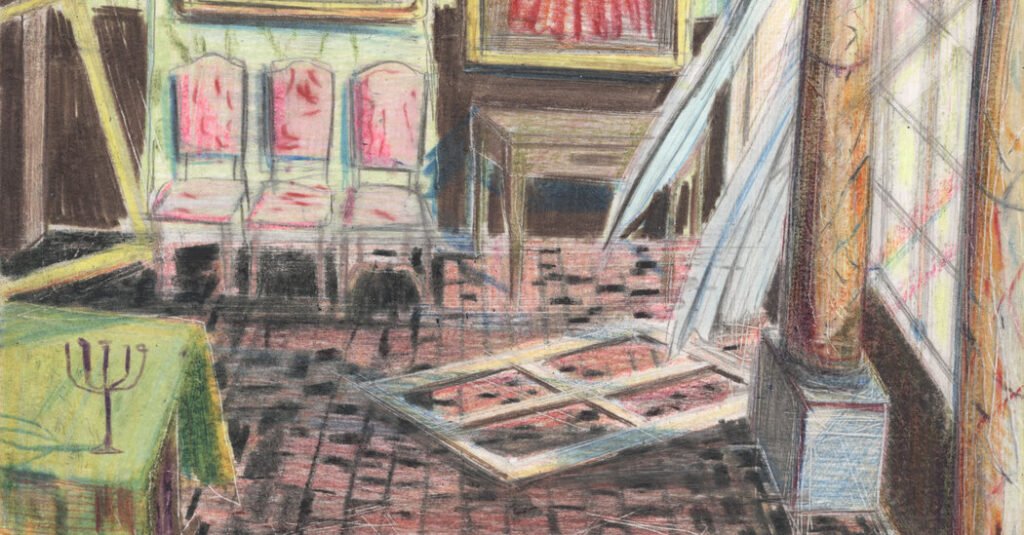
It seems just about everyone has been fingered at one time or another as the perpetrator of the largest art theft in U.S. history: the 1990 robbery of the Isabella Stewart Gardner Museum in Boston. Two men dressed as police officers showed up at the door of the museum just after 1 a.m. on March 18 as the city rested after celebrating St. Patrick’s Day. They tied up the two guards on duty and walked off with 13 items, including masterpieces by Rembrandt and Vermeer.
In the ensuing decades all kinds of theories were hatched about who was behind the theft. The Corsican mob. The Irish mob. Noted art thieves. Unknown petty criminals. People who worked in the building. The Irish Republican Army.
Geoffrey Kelly, the F.B.I. agent who handled the case for 22 years, heard all of them and investigated many of them. In his new book, “Thirteen Perfect Fugitives,” Kelly dismisses many of the theories and outlines who he really thinks committed the crime but could never be prosecuted.
Here are his thoughts on some of the theories and his view of what really went down.
Was it the Corsican mob?
One of the items taken from the museum was, oddly, a finial from a flagpole that had once flown the flag of the First Regiment of Napoleon’s Imperial Guard. Not a top-shelf masterpiece. But in 2006, French national police investigators told the F.B.I. that they had heard some rumblings that a Corsican crime group (Napoleon was Corsican) was looking to sell some items from the museum.
An F.B.I. agent who specialized in art crime went undercover, posing as an intermediary for a buyer who was supposedly interested in buying stolen art. The investigation, called “Operation Masterpiece,” included a sting operation on a yacht and other intrigue. It turned up some criminal behavior involving art. But Kelly says the Corsicans were bluffing. They had access to some stolen art, but nothing from the Gardner heist.
Maybe the paintings never left?
What if the stolen works were really right under investigators’ noses? Kelly writes about “The Paintings Never Left the Museum Theory.” It became a perennial. Many tipsters called in to suggest that, since the works had not shown up on the market, or anywhere else, it was possible that they had been secreted somewhere inside the building.
“Why didn’t we think of that?,” Kelly asks in the book. “Actually, we did.”
In the mid-1990s, the Gardner updated its HVAC system and as part of the renovations a team of commercial specialists crawled through every nook and cranny of the building as they installed new ductwork. They found dust but no paintings.
Was the I.R.A. behind it all?
James (Whitey) Bulger, the infamous leader of South Boston’s Winter Hill gang, was involved in funneling money and weapons to the I.R.A. True.
In 1974, Rose Dugdale, and I.R.A. gunmen, stole art from an Irish museum in an effort to secure something that might be swapped to win the release of I.R.A. prisoners. True.
Still, says Kelly, there was nothing to a theory that placed the I.R.A. and possibly Bulger behind the Gardner heist. After Bulger went on the lam, members of his crew were charged with various crimes. Kelly says they would have been only too willing to turn over any information that might secure themselves leniency.
The F.B.I. asked about the Gardner art. They said they had no idea,
Maybe it’s buried in Florida?
In 2018, news reports raised questions about whether the art was buried in Florida under land that a dead man, identified by authorities as a mob associate, had once rented in Orlando. It was an old rumor, Kelly said, but the story got into the news, and while the F.B.I. thought it was unlikely, it felt pressured to look into it.
“Who buries stolen artwork,” Kelly asks rhetorically in the book. While the swampy land was dug up, Kelly “opted to stay back in Boston” because he did not want to be on site “to watch the breathtaking excavation of what turned out to be an abandoned septic tank.”
Was it was the guy who said he had slept in the museum?
A lifelong Boston criminal named Louis Royce drew attention at one point. Years before the heist, the F.B.I. had heard through informants that Royce and an associate had discussed plans to rob the museum, Kelly writes. Decades later, after the heist, Royce gave interviews in which he said that he had, as a teenager, sneaked inside the museum on cold nights to sleep, sometimes under an antique table on the third floor. His point: It wasn’t a hard place to get into.
Royce had been in jail on the night of the heist, but he told a journalist that he believed his criminal associates had stolen his idea.
Kelly writes that he did not view Royce as credible, in part because he doubted the veracity of his story about sleeping under the table, which he inspected. “Not even a wiry and undernourished Southie teenager could squeeze under that table,” he writes, referring to a Boston neighborhood.
So who did it?
The F.B.I., Kelly writes, came to believe that the heist was the work of a group of ragtag Boston mobsters. Their crew chief, Carmello Merlino, knew one of the men Royce had said he told of the Gardner’s vulnerabilities. But Kelly says it’s not clear whether that’s how Merlino might have come up with the idea.
What is clear, Kelly writes, is that in the 1990s Merlino told the F.B.I. that, while he did not have the art, he may know someone who did. Investigators promised Merlino immunity if he could produce any of the paintings. But he later became uncooperative and negotiations fizzled out.
Investigators came to view two members of Merlino’s crew — Leonard DiMuzio and George Reissfelder — as likely being the men who had posed as the police. For one thing, they thought the pair resembled sketches of the thieves drawn from the guards’ recollections. Reissfelder died in 1991, but almost two decades later his brother admitted seeing one of the stolen paintings, a Manet, in his brother’s apartment, Kelly writes.
Then, in 2010, he writes, the wife of a Merlino associate told Kelly that years earlier her husband had shown her some of the works in a car at their farmhouse in Maine. They then drove off to have dinner with a man and his wife and, on the way back home, her husband told her he had transferred the art to the man, Bobby Gentile of Connecticut. But Gentile would not talk, Kelly writes.
Over the next few years, the F.B.I. executed several search warrants at Gentile’s home. During one, the agents found a handwritten list of the missing 13 works, with individual reward values penciled beside each line item.
But no art — even after digging up some of the yard.
Merlino and DiMuzio are now dead. Until his death in 2005, Merlino told investigators that he never came to know the whereabouts of the art, Kelly says. Gentile, who died in 2021, insisted he knew nothing about the art. He never explained to investigators why he had such a list, Kelly said in an interview.
Gentile’s lawyers defended him zealously for years, citing the incongruity of their client — sick, needing money and offered immunity — turning down an offer for a major reward long after it had become clear that the Gardner works were too hot to sell.
“Would he really pass on a chance to get $5 million if he knew something?” A. Ryan McGuigan, one of Gentile’s lawyers, asked in 2015.
In the book, Kelly acknowledges that the F.B.I.’s inability to secure the art over such a long period of time led to much criticism, some of it directed at him personally. “There is little doubt that being the case agent on the Gardner museum investigation is a dubious distinction,” he writes. “I was often introduced to other agents as the “He’s-got-the-Gardner-case” guy, and the response was usually a furrowed brow and a sympathetic head tilt.”
But Kelly at one point addresses the “armchair detectives” who think they could have found the artworks. If you think it’s so easy, he writes, “you go find them.”
The reward is now $10 million.
The post Got an Idea About Who Robbed the Gardner Museum? Get in Line. appeared first on New York Times.