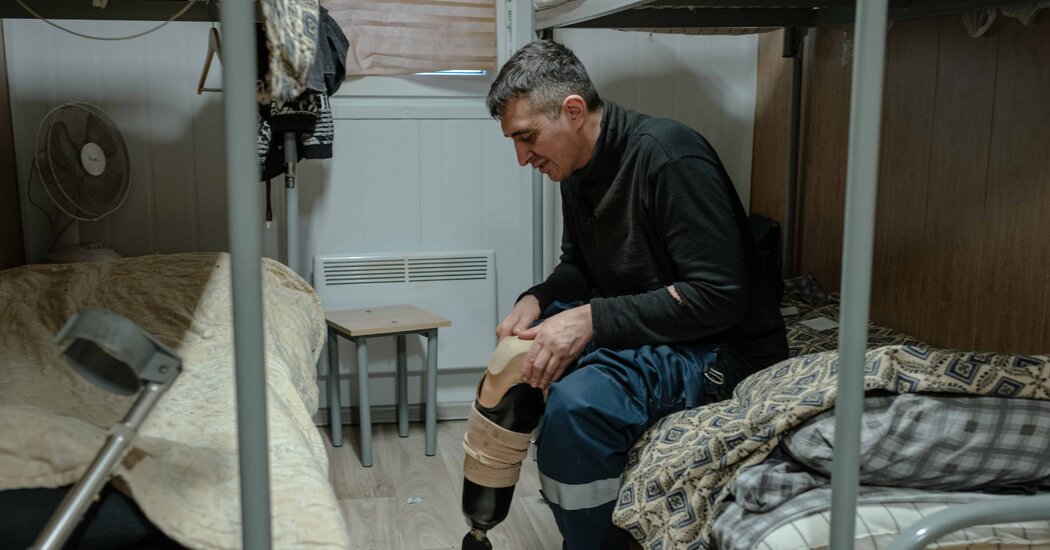
After being locked up for murder, Aleksandr Abbasov-Derskhan signed up to fight in Ukraine, thinking it would give him a shot at starting his life over. All he needed was to survive the front lines.
But after leaving prison six years early to join Storm Z, a Russian military unit made up of convicts, and losing his right leg to an anti-personnel mine, Mr. Abbasov-Derskhan believes he was deceived. He was misled not only about the war’s aims, he said, but also about the benefits he would receive after he came home.
“I risked my life, but it is unclear for what,” Mr. Abbasov-Derskhan, 39, said recently in an interview in Lyubertsy, a working-class suburb of Moscow.
“Recruitment officers told us, ‘You will have payments like the others who are on contract,’” he said. “They attracted us with the promise that we would be able to rehabilitate ourselves, that we would become a full-fledged part of society. That didn’t happen.”
Mr. Abbasov-Derskhan first spoke with The New York Times for an article early last year about Russian soldiers facing long recoveries from injury. His decision to speak again is a measure of his desperation. Publicly criticizing the Russian government, especially about the war, can carry severe personal and legal risks.
He is among a small number of former convicts who have given interviews to journalists as a last resort. The Times was not able to verify all of the details of Mr. Abbasov-Derskhan’s account, but his story mirrors the accounts of others, as well as confidential complaints filed by soldiers and their families that were inadvertently posted online by the Russian government last year.
Those complaints, the subject of a Times investigation published in December, contained similar stories of former convicts who signed up to fight and then did not receive the compensation they believed they were entitled to collect.
While Mr. Abbasov-Derskhan’s path to the battlefields of Ukraine was his choice, it was precipitated by other bad decisions.
In February 2019, he was drinking with some acquaintances in the Tula region, about 100 miles south of Moscow, when one of them threatened his mother’s life, according to court records. After the man went to sleep, Mr. Abbasov-Derskhan attacked him with a stool, then dragged him onto the floor to continue beating and kicking him. Two other drinking buddies joined in, and the man was pronounced dead not long after the attack.
Mr. Abbasov-Derskhan was arrested the next day and eventually sentenced to 10 and a half years in a “strict” prison colony.
Prisoners, he said, are “doomed people” because it is so difficult for them to build a life after being convicted. When his mother died two weeks after he was jailed, he became focused on getting released before his father, who had been an inconsistent presence in his life, died, too.
When recruiters from the Wagner paramilitary group appeared at the prison in 2022 offering freedom in exchange for six months of fighting, Mr. Abbasov-Derhkhan was initially wary. He had heard that Wagner had a reputation for brutality, even killing members in its own ranks.
In February 2023, conditions in the penal colony worsened, he said, with the administration further limiting the types of items inmates could receive in care packages. So when recruiters from the Ministry of Defense arrived in the spring of 2023, he was ready to sign a six-month contract with Storm Z.
“It wasn’t coercion. It was a voluntary agreement,” he said. “I would have hated myself if I didn’t do it.”
On top of that, he thought it would be a test of his physical and emotional endurance.
“I had never served in the army,” he said. “Maybe I wanted to prove to myself that I could do it, that I had the courage. And I did.”
But rather than being lauded as a hero on his return, Mr. Abbasov-Derhkhan says he was greeted with nothing but broken promises. Among them were far less generous benefits than he said he was led to expect and a refusal by the government to expunge his criminal record.
Mr. Abbasov-Derkhan says he received $6,300 for six months of service and a one-time insurance payment of $3,800 for the loss of his leg.
Men who sign a military contract outside prison are entitled to 10 times as much for a lost limb, plus a disability pension of $55 to $283 per month, according to publicly available information published by the regional government in Tula, and a decree signed by President Vladimir V. Putin of Russia. Civilian enlistees from Mr. Abbasov-Derkhan’s region were given a one-time signing bonus of roughly $3,730 and a minimum monthly salary of $2,580.
When he signed up, he said, recruits were given three pages of fine print to read in a few minutes. He did not even try, he said, and he was told: “Did you look at it? OK, sign.” He called the process a “setup.”
Mr. Abbasov-Derkhan said that the recruiting officers had led him to believe that he would receive benefits similar to those that civilian enlistees were promised. “It was only bait, candy meant to attract us,” he said.
In late October, Mr. Putin signed a law stipulating that Storm Z soldiers recruited between Oct. 1, 2022, and Sept. 1, 2023, were entitled to the same payments and status as other veterans.
But Mr. Abbasov-Derskhan is skeptical that he will see any benefit from it. “These are the things my country owes me,” he said, “but they are trying in every way to distance themselves from this responsibility.”
After he signed up to fight, Mr. Abbasov-Derskhan deployed to the front line near Kupiansk, an embattled and strategically important city in eastern Ukraine that Russian forces were striving to retake after Ukraine’s 2022 counteroffensive.
The circumstances that led to his injury were a blur, he said, adding that it was only six months into his recovery that he established what he thinks really happened.
Shortly after his group’s arrival, one of its members was killed under Ukrainian fire, he said. The following day, his commander, who went by the call sign Kazan, sent a group of conscripts to mine the area. The day after that, he said, he was sent to evacuate the body of the soldier who had died.
Mr. Abbasov-Derskhan stepped on a mine that he later realized had been set by Russian troops, he said. A friend from prison who had signed up and now launched grenades carried him out on a stretcher.
His injury most likely saved his life.
The next day, Kazan sent the remaining group, including Mr. Abbasov-Derskhan’s friend, back on a combat mission.
Out of about 180 men, he said he had heard that only one survived.
After his injury, Mr. Abbasov-Derskhan was shuttled through military hospitals before he got treatment in the occupied Ukrainian territory of Luhansk.
Once he had been through an initial recovery phase, it fell to his father to start the process of retrieving his military benefits. He was told that his son had signed not a “contract” but an “agreement,” Mr. Abbasov-Derskhan said, and that he was not entitled to the same benefits as civilian volunteers.
As worrisome to him, Mr. Abbasov-Derskhan said, was the government’s failing to keep its promise to expunge his criminal record. This has clouded his employment prospects. As long as he is still considered an ex-convict, he said, he cannot get a well-paid job at military industrial enterprises, which typically do not hire people with criminal backgrounds.
Despite his injury, Mr. Abbasov-Derskhan works as a welder, making rebar for about 12 hours a day, six days a week. In addition to his salary of about $1,700 a month, he receives about $175 from the state in disability payments.
As he limped slightly into a cafe next to the Lyubertsy metro station, recruiters for the Ministry of Defense stood under a tent, encouraging people to sign a contract to fight.
He said he was shocked that people he knew who had been injured in the war were still returning to the battlefield for the money.
“People don’t value their lives,” he said.
“Patriotism,” he added, “is when you work 12 hours a day here for my salary, buying discounted products so that you have enough to make it through the month.”
“The fact that you went there and killed yourself with some shell out of stupidity? That is not patriotism.”
Ksenia Churmanova contributed reporting from London, and Milana Mazaevafrom Berlin.
Valerie Hopkins covers the war in Ukraine and how the conflict is changing Russia, Ukraine, Europe and the United States. She is based in Moscow.
The post He Lost a Leg for Russia. Then, He Says, His Country Betrayed Him. appeared first on New York Times.