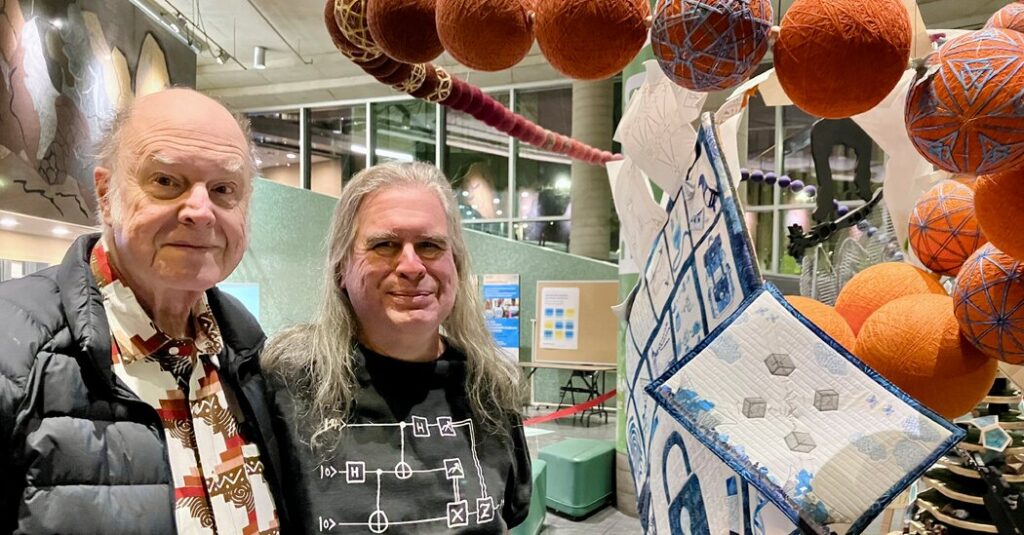
In the mid-1980s, Charles Bennett and Gilles Brassard invented an encryption technology that could theoretically never be broken.
Called quantum cryptography, their technology relied on quantum mechanics, the strange and powerful behavior exhibited by electrons, photons and other very small things.
At the time, their technique was a fascinating but impractical creation. Forty years later, it is poised to become an essential way of protecting the world’s most sensitive information.
On Wednesday, the Association for Computing Machinery, the world’s largest society of computing professionals, said Drs. Bennett and Brassard had won this year’s Turing Award for their work on quantum cryptography and related technologies. The Turing Award, which was introduced in 1966, is often called the Nobel Prize of computing, and it includes a $1 million prize, which the two scientists will share.
In recent years, companies like Google and Microsoft have made great strides toward building a new kind of computer, called a quantum computer, which also relies on the counterintuitive properties of quantum mechanics. Experts believe that such a machine will soon be powerful enough to crack the encryption techniques that have guarded the world’s secrets since the 1970s.
If that happens, governments, businesses and even individuals will need the cryptographic techniques developed by Dr. Bennett, 82, a researcher at an IBM computer science lab in Yorktown, N.Y., and Dr. Brassard, 70, a professor at the University of Montreal.
The two met in 1979 while swimming in the Atlantic just off the north shore of Puerto Rico. They were taking a break while attending an academic conference in San Juan. Dr. Bennett swam up to Dr. Brassard and suggested they use quantum mechanics to create a bank note that could never be forged.
“It was a bit shocking,” Dr. Brassard remembered in an interview. “That is not something that happens every day.”
Collaborating between Montreal and New York, they applied Dr. Bennett’s idea to subway tokens rather than bank notes. In a research paper published in 1983, they showed that their quantum subway tokens could never be forged, even if someone managed to steal the subway turnstile housing the elaborate hardware needed to read them.
This led to quantum cryptography. After describing their new form of encryption in a research paper published in 1984, they demonstrated the technology with a physical experiment five years later.
Called BB84, their system used photons — particles of light — to create encryption keys used to lock and unlock digital data. Thanks to the laws of quantum mechanics, the behavior of a photon changes if someone looks at it. This means that if anyone tries to steal the keys, he or she will leave a telltale sign of the attempted theft — a bit like breaking the seal on an aspirin bottle.
“They introduced a totally new way of thinking about encryption,” said Prineha Narang, a professor of physical sciences and electrical and computer engineering at the University of California, Los Angeles. “The fundamental laws of physics can make it unhackable.”
The importance of this creation was first shown in 1994 when Peter Shor, a researcher at Bell Labs in New Jersey, proved that a quantum computer could break encryption schemes that did not rely on the techniques laid out by Drs. Bennett and Brassard.
That same decade, the two computer scientists took their ideas a step further. Alongside other researchers, they showed that data could be securely transmitted over long distances in a way that many scientists, even Albert Einstein, had deemed impossible.
Called quantum teleportation, their technique relied on a quantum property called “entanglement.” This is when two quantum objects — such as two electrons — are linked to each other, even though they are very far away. .
As companies like Google and Microsoft create increasingly powerful quantum computers, quantum teleportation — what Einstein called “spooky action at a distance” — could profoundly change the way data travels from place to place.
Quantum teleportation could move information between quantum computers — and it could do so in a way that prevents anyone from intercepting it. In other words, Drs. Bennett and Brassard helped create what may be the computer networks of the future. And they ensured that these networks could stand up to hackers.
“For a long time, it was not clear how these ideas would be used,” Dr. Narang said. “Now, small companies, large companies and even the U.S. government is trying to deploy this technology.”
Cade Metz is a Times reporter who writes about artificial intelligence, driverless cars, robotics, virtual reality and other emerging areas of technology.
The post Turing Award Goes to Inventors of Quantum Cryptography appeared first on New York Times.