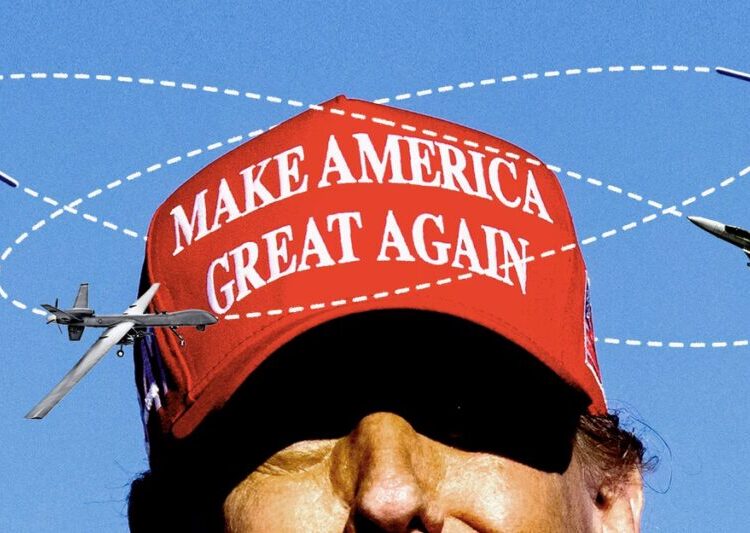
As a candidate, Donald Trump called the economy under President Joe Biden a “nightmare.” As president, he says the United States is “bigger, better, richer and stronger than ever before.” Democratic rhetoric has shifted just as sharply, from Vice President Kamala Harris touting the U.S. economy as “the strongest in the world” during the 2024 campaign to Democrats today decrying an “affordability crisis.” And that was before gas prices jumped more than $0.50 a gallon in the wake of the Iran strikes.
While the rhetoric on both sides has done a 180-degree turn, the economy itself has not. It didn’t change after tariffs were rolled out. It didn’t change after A.I. became more widely adopted. The economy over the last year has looked a lot like it did in 2024. I don’t expect it to change because of the latest disappointing numbers on jobs, fluctuations in the gross domestic product or the start of the Iran war, either.
Just about every significant economic variable was similar across the two years, often well within the range of measurement error: G.D.P. growth, the unemployment rate, the employment rate for prime-age workers, inflation, real wage growth, productivity growth, the budget deficit, the trade deficit, stock-market gains and mortgage rates. The one indicator that changed meaningfully was job growth, which slowed sharply in 2025, but the unemployment rate didn’t get much higher — reflecting the fact that fewer people needed jobs, either because they had already found them or because immigration inflows fell drastically.
If you wanted to tell an anti-Trump story, you could focus on the fact that food prices rose more quickly in 2025 than they did a year before. If you wanted to tell a pro-Trump story, you could emphasize that mortgage rates are lower today than they were at the end of 2024.
Gas prices had been falling, too, but what was once a point for the Trump side has turned into the opposite as the war with Iran has sent gas prices rapidly climbing. But cherry-picking misses the point: The overall purchasing power of wages rose by 1.4 percent in the 12 months through February, basically the same as the 1.2 percent growth in 2024.
That the 2025 numbers looked much like the 2024 numbers should not be that surprising. The American economy, like an ocean liner, is extremely hard to turn. The best guess of what will happen next year is that the economy will continue doing what it did last year.
Yes, there are twists and turns. Very sophisticated forecasters, including the Federal Reserve, can do somewhat better than mindless extrapolation by teasing out signals from labor markets, prices, expectations and more. But in practice, these adjustments do not add much forecasting power, and for most people, going down that path risks over-adjusting for the wrong factors, adding more noise than insight.
Perhaps the most common mistake is to overrate the importance of the president. Sometimes presidents can make a big difference, but usually the aggregate economic effects of their policies are smaller — for good or ill — than their supporters or detractors would have you believe.
Consider President Trump’s tariffs. There is good evidence that they have added at least half a percentage point to inflation and good reason to believe they have also reduced economic growth. That is, in my view, an unnecessarily large unforced error. But it is also far from the economic Armageddon — or even the recession — many predicted.
Part of the reason is that Mr. Trump cut his tariffs roughly in half from what he announced in April, and encountered little foreign retaliation. More broadly, although the United States now has its highest tariff rates since the 1940s, about 90 percent of the economy is not heavily involved in trade, and, on average, Americans did not significantly alter their economic decisions as a result of the new impositions. The economy is a large, complex system and Mr. Trump is a small part of it relative to the amount of ink spilled on him.
The same goes for A.I., a topic that generates nearly as much heated and polarized discussion as Mr. Trump himself. So far, however, A.I. has not had a large macroeconomic impact.
Analysts who look closely at the data debate whether A.I. has displaced a small number of jobs in specific sectors, such as software, or whether recent job losses are instead a result of larger economic conditions or even just corrections for mistakes that individual companies made in prior years. Productivity growth is showing some tentative signs of increasing but has still largely followed the trajectory expected before the pandemic.
I will also go out on a limb and say the same will apply to the latest war in the Middle East. It is already hurting consumers and damaging the U.S. economy. But, like tariffs, it would be a mistake to think the war will significantly alter the economy’s direction. Oil prices have soared, but financial markets are betting that they will come back down, albeit not to as low as was expected before the latest events.
The U.S. economy is much less oil intensive than it used to be, and consumers spent only 2 percent of their budgets on gasoline in 2025, less than half as much as they did 50 years ago. Moreover, as the world’s most dominant oil producer, the United States is mostly hedged, with higher prices hurting consumers but helping producers. A repeat of the deep stagnation that followed the 1979 Iranian revolution will come only if we see a major, sustained escalation in the destruction of oil infrastructure in the Middle East.
Even though the economy and affordability continued to improve at roughly the same pace in 2025 as in 2024, consumer sentiment about the economy worsened. In 2024, analysts were puzzling about the “vibecession,” people feeling badly despite the overall numbers looking good. Since then, we have fallen into something more like a vibedepression, with consumer sentiment falling below its levels during the financial crisis and the pandemic. And this was with lower gasoline prices. I expect the data for sentiment this month to set new lows as consumers react to rising gas prices and the news coverage of the Middle East.
There are many explanations for negative feelings about the economy, including the legitimate concern that the purchasing power of wages is below the track it was on before Covid; public frustration with high prices even if inflation is moderating; and a failure to consider the ways that wages have risen alongside those prices. Perhaps most important, measures of how the economy is doing are increasingly measures of how people feel about the party in power. Democratic and Republican views of the economy flipped after Mr. Trump returned to office, although Democrats have become even more negative about the economy than Republicans were about Mr. Biden’s. When politics changes, perceptions follow — even if paychecks, prices and jobs do not.
This does not mean presidents don’t matter for the economy. I believe the economy would be even better today were it not for Mr. Trump’s reckless tariffs and his Middle East adventures. It means, however, that we should probably be more honest about judging the economy and more explicitly admitting that our opinion is based on much more than interest rates or inflation or even our own economic circumstances.
Graphics by Bhabna Banerjee.
Jason Furman, a contributing Opinion writer, was the chairman of the White House Council of Economic Advisers from 2013 to 2017.
The Times is committed to publishing a diversity of letters to the editor. We’d like to hear what you think about this or any of our articles. Here are some tips. And here’s our email: [email protected].
Follow the New York Times Opinion section on Facebook, Instagram, TikTok, Bluesky, WhatsApp and Threads.
The post If You Hate Trump’s Economy, I Have News for You appeared first on New York Times.