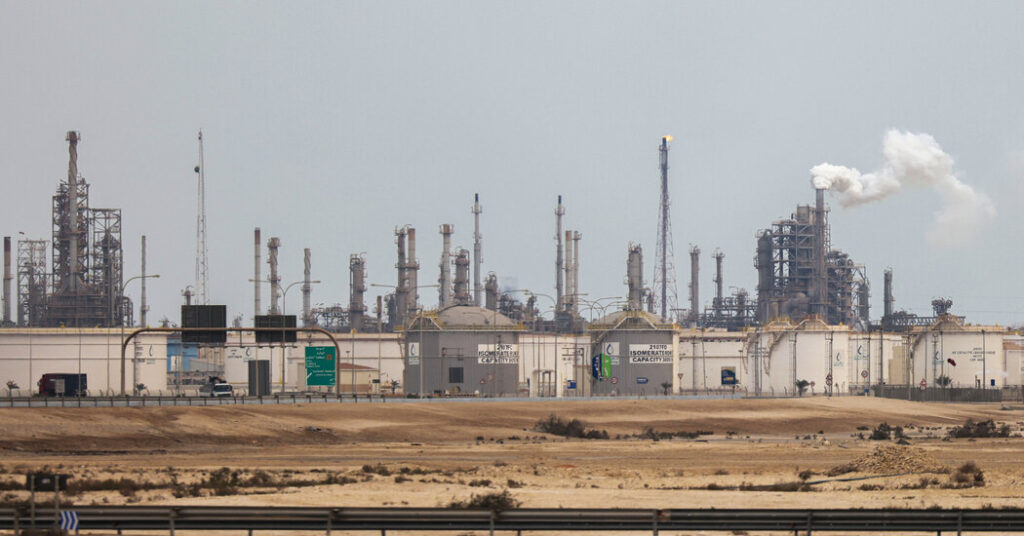
The war in the Middle East is forcing a reckoning for nations dependent on liquefied natural gas, the fuel anchoring power generation across many of Asia’s largest economies.
Now in its third week, the fighting has effectively closed the Strait of Hormuz and shut down Qatari production, removing about a fifth of the global supply of liquefied natural gas, or L.N.G., from the market.
This poses an existential threat to energy networks throughout Asia, by far the world’s largest consumer of the fuel and the recipient of more than 80 percent of Qatar’s exports. Locations including Japan, Singapore, Thailand, Taiwan, Pakistan and Bangladesh generate a third or more of their electricity from natural gas.
To ward off potential shortages, utilities across the region have competed to buy up remaining cargoes at record prices on the so-called spot market. Some are taking steps to ration energy and dip into state funds to alleviate price increases. Many facing supply shortages and price increases are turning back to coal-fired power plants.
Analysts and energy officials expect the impact of the disruptions to last far beyond the current conflict. In Asia, L.N.G. has long been called a bridge fuel — less polluting than coal, more reliable than renewables and capable of powering a region where ballooning populations and economic activity are set to drive more than half of global energy demand growth by 2050.
In a report released on Monday, Shell, the world’s largest L.N.G. trader, estimated that consumption in Asia would help propel global demand for the fuel by as much as 85 percent by 2050, up from 422 million metric tons in 2025.
But that all depends on a reliable supply of the fuel. Because much of Asia’s geography precludes cross-border pipelines, countries must rely on seafaring tankers from the world’s two largest producers, the United States and Qatar. American gas is thousands of miles away, while Qatari supply is trapped behind the Strait of Hormuz, a choke point paralyzed by the war with Iran.
After Russia’s 2022 invasion of Ukraine, L.N.G. prices spiked as Europe raced to replace Russian pipeline gas with L.N.G. shipped at sea. Even before the U.S. strikes on Iran, Asian buyers were growing increasingly nervous about a market in which just two countries were set to dominate the majority of new supply through 2030.
For now, “Asia is in full price competition, with any country that can switch from gas to coal doing so,” said Henning Gloystein, a managing director for energy at Eurasia Group, a political risk research firm.
The disruptions also underscore the longer-term risks of relying on L.N.G. “If you’re an importer, you say: ‘Well, there are two major crises in five years. We can’t keep dealing with this,’” Mr. Gloystein said.
Japan plays a big role in the region as a middleman, importing and re-exporting L.N.G. to countries in Southeast Asia. For years, it and other sellers marketed L.N.G. as a way for countries dependent on coal to meet booming energy needs, while lowering emissions.
Many nations in Southeast Asia began significantly ramping up import volumes in the early 2010s as domestic gas reserves dwindled. Thailand led the push. The country built two major import terminals and took steps to liberalize its domestic gas market. By 2022, natural gas generated more than half its electricity, with L.N.G. accounting for nearly a quarter of that supply — up from just 2 percent in 2011, according to data from the Asia Pacific Energy Research Center, a research organization in Tokyo.
The Russia-Ukraine war dented confidence in L.N.G. When Moscow cut pipeline supplies to Europe in 2022, wealthy European nations pivoted to the global L.N.G. market, often outbidding developing Asian economies. The resulting shortages forced countries to curb imports and endure rolling blackouts. In Thailand, electricity rates rose to record highs, prompting the government to postpone the retirement of coal-fired units at the Mae Moh power plant.
Four years later, the pattern is repeating. This month, the Thai government ordered coal-fired power plants to operate at full capacity and began tapping heavily into a state energy-subsidy fund to help absorb price shocks.
With ships being rerouted, “it’s once again widening economic disparities between the richer countries and the emerging economies,” said Dinita Setyawati, an Indonesian-based senior energy analyst at Ember, a think tank.
In Bangladesh, utilities have begun significantly increasing their use of coal to create electricity since the start of the war in Iran, data from Bangladesh’s state-owned company responsible for electricity transmission show.
Supply disruptions are causing problems in Asia’s most developed economies as well. Taiwan’s economy ministry said this month that it would be prepared to buy more L.N.G. from the United States and restart its retired Hsinta coal-fired power plant if supply disruptions persisted through April. South Korea is also preparing to boost nuclear and coal-fired power generation to offset volatility in oil and L.N.G. supply, its industry minister said last week.
“Asia is at an important junction,” Ms. Setyawati said. In the wake of the 2022 energy crisis, L.N.G. was promoted as a stable alternative to pipeline gas because it could be shipped anywhere in the world. Now, those L.N.G. supply chains are grappling with their own bottlenecks.
“Energy security is vital for the continuation of economic development in this part of the world,” Ms. Setyawati said.
At the same time, the United States — already the world’s biggest supplier of L.N.G. — is boosting exports. Under his so-called energy dominance agenda, President Trump has rescinded a moratorium on new L.N.G. export terminal licenses. Even before the war with Iran, the administration was marketing L.N.G. to Asia, including from a $44 billion project in Alaska, as a stable alternative to Russian and Middle Eastern supplies.
For now, most analysts in Asia expect countries to continue temporarily switching to coal to replace expensive gas through the duration of the war. Further out, however, they have a choice to stick with L.N.G. or move more rapidly toward renewables, said Amy Kong, an analyst at the research group Zero Carbon Analytics.
She points to Pakistan, which, in the wake of the Russia-Ukraine war’s disruption of natural gas markets, roughly tripled its solar energy capacity between 2021 and 2024. That shift, largely prompted by the proliferation of low-cost Chinese solar panels, helped the country reduce its dependence on L.N.G. imports.
While the country continues to grapple with significant energy disruptions, such as gas cutoffs affecting local producers like fertilizer plants, the shift toward renewables is shielding Pakistan from even greater instability, Ms. Kong said.
In Asia, “the immediate reaction will inevitably be leaning on domestic existing supplies, especially coal,” she said. But five years out, “there will be more conversations about gas, and whether it really wins out against renewables in terms of economics and stable supply.”
Muktita Suhartono and Elian Peltier contributed reporting.
River Akira Davis covers Japan for The Times, including its economy and businesses, and is based in Tokyo.
The post As War Chokes Natural Gas Supply, Asia Turns Back to Coal appeared first on New York Times.