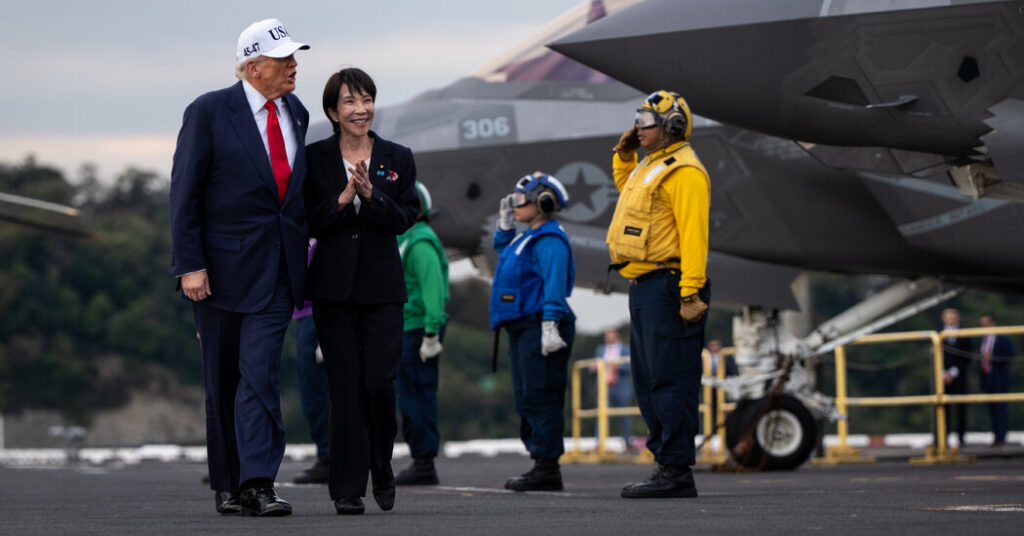
President Trump and Prime Minister Sanae Takaichi of Japan have built a close relationship over the past few months, bonding over baseball and shared conservative values, and heaping praise on each other even as they spar over issues like trade.
That friendship is about to undergo a major test on Thursday as Ms. Takaichi visits the White House for the first time.
Spurned by European allies, Mr. Trump is expected to use the summit meeting to urge Japan to dispatch minesweepers and maritime forces to assist in reopening the Strait of Hormuz, as the war in the Mideast enters its third week. He has already piled on the pressure, suggesting that Japan owes the United States for years of defense aid and that Japan must act because of its heavy reliance on Middle Eastern oil.
The demands have put Ms. Takaichi, a hard-line conservative who last fall became the first woman to lead Japan as prime minister, in a difficult position. She is constrained not just by Japan’s pacifist constitution, but overwhelming public opposition: Only 9 percent of Japanese endorse the U.S.-Israeli attack on Iran, according to a recent poll by the Asahi Shimbun newspaper.
Now Ms. Takaichi faces the delicate task of finding a way to signal support for Mr. Trump without getting entangled in the war. She must do so in the high-pressure forum of the White House, over lunch and dinner with a president who seems increasingly impatient and aggrieved.
“This was supposed to be a pretty straightforward, easy summit,” said Zack Cooper, a senior fellow at the American Enterprise Institute in Washington. “Now it’s exactly what the Japanese don’t want: an unpredictable situation with no obvious answers.”
The Iran crisis could hit Japan hard; the country imports almost all its energy, and about 95 percent of its oil comes from the Middle East — a fact that Mr. Trump has eagerly highlighted in recent days.
The United States is Japan’s chief ally, and Ms. Takaichi is counting on Mr. Trump for help in countering China’s growing military and economic clout in Asia. While European allies have openly sought distance from the conflict, Ms. Takaichi has been more equivocal.
She has said it would be “legally difficult” for Japan to order its navy to take part in security operations at sea, and that the Iran situation did not yet constitute a “survival-threatening” situation for Japan that would allow a military response. But she has also said she is considering “what we can do.” And she has refrained from commenting on the legality of the U.S.-Israeli attack.
Mr. Trump appears to have his eye on Japan’s fleet of advanced minesweepers, which could help escort oil tankers in the Strait of Hormuz. Japan deployed them to the Persian Gulf in 1991 — the military’s first overseas mission since the end of World War II — but only after the American combat mission there had ended.
In 2019, during his first term, Mr. Trump pressured Japan to play a more active role in protecting its interests in the Middle East after a series of attacks on oil tankers in the region. Japan responded by sending maritime defense forces to patrol shipping lanes and gather intelligence. But it steered clear of the Strait of Hormuz, an apparent attempt to avoid giving the impression that it was standing with the United States against Iran, with which Japan has long maintained friendly relations.
The question of dispatching the military overseas is fraught in Japan, where memories of World War II still linger. Pacifism is enshrined in the Constitution, with a clause known as Article 9 calling for the complete renunciation of war.
In 2015, Prime Minister Shinzo Abe — a friend to both Mr. Trump and Ms. Takaichi — made it easier to send the military abroad, revising the law to permit overseas combat missions alongside allied troops in the name of “collective self-defense.”
But the situation must be deemed a threat to Japan’s survival. Alternatively, the law permits the military to be deployed overseas — but only after fighting has stopped.
Japanese lawmakers have raised concerns that the attacks by the United States and Israel violate international law, and some commentators have urged Ms. Takaichi to take a neutral approach.
“Dispatching Japanese patrol ships would almost certainly be seen as siding with the United States, undermining Japan’s standing in the international community,” read an editorial this week in Mainichi Shimbun, a prominent Japanese newspaper.
Mr. Trump and Ms. Takaichi had an easy rapport when they first met last October in Tokyo, discussing their shared admiration for Mr. Abe, who was assassinated in 2022.
The summit this week was supposed to be a chance to rekindle that chemistry. Japanese officials had hoped to use the meeting to persuade Mr. Trump to avoid making a sweeping deal with China’s leader, Xi Jinping, that would jeopardize the security of allies in the region. Japan is also eager to highlight investments in the United States and joint efforts to reduce reliance on China for rare earth metals.
Ms. Takaichi will be looking to gauge Mr. Trump’s timeline and strategy for the war, analysts said, given the damage it could inflict on Japan’s economy and society. Japan is concerned that the conflict could affect its security if the United States continues to move warships, missiles and air defenses from Asia to the Middle East.
Jeffrey W. Hornung, an expert on Japan at the RAND Corporation, a research group in Washington, said that Ms. Takaichi would face the challenge of responding in real time to Mr. Trump’s demands.
“If Takaichi goes there and says, ‘This is a huge concern for us,’ and Trump turns around and says, ‘So what are you going to do about it?’— I don’t know how Japan answers that question,” he said.
Hisako Ueno contributed reporting.
Javier C. Hernández is the Tokyo bureau chief for The Times, leading coverage of Japan and the region. He has reported from Asia for much of the past decade, previously serving as China correspondent in Beijing.
The post Trump’s Friendship With Japan’s Leader Faces Test Over Iran appeared first on New York Times.