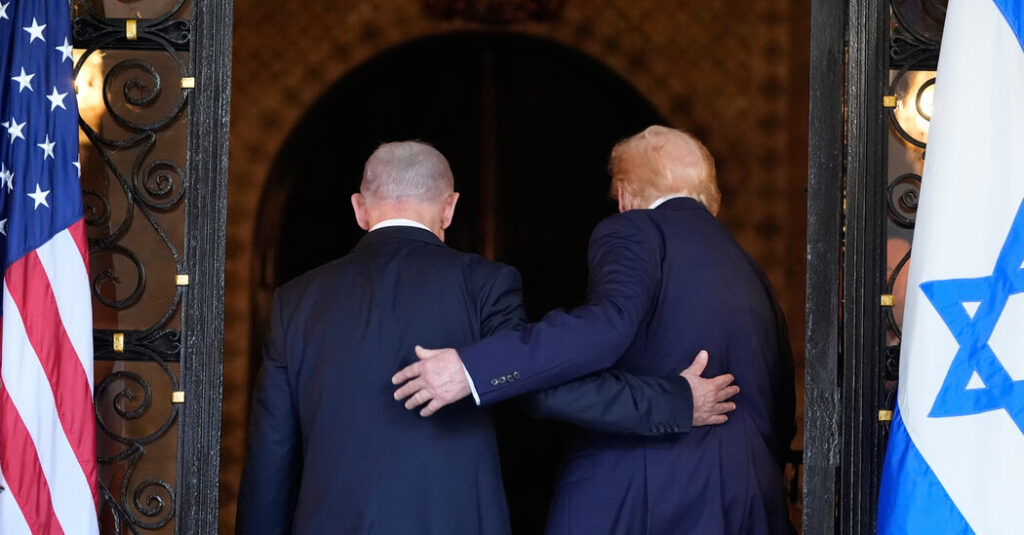
For most of the postwar era, the United States has gone to war with partners whose military contributions ranged from moderately helpful to mainly symbolic. Britain in Afghanistan and Iraq comes to mind in the first case. Germany in the 1999 Kosovo war comes to mind in the second.
The war against Iran is different. As of Monday, Central Command reports that the United States had struck over 7,000 targets inside Iran. Israel, for its part, had carried out some 7,600 strikes, according to a representative of the Israeli military. This may be the first time since the Second World War that Washington has had an equal partner with which to share the burdens of war.
That’s a good starting point from which to consider the claim that the U.S. war with Iran is really a war for Israel. Past administrations have, in fact, gone to war for other countries. In the early 1990s, we went to war in the Persian Gulf for the sake of freeing Kuwait and defending Saudi Arabia — two countries that couldn’t defend themselves — from Iraq. Later that decade, we went to war in the Balkans after Europe proved shamefully unable to police its own neighborhood.
In both cases, American presidents believed they were serving the national interest. But the military helplessness of our allies was a major factor in the decision to intervene.
As for Israel, the charge that the United States has gone to war for it isn’t new.
In 1990, Patrick Buchanan insisted that the only groups in favor of a war against Saddam Hussein over his invasion of Kuwait were “the Israeli Defense Ministry and its amen corner in the United States.” (That amen corner, Buchanan later indicated, consisted of the columnists A.M. Rosenthal and Charles Krauthammer, the defense expert Richard Perle and Henry Kissinger, the former secretary of state. Spot the commonality.) Opponents of the later Iraq war also spun a tale that the Bush administration was mostly doing Israel’s bidding. And on Tuesday, Joe Kent, a top adviser to Tulsi Gabbard, the director of national intelligence, announced his resignation over what he called a war started “due to pressure from Israel and its powerful American lobby.”
Those charges always sat awkwardly with the facts. Israel stayed out of the gulf war under heavy U.S. pressure, despite being hit by Iraqi missiles. As for Iraq, Ariel Sharon, then the Israeli prime minister, told the journalist Nadav Eyal that George W. Bush was fighting “the wrong war.” Sharon thought Iran was the more dangerous enemy in what was then called the war on terror.
In the case of Iran, the idea that crippling its capacity to threaten its neighbors is some sort of purely Israeli interest is belied by every Iranian missile or drone that falls on Dubai, Doha, Manama or Riyadh, not to mention U.S. and NATO military bases in the region. In October 2024, Kamala Harris called Iran our “greatest adversary,” adding that one of her “highest priorities” as president would be to ensure that Iran never became a nuclear power. Was she, also, just another of Benjamin Netanyahu’s little stooges — a manipulated American politician with no mind of her own?
That charge is now being leveled at Donald Trump, never mind that the president first expressed a desire to thwack the Iranian regime in 1980, during the hostage crisis at the U.S. Embassy in Tehran, and repeated the point over decades. Whatever one thinks about the wisdom or the timing of Trump’s decision to go to war, it was, plainly, his decision — one for which he needed little convincing from Netanyahu, or, for that matter, Crown Prince Mohammed bin Salman of Saudi Arabia, who, The Times reports, is urging Trump to “keep hitting the Iranians hard.”
What is true is that the United States is going to war with Israel, not for it. That’s something many Americans, MAGA-type conservatives most of all, often claim to want: an ally that pulls its weight, shares the risk and contributes meaningfully to victory.
That means that when Israel on Tuesday took out Ali Larijani, the regime’s de facto leader and an architect of January’s massacres of Iranian civilians, as well as Gholamreza Soleimani, the commander of the Basij militia that did much of the killing, it was making a unique contribution to a joint effort to destroy Iran’s command and control system, and thus its ability to harm America, Israel and Arab states alike.
Since when, one wonders, has the Pentagon or the C.I.A. had such help from our resourceful friends in, say, Paris?
It is of course true that Israel greatly benefits from Trump’s courageous decision to join the war. Also true is that U.S. and Israeli interests, goals and tactics don’t perfectly overlap and sometimes conflict. That’s always the case whenever allies go to war. But the central point is that Israel, population 10 million, is behaving as an equal partner to America, population 342 million, in a war that the elected leadership of both countries believe is in their respective national interests. Whatever else that is, it isn’t the tail wagging the dog.
The killing of Larijani may help dispel the odd gloom that’s descended on a war that is persistently dismantling Iran’s ability to put up a meaningful fight, beyond the desperate play of seeking to shut the Strait of Hormuz. That, too, won’t last long, thanks to the United States achieving what’s known among war planners as “escalation dominance.” Good thing that, in this war, the United States for once had a bold and competent ally to help us achieve it.
The Times is committed to publishing a diversity of letters to the editor. We’d like to hear what you think about this or any of our articles. Here are some tips. And here’s our email: [email protected].
Follow the New York Times Opinion section on Facebook, Instagram, TikTok, Bluesky, WhatsApp and Threads.
The post For Once, We Fight With an Equal Ally appeared first on New York Times.