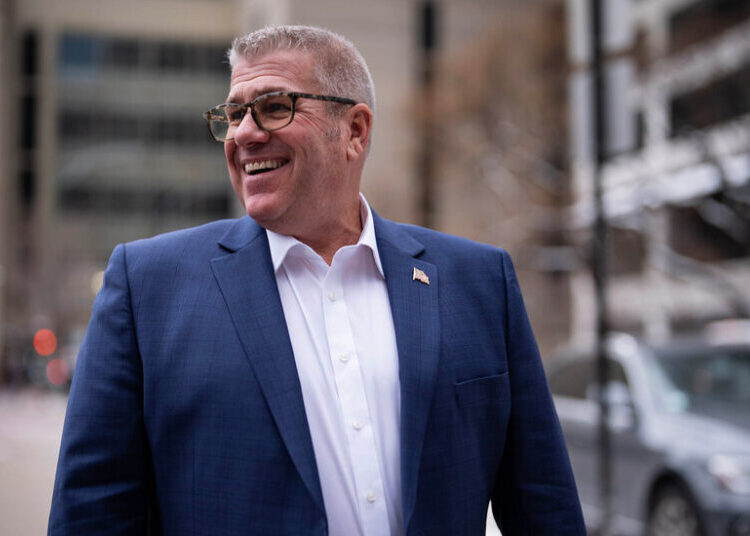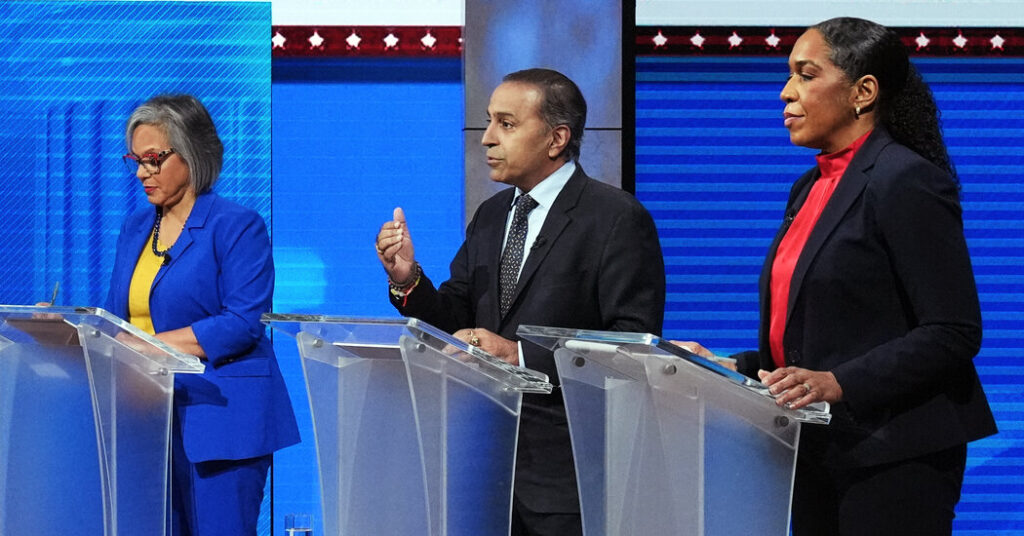
Interest is high in Illinois, where the winner of Tuesday’s Democratic primary for a Senate seat will almost assuredly win the general election for the seat this fall — both of the state’s seats in the chamber have been held by Democrats since 2017.
Recent polls in the crowded race have produced a wide range of results, with some showing a narrow lead for Lt. Gov. Juliana Stratton, who has Gov. JB Pritzker’s endorsement, and others indicating that Representative Raja Krishnamoorthi, who represents the state’s Eighth District, is ahead by as many as 11 percentage points. Representative Robin Kelly, who represents the state’s Second District, has not led in any public polls.
Swings like these are common in polling of primary elections, which are extremely difficult to measure. Endorsements pop up unexpectedly, candidates join or leave the race on short notice, and voters make last-minute decisions. In Illinois, polling has also been relatively infrequent, with only 12 polls conducted since the start of the year.
An FM3 Research poll sponsored by the American Future Fund, a conservative nonprofit group, found over 10 percent of likely Democratic primary voters were still undecided just one week before the election. A group that big could swing the result.
The situation is fairly similar to that in the recent Democratic primary in Texas, where polls ranged from showing James Talarico, a member of the State Legislature, ahead by double digits to some indicating that Representative Jasmine Crockett was up by even larger margins. In the end, Mr. Talarico won by six percentage points
Internal Polls Are Selectively Released
A significant portion of the polling in primary races comes from surveys conducted for campaigns or organizations aligned with them. Such polls do offer insight, but they are released with a purpose; campaigns decide which findings to share, meaning the polls that become public may emphasize results that reflect well on the candidate who commissioned them.
In the Illinois Democratic primary, just five polls have been fielded independently. Mr. Krishnamoorthi leads in all the polls he has commissioned, while Ms. Stratton leads in the recent three-way polls an affiliated group paid for.
Illinois Hasn’t Had a Race Like This in Years
Participation in primaries is harder to forecast than in general elections. The electorate is normally smaller and less stable, with turnout depending heavily on how competitive voters believe the race to be.
Senator Richard J. Durbin has been in this seat since 1997, and Senator Tammy Duckworth has been in hers since 2017, so Democratic voters in Illinois have had little reason to show up for a Senate primary in a decade. The last competitive Democratic Senate primary in a nonpresidential year was in 2010, when Alexi Giannoulias won the nomination. Independent surveys in the final weeks of that contest showed Mr. Giannoulias’s top competitor, David Hoffman, with less than 20 percent of the vote; he ended receiving 34 percent.
Four open U.S. House seats in Illinois have also drawn competitive Democratic primaries in this cycle, which could reshape the Senate primary electorate in ways that are hard for pollsters to anticipate.
What the Polls (Cautiously) Suggest
Primary polls need to be approached with caution, as any demographic patterns come with the caveat that the breakdowns are based on subsamples too small and unrepresentative to be treated as reliable on their own.
But based on the limited data available, Mr. Krishnamoorthi appears strongest with older voters, particularly seniors. He also draws support from the Cook County suburbs outside Chicago and downstate areas — regions that historically account for a modest share of the Democratic primary vote. Around 40 percent of the Democratic primary vote tends to come from Chicago, where the race among the top three candidates seems to be more closely contested.
Ms. Stratton and Ms. Kelly split the Black vote in the vast majority of these polls, with Ms. Stratton holding a slight edge.
Ms. Kelly reaches nearly 20 percent in some polls but leads in none. Candidates outside of the top two sometimes underperform in comparison with their polling numbers. Wesley Hunt, who polled above 25 percent in some early February surveys in Texas’ recent Republican Senate primary, ended up with 14 percent on election night.
The central question on Tuesday is whether Ms. Stratton can consolidate enough of the Black vote and the Chicago vote to overcome Mr. Krishnamoorthi’s apparent advantages elsewhere. If she can’t do both, her path to victory looks narrower.
Alex Lemonides and Christine Zhang contributed reporting.
Caroline Soler is a Times researcher focused on collecting and analyzing polling and election data.
The post Independent Polls are Scarce in the Illinois Democratic Senate Primary appeared first on New York Times.