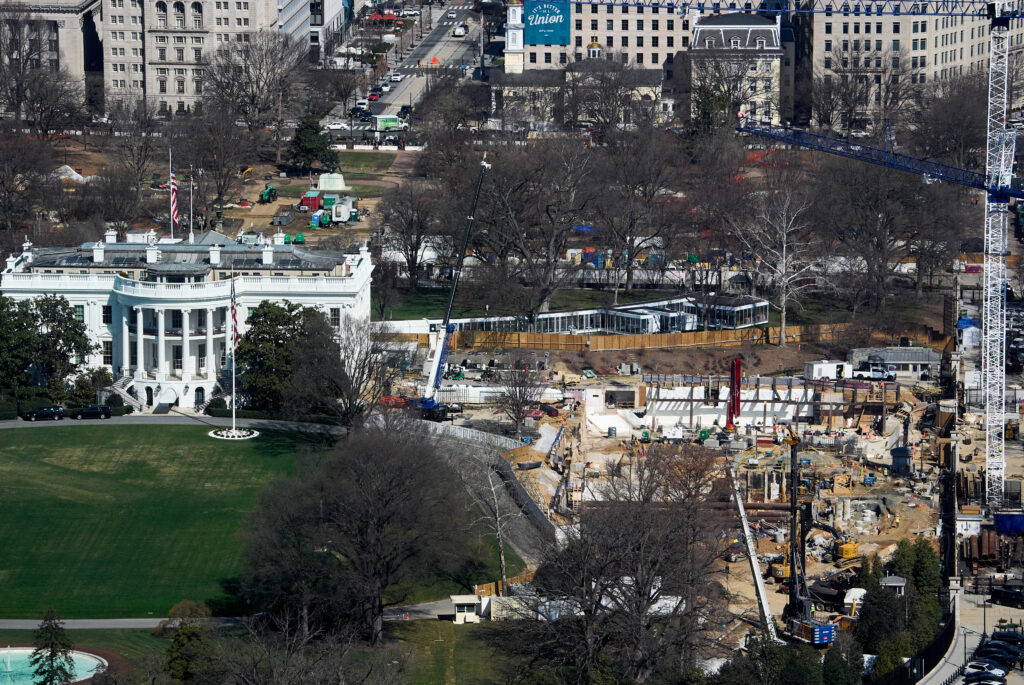
A federal judge on Tuesday grilled Trump administration lawyers on the legal justification for the president’s $400 million White House ballroom plan, accusing the Justice Department of “shifting” arguments as historic preservationists urged him to halt the controversial project.
U.S. District Judge Richard J. Leon said he hoped to issue a ruling by the end of March. The White House has said that it plans to begin aboveground construction of the ballroom in April. The project is a top priority of President Donald Trump.
Leon repeatedly questioned the administration’s insistence that the president does not need congressional approval for the project. The White House has countered that Congress set aside several million dollars for alteration and maintenance of the president’s residence — a characterization that Leon said was “brazen,” given the scope of the planned 90,000-square-foot project.
“I’m struggling to see this as an ‘alteration,’” Leon said later.
The judge also grew frustrated after a Justice Department lawyer defended the project — which involved demolishing the White House’s East Wing last year — by citing past projects at national parks, with Leon saying there was no comparison.
The White House “is a special place,” he said. “This is an iconic symbol of this nation.” The judge added that Trump was a “steward” of the White House, not its owner.
The National Trust for Historic Preservation, a nonprofit charged by Congress with preserving historic buildings, has argued that Trump exceeded his authority by demolishing the East Wing and soliciting private donations to build a ballroom in its place. They have asked Leon to issue a temporary injunction and pause the project until the administration receives congressional approval.
The Justice Department has defended the project as within the president’s authority, citing construction efforts overseen by past presidents, such as a pool built by President Gerald Ford. They also have said that any pause to the ballroom project could pose a threat to national security, although they have declined to publicly specify the risks. A presidential emergency bunker has been located for decades under the former East Wing site.
Yaakov Roth, a senior Justice Department lawyer arguing the case, urged Leon not to issue an injunction.
“It does not benefit the [National] Trust, it does not benefit the public, to have this [White House] site dormant,” Roth said.
Tad Heuer, a lawyer with Foley Hoag representing the National Trust, countered that time has run short and that construction is set to soon begin.
“The imminent is now imminent,” Heuer said.
Leon pressed the Justice Department on whether the National Park Service was playing a central role in the project, saying that Trump officials had repeatedly changed their stance on that matter.
Roth said that the White House was continuing to drive the project and that the administration had not changed its stance that the Park Service was legally allowed to solicit gifts that could be used to fund the ballroom. He also reiterated the administration’s stance that Congress had authorized the changes by setting aside money for the maintenance of the White House and its grounds.
“This has always been a dual source of funding,” Roth said.
Leon has been skeptical of the administration’s arguments in hearings, saying that past White House renovation projects are not comparable to Trump’s expansive ballroom. The judge nonetheless sided with the Justice Department last month and ruled against an earlier complaint brought by the National Trust, citing procedural issues. The National Trust quickly revised its complaint.
Ahead of the hearing on Tuesday, both sides renewed their arguments in dueling filings, with the historic preservationists urging Leon to block the project before aboveground construction commences in several weeks.
“In the end, all roads lead to the same place. The Defendants have no authority to build the Ballroom — not even close,” the National Trust’s attorneys wrote in a court filing Monday. “ … The Defendants must halt construction on the Ballroom unless and until they obtain the congressional authorization that they should have secured long ago.”
Justice Department lawyers countered by focusing on procedural issues, arguing that it is too late to seek a halt to the project, particularly after the earlier complaint was rebuffed.
“The Trust should not even be afforded another try at a preliminary injunction,” the Justice Department wrote last week. The lawyers also invited Leon to visit the site to judge the project for himself.
In his Feb. 26 denial of the National Trust’s earlier request, Leon said that the organization had wrongly invoked the Administrative Procedure Act to attempt to block Trump’s project, finding that the law did not apply to the White House executive residence because it is not a federal agency. He invited the group to revise its challenge, however, and said he would “promptly” consider the amended request. The National Trust submitted its amended request the following day.
Trump subsequently claimed on Truth Social that Leon had “thrown out, and completely erased, the effort to stop” the ballroom’s construction, mischaracterizing the ruling.
Trump has prioritized the project, saying that presidents have long needed a permanent space to entertain VIP guests and that he hopes to hold events in the new ballroom before his term ends. The planned addition represents the most significant change to the White House campus in decades.
The way the project is unfolding has raised questions about oversight and transparency. Democrats and watchdog groups have questioned whether ballroom contributors — including major corporations such as Amazon, Google and Palantir that collectively have billions of dollars in contracts before the administration — will receive special access or other perks in exchange for their gifts. (Amazon founder Jeff Bezos owns The Washington Post.) Some Democrats have acknowledged the potential value of renovating the White House grounds but said the ballroom should be far smaller and should undergo congressional review.
The National Trust sued the Trump administration in December, arguing that the ballroom project was illegal and calling for a pause until it could undergo public review. The White House subsequently submitted plans to the Commission of Fine Arts, a federal review panel that advises on major design projects. It approved the ballroom on Feb. 19. The National Capital Planning Commission, another review panel, is set to vote on the project on April 2. Trump has packed both panels with allies, including his 26-year-old executive assistant.
Attorneys for the National Trust have repeatedly focused on Trump’s decision to solicit private donations, saying that the project needed express authorization by Congress.
“Rather than admit that none exists, the Defendants invent a Rube Goldberg machine” to justify proceeding with the project without express congressional approval, the National Trust’s attorneys argued in court filings in January.
Leon, an appointee of President George W. Bush, echoed that criticism in a January hearing and again on Tuesday.
The judge said in January that he expected the case to be appealed, potentially to the Supreme Court, regardless of how he rules.
The post Judge questions Trump aides’ ‘brazen’ claims on White House ballroom appeared first on Washington Post.