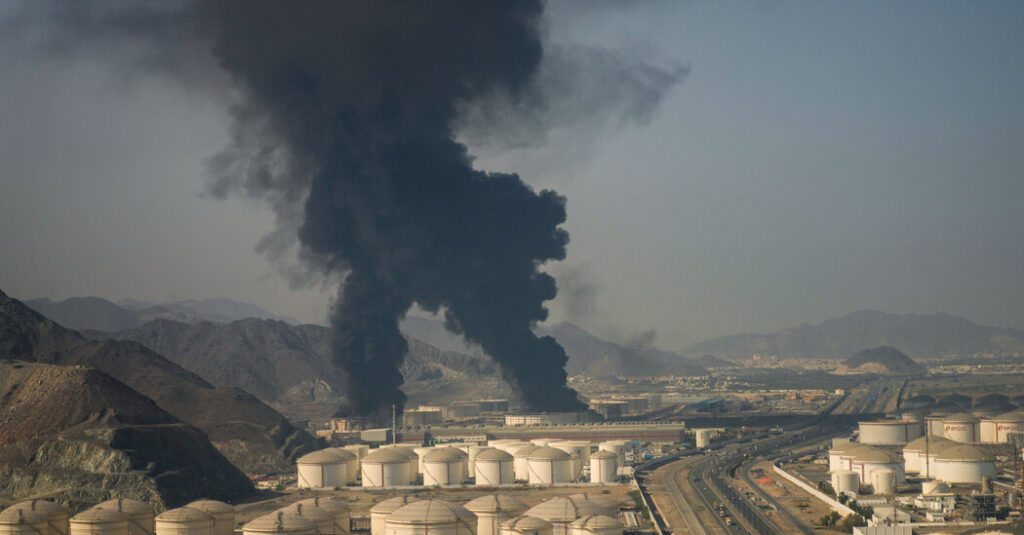
The effects of the war in Iran are rippling around the globe as fuel prices jump and countries roll out energy conservation plans, including one nation that has started mandatory energy holidays. Here’s the latest:
Another tanker attacked: A tanker off the coast of the United Arab Emirates was attacked in the Strait of Hormuz on Tuesday. Iran has said it plans to keep the passageway, which conveys a fifth of the world’s oil supply, closed to most shipping traffic.
Oil infrastructure attacked: On Tuesday, one of the world’s largest oil and gas export terminals, which is located in the United Arab Emirates, caught on fire after a drone attack. A separate drone strike set a U.A.E. oil and gas field ablaze on Monday.
How countries are cutting energy use: The European Union, which imports 90 percent of its oil and 80 percent of its natural gas, is trying to ease energy prices by making more carbon emissions permits available, and Denmark’s energy minister asked people to avoid driving.
Countries in Asia, many of which import most of their oil and gas from the Middle East, are carrying out some of the most serious conservation measures.
To reduce demand, Sri Lanka has declared every Wednesday a holiday for public officials. Myanmar is limiting the use of private vehicles, allowing drivers to use them every other day. Bangladeshi colleges have canceled classes. South Korea lifted limits on burning coal, and local governments in the Philippines shifted to four-day work weeks.
Rising fuel prices: Gasoline prices in the United States have risen 27 percent since the start of the war, jumping to an average of nearly $3.79 a gallon, and diesel soared above $5 for the second time ever on Tuesday. Delta’s chief executive said the company’s jet fuel costs had doubled since the start of the quarter, and the airline has increased fares.
Water supplies at risk: Desalination plants provide a large proportion of drinking water to some of the Persian Gulf nations, as we reported over the weekend. Two plants have been damaged in military operations, and experts worry they could face other indirect threats. Some plants draw water from the sea, raising the prospect that oil spills could contaminate pipes or clog filters.
Antarctica
How a melting glacier could affect tens of millions around the globe
Scientists spent the first weeks of the year on an expedition to Antarctica to study the Thwaites Glacier, which is melting at an alarming rate. If it breaks apart entirely, it could push up global sea levels by two feet over the course of several decades, affecting tens of millions worldwide, according to a New York Times analysis.
These are just the minimum effects that Thwaites’s disintegration would be likely to have on the world’s coastlines. As the glacier breaks apart, global warming will raise sea levels even higher by melting the ice from Greenland and causing oceans to expand in volume. And the Thwaites acts as a plug, holding back many of the Antarctic glaciers on land around it. If it collapses, they could break apart and spill into the sea as well.
Seaside cities all over the world are at risk, but the threat is especially acute in Asia and includes some of the world’s fastest-growing urban areas. Shanghai, one of the major cities under threat, already has more than 600,000 residents living below sea level. If average sea levels rose two feet, an additional 4.7 million people would be affected. — Mira Rojanasakul
More climate policy news:
The Trump administration weighs paying $1 billion to stop wind farms: The administration is considering a new strategy for throttling the country’s offshore wind industry after federal judges blocked its five previous attempts to stop wind farms under construction off the East Coast. Officials are drafting settlement agreements that would pay nearly $1 billion to TotalEnergies, the French energy company behind two wind farms off New York State and North Carolina. — Maxine Joselow
The ‘God Squad’ will meet: The Trump administration plans to convene the so-called God Squad, a federal panel that has the power to override protections under the Endangered Species Act.
The meeting is related to the Gulf of Mexico, which is home to the critically endangered Rice’s whale, a species that exists nowhere else. According to the latest available federal estimates, around 50 of the animals remain on Earth. It will be the first time in three decades that the panel will gather. — Catrin Einhorn
Democrats hammer Trump on ‘energy affordability’: In a new report on Tuesday, top Senate Democrats accused the Trump administration of waging a “war on energy affordability” by canceling hundreds of clean energy projects even before the United States and Israel launched strikes on Iran — strikes which have sent energy costs higher.
The report is a precursor to a series of live-streamed round-table discussions that party leaders hope will keep a spotlight on cost-of-living issues. — Lisa Friedman
One last thing
Bringing a bird’s song back from the edge of extinction
Regent honeyeaters, the black-and-yellow songbirds that were once abundant in the forests of southeastern Australia, are critically endangered, with just a few hundred remaining in the wild. Emily Anthes reports that the bird’s song has changed as its numbers have diminished. Some young males adopted the songs of entirely different species. Others produced shorter, simpler versions of the standard song.
Now, scientists are restoring the song, she reports, by deploying a few skilled honeyeaters to act as vocal tutors.
More climate news from around the web:
-
Even low-risk homes are caught up in California’s insurance crisis, Bloomberg reports.
-
Simon Stiell, the United Nations climate chief, said the war in Iran was a warning about the world’s reliance on fossil fuels. “If there was ever a moment to accelerate that energy transition, breaking dependencies which have shackled economies, this is the time,” he said, according to Reuters.
-
“One year into President Donald Trump’s second term,” Inside Climate News reports, “the Department of the Interior is in turmoil, hobbling many of the agencies overseeing the country’s public lands and waters.”
-
Last year, as part of its DOGE cuts, the Trump administration laid off staff members who would have been responsible for gaming out possible scenarios if the Strait of Hormuz was closed, NOTUS reports.
Read past editions of the newsletter here.
If you’re enjoying what you’re reading, please consider recommending it to others. They can sign up here.
Follow The New York Times on Instagram, Threads, Facebook and TikTok at @nytimes.
Reach us at [email protected]. We read every message, and reply to many!
Claire Brown covers climate change for The Times and writes for the Climate Forward newsletter.
The post The Iran War Is Pushing Some Countries to Cut Back On Energy Use appeared first on New York Times.