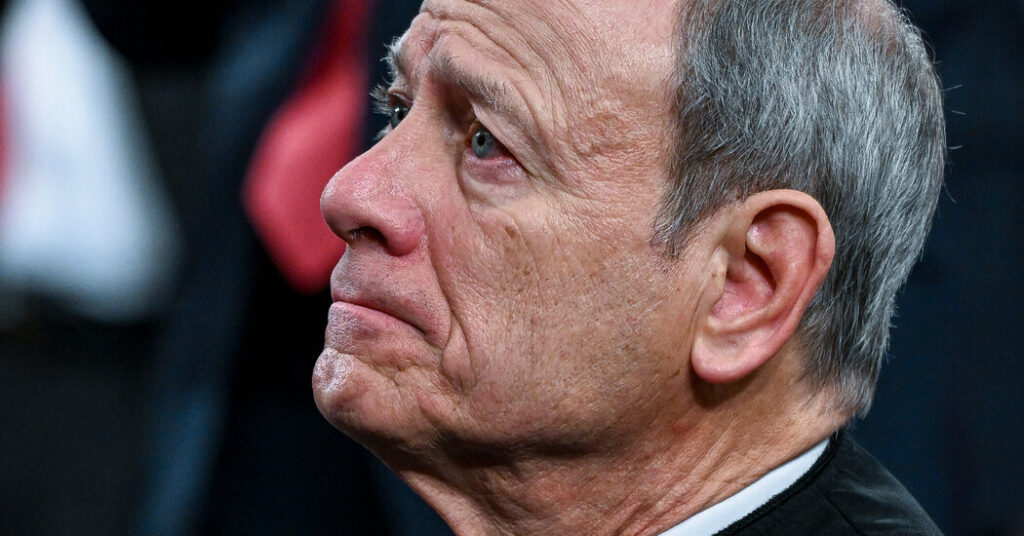
Chief Justice John G. Roberts Jr. on Tuesday denounced personal attacks aimed at judges and justices, calling them “dangerous.”
“It’s got to stop,” he said.
The comments, part of a wide-ranging conversation with the chief justice at Rice University, were his first public remarks since President Trump castigated the six Supreme Court justices who ruled against his sweeping tariffs last month as “fools and lap dogs.”
Chief Justice Roberts made clear his comments were not directed at any particular person or political party. And he distinguished between critiques of legal analysis, which he said were necessary and healthy, and harsh personal attacks.
“It’s important that our decisions are subjected to scrutiny, and they are,” he said. “The problem sometimes is that the criticism can move from a focus on legal analysis to personalities.”
Judges around the country, he added, are working hard “to get it right and, if they don’t, their opinions are subject to criticism.” But he said that “personally directed hostility” needed to end.
The remarks came during his discussion with a Texas-based federal judge at an event sponsored by the university’s Baker Institute for Public Policy in Houston reflecting on his 20 years leading the Supreme Court.
In addition to the case involving the president’s tariffs, the Supreme Court is considering a series of legal challenges to the Trump administration’s expansion of presidential power. For months, Mr. Trump and his allies have repeatedly attacked lower-court judges, as well as the justices, when they have ruled against him.
At a news conference the day the Supreme Court released its tariff opinion, Mr. Trump called the majority who had ruled against him a “disgrace to our nation.” The opinion was written by Chief Justice Roberts. Mr. Trump suggested that Justices Neil M. Gorsuch and Amy Coney Barrett, whom he nominated during his first term, were “an embarrassment to their families” because of their votes.
On Tuesday, Judge Lee H. Rosenthal of the Southern District of Texas alluded to those attacks when she asked the chief justice how he coped with criticism.
Chief Justice Roberts has previously objected to attacks on judges, but primarily in writing. In his annual report on the state of the federal judiciary in December 2024, he issued a prescient warning that judicial independence was under threat.
“Violence, intimidation and defiance directed at judges because of their work undermine our Republic, and are wholly unacceptable,” he wrote, weeks before Mr. Trump returned to office for his second term.
He also issued a stern written statement last March, rejecting the president’s calls for the impeachment of a federal judge in Washington who had ruled against the administration.
But his comments on Tuesday seemed to suggest that the chief justice is growing fed up with the name-calling.
Judge Rosenthal thanked the chief justice for his defense of the judiciary on behalf of the hundreds of federal trial court judges nationwide.
“While we know that you may not always agree with us, we always know that you have our backs and that means a great deal,” she said, prompting vigorous applause from the audience of more than 700 people, including students and faculty members. “I hope it continues. I know it will.”
The chief justice’s remarks come as the federal court system has signaled more openness to allowing judges to speak publicly to respond to attacks. In guidance issued last month, the judiciary’s ethics committee said the code governing judges’ behavior allowed “measured defense of judicial colleagues from illegitimate forms of criticism” and from attacks that “risk undermining judicial independence or the rule of law.”
The guidance cited Chief Justice Roberts’s 2024 year-end report, which listed four types of behavior that go beyond fair criticism, including intimidation and “threats to defy lawfully entered judgments.”
Matt Schwartz contributed reporting.
Ann E. Marimow covers the Supreme Court for The Times from Washington.
The post Chief Justice Says Personal Attacks on Judges Are ‘Dangerous’ and Must Stop appeared first on New York Times.