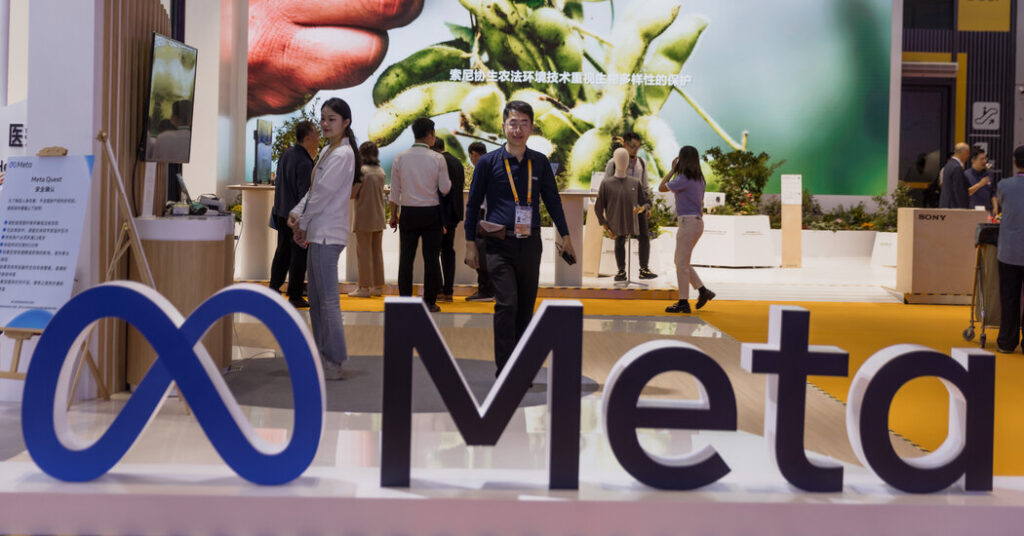
The Chinese government is taking actions to penalize people linked to Meta’s $2 billion acquisition of Manus, a Singapore artificial intelligence start-up with Chinese roots, in an apparent effort to discourage Chinese A.I. executives from moving businesses offshore, two people with knowledge of the matter said.
Officials at China’s National Development and Reform Commission, a high-level ministry that oversees economic planning including A.I., called in Meta and Manus executives for a meeting late last week to express concerns about the deal, which was announced in December, said the people, who declined to be named publicly in order to discuss sensitive issues.
The scope of the Chinese government’s actions remains unclear but appears to include an effort to restrict Manus executives from departing China for Singapore, one of the people said. Beijing has issued exit bans in the past for corporate executives who were under scrutiny.
“The transaction complied fully with applicable law,” Andy Stone, a Meta spokesman, said in a statement. “The outstanding team at Manus is now deeply integrated into Meta.”
He added, “We anticipate an appropriate resolution to the inquiry.”
Manus did not respond to a request for comment. The Chinese Embassy in Washington and the White House did not immediately respond to requests for comment.
Manus was founded by Chinese engineers and had a Chinese parent company before moving to Singapore. Last year, the start-up turned heads in Silicon Valley with an A.I. application that carried out complex tasks without human oversight.
Meta’s purchase of Manus became a rare deal that linked talent from the United States and China, which are vying for dominance over cutting-edge A.I. It was Meta’s second acquisition in a matter of months after the Silicon Valley company, which owns Facebook and Instagram, was found not to have violated U.S. antitrust law in November. Meta is spending billions on A.I. researchers and data centers in a race to lead the technology.
In January, Chinese officials said they were investigating whether the deal violated Chinese rules requiring companies to obtain approval for the export of certain technologies, including interactive A.I. systems. They are also assessing whether the deal violated China’s rules on outbound investment.
With the acquisition complete, it’s unclear what the Chinese government would do. In addition to exit bans, the Chinese authorities may try to claw back the export of data, experts said, or declare that Manus’s departure to Singapore was not lawful.
The developments send a pointed signal to an A.I. industry that, despite U.S.-Chinese tensions, has been defined by the flow of talent and technology between the two nations. The friction could shut down the path Manus took, in which Chinese executives register companies outside China to sidestep regulations from both Washington and Beijing.
Trump Administration: Live Updates
Updated
- Democrats hammer Trump on ‘energy affordability.’
- What’s in the voter ID bill that Trump and Republicans are pushing?
- The Senate’s debate over the bill is expected to be long and bitter.
Any sharper punishment would underscore growing fears in Beijing about losing A.I. talent and business to the United States. Exit bans may stoke concerns among talented Chinese engineers about leaving to work in the United States, or remaining at American companies where many have pivotal roles.
The moves could also trigger a reaction in Washington, where officials have recently moved to allow a greater flow of high-end A.I. chips to Chinese firms.
The incident comes at a sensitive moment for the U.S.-Chinese relationship. American and Chinese officials met on Sunday and Monday to prepare for a planned visit by President Trump to China to meet Xi Jinping, the Chinese leader, at the end of the month. But Mr. Trump said on Monday that he had asked the Chinese government to delay his visit because of the war in Iran. On Tuesday, he said he expected the meeting to happen in “five or six weeks.”
Last Wednesday and Thursday, the United States initiated two separate trade investigations into China and a number of other countries that are expected to result in higher tariffs.
The investigations targeted “excess capacity” in foreign factory sectors and trade in forced-labor goods, two issues that the United States has typically connected with China. In the past, the Beijing responded to Washington’s trade moves by taking retaliatory actions against U.S. companies.
Shengyu Wang, a research assistant at the Asia Society Policy Institute’s Center for China Analysis, said the Chinese government’s scrutiny of Meta could be an effort to create “some bargaining chips ahead of the trade talks” with the United States, as well as signaling to Chinese A.I. researchers not to try to follow in Manus’s footsteps.
If Beijing tolerated this deal, Mr. Wang said, other Chinese A.I. researchers might try to build apps using China’s research and development ecosystem before leaving to be acquired by an American firm.
Meta’s deal for Manus could come up in talks between American and Chinese officials, as could the U.S. government’s ongoing review of the Chinese internet giant Tencent’s minority stake in Epic Games, the U.S. maker of the hit video game Fortnite. Chinese electric vehicle companies have also been hoping that Beijing will press for more access to the U.S. market.
Many Chinese tech start-up founders aspire to launch a global hit product and attract funding from Silicon Valley investors. To get around scrutiny from Washington and Beijing, a few Chinese tech companies, including Shein and TikTok, moved their headquarters to locations like Singapore.
Roselyn Hsueh, a professor of political science at Temple University, said the practice was known as “Singapore washing.” The term refers to the idea that Chinese companies could “wash away their Chinese identity” by going to a third country, she said.
“You see more and more companies either doing so or wanting to do so,” she said. “For several reasons, they want to circumvent regulators, particularly in more sensitive sectors like A.I.”
Tony Romm contributed reporting from Washington.
Ana Swanson covers trade and international economics for The Times and is based in Washington. She has been a journalist for more than a decade.
The post China Ramps Up Scrutiny of a Meta A.I. Deal appeared first on New York Times.