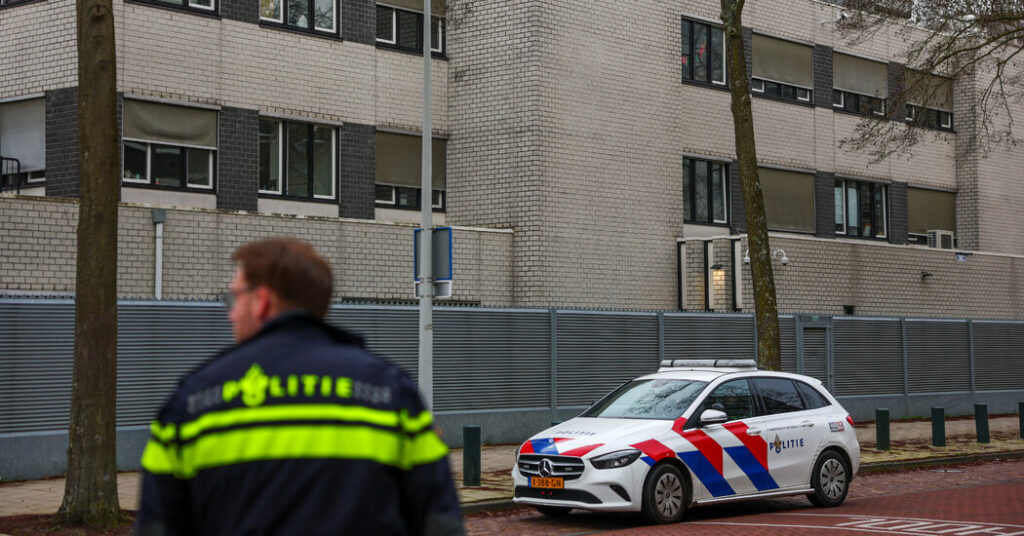
Dutch Jews have long been used to seeing security and armed police in front of their schools, synagogues and gatherings.
But since the weekend, a renewed sense of unease has settled in.
On Friday and Saturday, assailants struck Jewish buildings — a religious school in Amsterdam, where most Dutch Jews live, and a synagogue in Rotterdam — with explosive devices.
“For the Netherlands, this really is a next step,” said Asjer Waterman, 33, who is Jewish and lives in Amsterdam. “But in the broader picture of what’s happening in Europe, this is not new at all.”
“For me, actually, there’s a feeling of determination,” Mr. Waterman said, adding that he would not change anything about how he lives his life. But among his friends and family — as well as on the national news — the attacks have been a major topic of conversation.
Mayor Femke Halsema of Amsterdam called the overnight blast at the school a “targeted attack against the Jewish community.”
Before the Holocaust, the Netherlands had a robust Jewish population. The Nazis deported 75 percent of Dutch Jews to death camps, the highest such rate in Nazi-occupied western European nations. Today, the Jewish population of the Netherlands is estimated at about 35,000 people, 0.2 percent of the country’s roughly 18 million residents.
“I am mostly angry,” said Menno ten Brink, a rabbi at the Liberal Jewish Community in Amsterdam. “I’m mad that this can happen and that it does happen.”
He said that his congregation had not canceled any events or implemented new measures. After the attacks, the Dutch authorities said they had moved quickly to enhance security at Jewish institutions.
“We’re being protected at a very high level,” Mr. ten Brink said. “It’s unimaginable that it’s necessary.”
No one was injured in the attacks in the Netherlands. In Amsterdam, the blast damaged the school’s outer wall. But the lack of injuries did not prevent a sense of fear and intimidation from seeping in among Dutch Jews.
“The emotional damage that is inflicted is considerable,” Mr. ten Brink said.
The incidents in the Netherlands come amid a spate of antisemitic attacks since the start of the U.S.-Israeli war with Iran and Israel’s strikes on Lebanon.
A few days before the incidents in the Netherlands, an explosion damaged a synagogue in Liège, Belgium. Last Thursday, a man drove a truck into a synagogue in Michigan. In France, the authorities are investigating two brothers whom they accuse of plotting a “lethal and antisemitic” attack, though they have given few specifics.
Since the Hamas-led attack on Israel on Oct. 7, 2023, and Israel’s war in Gaza that followed, incidents of antisemitism have risen across Europe, and Jews have reported a heightened sense of fear.
“I am not the Netanyahu government,” said Wanda Reisel, a Jewish author who lives in Amsterdam. “Holding Jews in Europe or elsewhere in the world responsible for what happens in Israel, that’s pure Nazi ideology,” she said. “That’s a fascist way of thinking.”
She said she remembered a similar feeling when she was in elementary school during the Arab-Israeli war of 1967. “The other kids looked at me like, ‘That’s you, right?’” Ms. Reisel recalled. “And back then I already thought, ‘No, that’s not me at all. I have nothing to do with that country.’”
Ms. Reisel, who is not religious, said she would not alter anything about her daily life, but that she was shocked by the recent attacks. “It’s actually unbelievable,” she said.
The explosions have had a big impact on Dutch Jews and the wider society, said Eddo Verdoner, the Dutch national coordinator for combating antisemitism. Antisemitism has been increasing over the last decade or so, he said, with an “exponential increase” since October 2023.
He said other contributing factors included more distance from the Holocaust, with declining awareness of its history and lessons, and a more polarized society.
“It feels like there are fewer places to be openly Jewish,” Mr. Verdoner said.
Prime Minister Rob Jetten of the Netherlands called the incidents “shocking and unacceptable.”
“These cowardly acts have an impact on the entire Jewish community in the Netherlands and are causing feelings of fear,” he wrote on X, after meeting with a group of Dutch Jews on Monday.
The police have not arrested anyone in connection with the attack in Amsterdam, but are looking for suspects, a spokesman for the Dutch police wrote in an email on Tuesday. In Rotterdam, the police arrested four teenagers.
“Don’t be a bystander of antisemitism, but speak out,” Prime Minister Jetten said. “That should not and cannot only be the responsibility of the Jewish community.”
On Sunday, Keren Hirsch, a local politician in Amsterdam who is Jewish, went to the area where the explosion happened in the city and said the number of police cars she saw was jarring.
“This is how we have to live now,” she said. “People just don’t understand what this is like.”
Ms. Hirsch, 40, said she has long been accustomed to heavy security at Jewish events. “It’s normal for me,” she said. “But it is not normal.”
Still, she said, the attacks from the past weekend felt different. “It is meant to sow fear. And that has worked, I’m not going to deny that,” Ms. Hirsch said.
Claire Moses is a Times reporter in London, focused on coverage of breaking and trending news.
The post Antisemitic Attacks Bring Deeper Unease to Dutch Jews appeared first on New York Times.