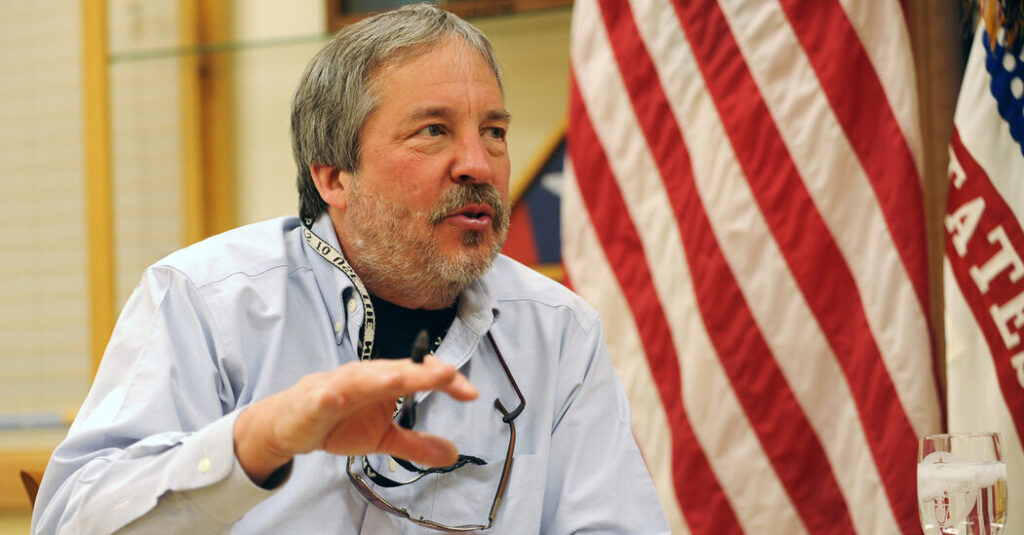
Richard Mauer, a dauntless, award-winning investigative journalist whose reporting in Alaska exposed political corruption, the failure of the local Roman Catholic archdiocese to punish an abusive priest and the tragic toll of suicide and alcoholism on young Native Alaskans, died on Feb. 23 in Seattle. He was 76.
His wife, Barb Jacobs, said that his death, under hospice care at an assisted living center, was caused by frontotemporal dementia.
“We don’t have a state journalism hall of fame, but if we did, Rich Mauer would be in the inaugural class,” Paola Banchero, chair of the journalism department at the University of Alaska, Anchorage, said in an interview. “Everyone who worked with him got something from him that wasn’t just, ‘Oh, he’s a good colleague.’ They learned something about the craft of reporting.”
Mr. Mauer spent 34 years at The Anchorage Daily News, working on many of the paper’s most important stories in areas of coverage that included the State Legislature and oil companies, which hold immense economic and political clout in Alaska. Campaign finance became a specialty; as an early adapter of database reporting, he and a colleague in 1985 used a Macintosh computer to help uncover violations of election law in donations to local politicians.
In 1988, Howard Weaver, the paper’s managing editor, assigned Mr. Mauer to do exploratory research for a series about the high rates of suicide — often fueled by alcohol — among young Native Alaskans in rural parts of the state.
“He spent almost a month interviewing people and researching statistics and then sent me a report,” Mr. Weaver wrote in “Write Hard, Die Free,” his 2012 memoir. “It began like this: ‘However bad you think this is, it’s worse.’”
For the Daily News’s resulting 10-part series, “A People in Peril,” Mr. Mauer wrote several of the articles, including ones about the increasing flow of bootlegged liquor into an otherwise dry village and the tide of alcohol that bootleggers paid for legally — by wiring money to liquor stores — and then took to dry villages to resell at a profit.
The series won the 1989 Pulitzer Prize for public service.
In 1988, Mr. Mauer covered a successful and widely publicized mission to rescue three gray whales that had been trapped beneath ice in the Beaufort Sea for more than three weeks, a story that was the basis of the 2012 action movie “Big Miracle,” starring Drew Barrymore and John Krasinski.
A year later, Mr. Mauer reported extensively on the environmental disaster caused by the supertanker Exxon Valdez’s spilling almost 11 million gallons of oil into Prince William Sound, along Alaska’s south coast. He also provided coverage of the spill as a freelance contributor for The New York Times.
Charles Wohlforth, a former Daily News reporter, recalled how Mr. Mauer confronted Lee Iarossi, an Exxon executive, at a news conference about reports that the tanker’s captain, Joseph Hazelwood, had had his driver’s license suspended or revoked three times for drinking while intoxicated.
“Mauer pushed hard, refusing to give up the floor,” Mr. Wohlforth wrote in his newsletter after Mr. Mauer’s death. “His tough, rapid-fire questions knocked Iarossi off balance till he stumbled and inadvertently blurted out the truth.”
Like most investigative journalists, Mr. Mauer was relentless. “He was tough, he had a good moral compass and he wasn’t scared of people,” Ms. Jacobs, his wife, said in an interview. “He wanted to make people aware of the corruption that was going on.”
Richard David Mauer was born on May 29, 1949, in the Bronx. His mother, Rosalyn (Bederson) Mauer, was a public school science teacher. His father, Arnold, was the comptroller of the United Cerebral Palsy Association.
After graduating from the Bronx High School of Science, Mr. Mauer studied science at the University of Colorado, Boulder and then left for a year to work in Idaho as a volunteer for Vista, the federal antipoverty program. After returning to Boulder, he changed his major to journalism.
Mr. Mauer worked for The Colorado Daily, the student newspaper, and graduated with a bachelor’s degree in 1973.
After reporting stints at The Daily Sentinel, in Grand Junction, Colo.; The Idaho Statesman, in Boise; and The Miami News, in Florida, Mr. Mauer fulfilled his desire to head north to Alaska when The Daily News hired him in 1983.
In 1984, he began to report on Bill J. Allen, the chairman of Veco, a major oil-field service company. Mr. Mauer revealed an employee payroll deduction plan at the company that funneled money to pro-Big Oil Republican candidates in Alaska. The state authorities ruled that the plan was illegal and fined Veco more than $70,000.
Mr. Mauer continued to report on Mr. Allen, who became one of Alaska’s most powerful men. In May 2007, Mr. Allen pleaded guilty to making bribes to legislators and their families totaling more than $400,000 in cash and benefits.
A few weeks later, Mr. Mauer reported that the F.B.I. and a federal grand jury were investigating Mr. Allen’s role in paying for much of the cost of remodeling a house in Girdwood, Alaska, owned by his friend Senator Ted Stevens, the state’s most powerful political figure.
Mr. Allen became a cooperating witness in several corruption trials, including one in which Senator Stevens was charged with violating federal ethics laws by failing to disclose financial and other gifts from Mr. Allen for the remodeling of his house. Senator Stevens was found guilty on all counts, but his conviction was overturned in 2009.
Mr. Mauer told C-SPAN that the state had been reluctant to investigate corruption. “No one is really watching,” he said in 2009. “And so it was the federal government that actually came in and was investigating the case.”
One of Mr. Mauer’s most memorable stories, which unfolded in a three-part series in 2003, explored the history of sexual abuse of teenage boys by a popular priest in the Anchorage diocese, Msgr. Frank Murphy, in the 1960s and ’70s. The diocese, though aware of accusations of abuse against Monsignor Murphy, sent him to St. Louis to be treated for his alcoholism, then shuttled him to Boston, where he worked as a hospital chaplain.
“He was so interesting,” Mr. Mauer wrote about Monsignor Murphy, “that most people tolerated, if uncomfortably, the scruffy, troubled boys ever-present in the rectory, many sent there by Catholic social agency workers because he would take care of them.”
Nicole Tsong, who collaborated on the series with Mr. Mauer, said of him, “He was all about investigating abuses of power that needed to be opened up to the world.”
The Alaska Press Club awarded Mr. Mauer and Ms. Tsong its Public Service Award for the series.
In 2007, Mr. Mauer spent time covering the war in Iraq for McClatchy Newspapers, which owned The Daily News at the time.
He was laid off in 2017, then spent a year as a reporter at KTUU, a television station based in Anchorage. He left after his request to be a part-time employee was turned down, Ms. Jacobs said.
She survives him, along with their daughter, Jessica Mauer, and son, Michael; two grandchildren; and his sister, Peri Mauer.
Mr. Mauer was, at times, an editor, and acted as a kind of player-coach in the newsroom.
“As an editor, he was incredibly generous and patient,” said Lisa Demer, a former reporter at The Daily News, “which was surprising, because with people in power, he was ruthless and just went after them.”
Richard Sandomir, an obituaries reporter, has been writing for The Times for more than three decades.
The post Richard Mauer, Reporter Who Probed Corruption in Alaska, Dies at 76 appeared first on New York Times.