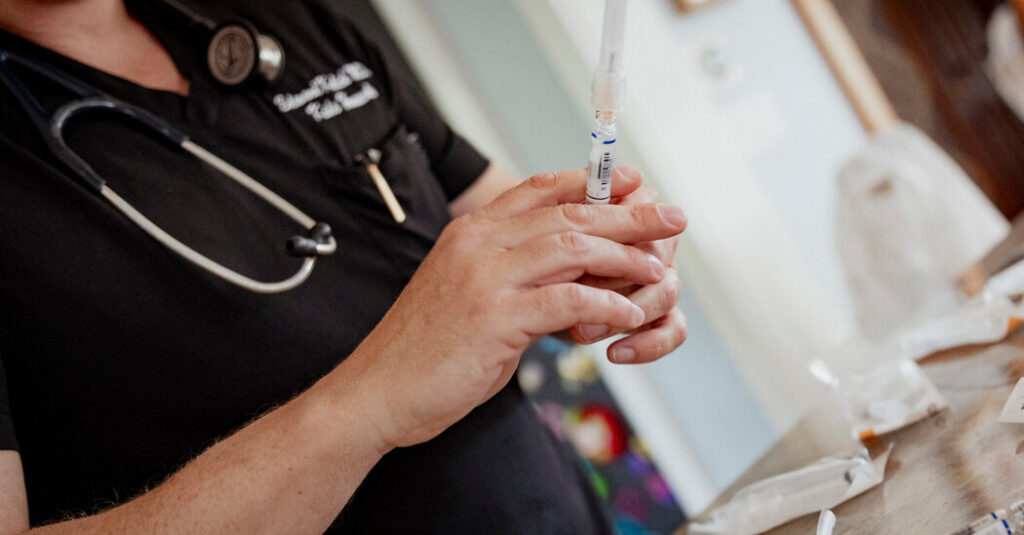
After a federal court on Monday halted, at least for now, the Trump administration’s sweeping changes to vaccine recommendations, pediatricians and researchers expressed concern that the ruling would have little effect on the confusion and mistrust that those changes have stoked.
Over the past year, pediatricians have reported a surge in parents who might once have been persuaded to accept vaccines for their children but are now staunchly opposed, as well as parents who were fully on board but now are unsure.
“No one is under the illusion that this puts the genie back in the bottle,” Michael Osterholm, who directs the Center for Infectious Disease Research and Policy at the University of Minnesota, said of the court ruling. “The damage has been done.”
The administration’s actions over the past year, including removing shots against six diseases from the routine childhood vaccination schedule and appointing vaccine critics to a federal advisory panel on immunizations, have given credence to unfounded fears about the safety of vaccines, said Jason Schwartz, an associate professor of health policy at the Yale School of Public Health. He added that those moves have made it harder for parents to know who to trust.
Dr. Schwartz and other experts said they thought it was unlikely that the court ruling, which effectively reinstates the more expansive vaccine schedule, could swiftly change that.
Dr. Suresh Nagappan, a pediatrician in Greensboro, N.C., said he had seen an increase in parents who “sort of threw up their hands and said, ‘I don’t know if I can trust anybody’” as the administration’s vaccine guidance strayed further from that of major medical organizations. If the Centers for Disease Control and Prevention now had one recommendation and the American Academy of Pediatrics had another, they weren’t confident in either.
“When you as a pediatrician tell them, ‘Hey, this is recommended by the A.A.P.’ or ‘this is recommended by the C.D.C.,’ that used to have some cachet,” Dr. Nagappan said. But now, he said, it is generally unhelpful and can even make parents more mistrustful.
In a statement, Andrew Nixon, a spokesman for the Department of Health and Human Services, said that “the only thing that has led to chaos and confusion” is efforts by medical groups, like those that filed the lawsuit that led to the ruling, “to try to undermine the Trump administration.” The administration has signaled that it plans to appeal the decision.
Hannah and Nathan Schwartz, new parents in St. Paul, Minn., said that when their son was born last month, they were asked if they wanted a hepatitis B vaccine, a vitamin K injection and an antibiotic eye ointment. The question was neutral, Mr. Schwartz, 30, said, with no indication that there is strong medical support for all three.
They consented to the shots and the ointment after pressing for an opinion from their care team, which supported all of them. The couple said that they would probably continue to follow the pre-Kennedy schedule, but that they felt less confident and more compelled to ask questions about each individual vaccine. And they said the ruling reinforced their sense, dating back to the administration’s initial changes, that the recommendations had come unmoored from any solid deliberative process.
The ruling is “good, I guess, if the old schedule is actually what’s going to keep our kid safe and other kids safe,” Ms. Schwartz, 26, said. “But then, who’s actually making the decisions about these things? A judge isn’t a doctor, a judge isn’t a clinical researcher, so is our whole public health system just based on politicians’ opinions?”
The overwhelming majority of Americans still support most childhood vaccines. After the Trump administration overhauled the schedule, polling from the nonprofit KFF found that most parents remained confident in the safety of measles, polio, hepatitis B and flu vaccines, though confidence in the safety of Covid vaccines was starkly split among partisan lines. That poll, and ones from the Annenberg Public Policy Center and Axios, found that large numbers of Americans didn’t trust the Trump administration’s health leadership or recommendations.
But even before Mr. Kennedy took office, uptake of some critical shots had slipped. The rate of kindergartners with complete records for the measles vaccine fell from around 95 percent before the pandemic to under 93 percent in 2024, less than the threshold needed for herd immunity that can stem the spread of the virus. While parents who refuse vaccines remain a minority, their decisions can still have significant consequences both for unvaccinated children and for public health.
Dr. Megan Ranney, an emergency physician and dean of the Yale School of Public Health, said reversing the decline in trust would require doctors and public health officials to empathize with confused parents, allay their worries and address broader issues that contribute to poor health and can make people distrustful of the medical system.
“This drop in trust did not happen overnight, and it’s not going to be fixed overnight,” she said.
But Dr. Ranney said that the court ruling could be a significant step forward, because it validated the guidance of organizations that stuck with the previous schedule, like the A.A.P. and the American Medical Association.
“There are still trustworthy sources out there,” she said.
When health officials overhauled the childhood vaccine schedule, they advocated for “shared clinical decision-making” for some shots, meaning that doctors would explain the risks and benefits of the vaccines and come together with the patient to make a decision instead of issuing blanket recommendations.
“This framework empowers parents and physicians to make individualized decisions based on risk, while maintaining strong protection against serious disease,” Dr. Mehmet Oz, the head of the Centers for Medicare and Medicaid Services, said in a statement at the time.
Many pediatricians said they had always talked to patients about their concerns and answered their questions. In practice, they said, the changes have instead pushed them to treat vaccinating and not vaccinating as equivalent.
“Pediatricians were really challenged by this, because they don’t have two equally good options for, say, measles prevention,” said Jennifer Reich, a professor of sociology at the University of Colorado and the author of “ Calling the Shots: Why Parents Reject Vaccines.” “They have one really good option and no other option.”
Dr. Nagappan, whose job involves training new pediatricians, said he was teaching them to immerse themselves in the evidence around vaccines, so they could tell parents they endorsed each shot not because a higher authority said so, but because they had personally assessed the research. A wealth of evidence shows that parents trust pediatricians and primary care doctors.
In Dr. Nagappan’s experience, this approach doesn’t convince parents who steadfastly oppose vaccines, but he has found it effective with some who are torn.
Dr. Reich said it had become harder for parents to access transparent, reliable information on vaccines in the past year. “Nobody should have to get a Ph.D. in immunology to be able to make health care decisions for their family,” she said.
Maggie Astor covers the intersection of health and politics for The Times. She welcomes tips on Signal: @maggieastor.63.
The post Doctors Say Court Ruling Can’t Undo Kennedy’s Vaccine Damage appeared first on New York Times.