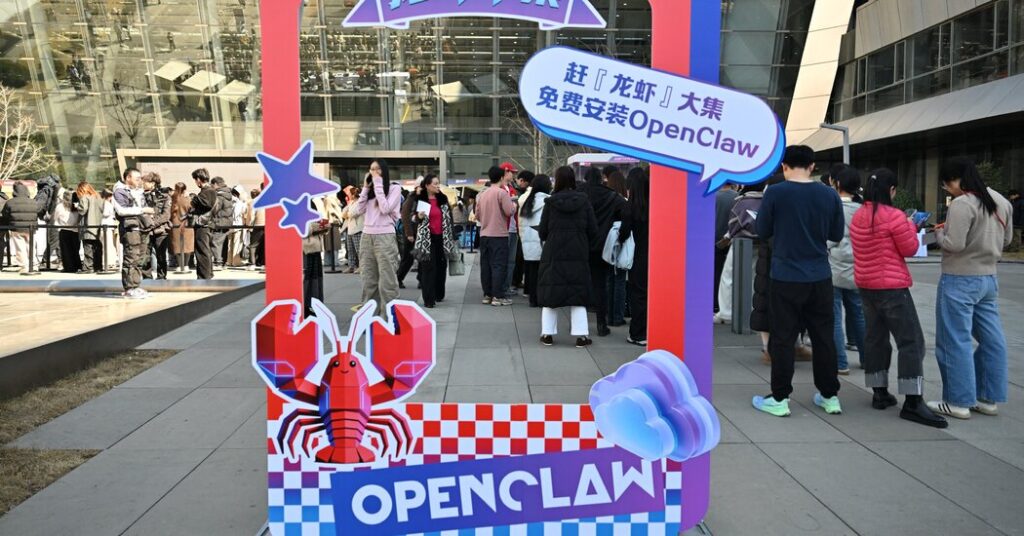
In the span of a month, an artificial intelligence assistant called OpenClaw has come to embody both China’s excitement and anxiety about what A.I. can do.
Long lines stretched across Shenzhen, China’s technology hub, as people sought help from engineers to install OpenClaw. Some local governments started offering subsidies, free computing and discounted office rent to companies that use OpenClaw to build new services. Share prices of Chinese tech companies surged as industry leaders and start-ups scrambled to offer the tool on their platforms.
Then, almost as quickly, the tide turned. The Chinese government warned that OpenClaw carried serious security risks. Seeking to capitalize on the software’s success, Chinese tech companies rushed to launch copycat versions of the tool.
OpenClaw’s turbulent rise — and broader interest in tools like it, known as A.I. agents — underscores how the rush into artificial intelligence is reshaping China’s tech industry. Beijing has spent billions trying to turn the country into an A.I. superpower and has identified the technology as a critical driver of economic growth.
OpenClaw is a freely shared tool that functions as a virtual assistant, helping users conduct research, send texts or emails, and manage their calendars. Installed directly on a user’s computer, the A.I. agent can carry out tasks on its own, such as reading and responding to messages on apps like WhatsApp or iMessage, after an initial prompt by the user. Unlike most chatbots that rely on a single company’s A.I. model, OpenClaw can run on a variety of models.
OpenClaw, which was released four months ago, has already vaulted into this month’s top 10 most popular projects on GitHub, an online global community for coders. It has spurred excitement about the potential of agents to use artificial intelligence to help people become more efficient in their everyday lives.
Earlier this month, Jensen Huang, chief executive of Nvidia, the American chip-making giant, added to the hype, telling an investor conference that OpenClaw was “probably the single most important release of software, you know, probably ever.”
Tech companies are vying to capitalize on the excitement by launching their own agent and assistant tools. Nvidia said it plans to launch an A.I. agent platform called NemoClaw. Peter Steinberger, the engineer who developed OpenClaw, said last month that he is joining OpenAI to work on agents.
The Chinese tech industry has also jumped on the bandwagon. Alibaba and Tencent, two of China’s biggest technology companies, said they are developing their own alternative A.I. agents.
Companies that build A.I. models and the hardware that powers them stand to gain financially from widespread use of A.I. agents, which can run continuously on a user’s device and frequently communicate with other models that charge based on usage.
Shares of Chinese tech companies offering OpenClaw-like products have risen on investor optimism about A.I. agents, including Minimax and Zhipu, two start-ups that went public in Hong Kong earlier this year, and have released tools called MaxClaw and AutoClaw.
In China, the phrase “raising a lobster,” a reference to OpenClaw’s logo, has spread online. While the government has raised concerns, the technology has been greeted by the public with more optimism than anxiety.
“Most people view technology as a convenience, so when something new comes out, they are more willing to try it,” said Wendy Chang, a senior analyst at the Mercator Institute for China Studies, a think tank.
But the same trait that makes OpenClaw useful, its versatility, also creates significant security risks.
In recent weeks, Chinese regulators have repeatedly warned about security vulnerabilities linked to OpenClaw, including potential leaks of personal information and errors in financial transactions.
One person in China left OpenClaw running with access to his credit card, only to find the agent had run up the card to its limit, according to Chinese media reports.
Multiple databases that track potential security breaches associated with the tool have sprung up online.
For some Chinese entrepreneurs, the idea that an A.I. system could be directed to act on its own has spawned a new vision of the internet where A.I. agents — and not human users — perform tasks such as buying things, sending messages, and connecting on social networks.
Felix Tao, a former Facebook and Alibaba employee and co-founder of Mindverse, a start-up in Hangzhou, launched a software-building competition last month for engineers to develop applications related to A.I. agents. Hundreds of developers signed up and created more than 150 apps, Mr. Tao said. This month, he plans to co-host another event with Zhihu, a Chinese chat forum similar to Quora.
Mr. Tao said his company has been building a product called Second Me that would use A.I. to help people manage their lives. It can send daily emails to colleagues, for example, or regular text messages to check in with relatives.
Part of the reason people have been able to build with OpenClaw so quickly is that it is open source and freely available online. Chinese developers have embraced open-source A.I. tools, whose code is publicly available, enabling anyone to examine, modify or build new programs from it.
In the year since the Chinese start-up DeepSeek stunned the tech world by announcing a new A.I. system that spends far less on computer chips than foreign rivals, Chinese companies have released a major share of the world’s top-performing open-source A.I. systems.
While leading American A.I. companies such as OpenAI and Anthropic keep their systems closed, Chinese firms have increasingly released details of their technologies publicly.
Chinese A.I. models offer a far cheaper option for engineers looking to experiment with tools like OpenClaw, helping explain why so many Chinese A.I. companies have released similar products in recent weeks, said Graham Webster, a professor at Stanford who focuses on geopolitics and technology.
Chinese regulators will also have to weigh the benefits these tools will bring to the country’s A.I. industry, because of the privacy and security risks they pose, Mr. Webster said.
“It could be a moment that starts to cause the Chinese government to think about the downsides of widely available open models,” Mr. Webster said.
Meaghan Tobin covers business and tech stories in Asia with a focus on China and is based in Taipei.
The post China Is Embracing OpenClaw a New A.I. Agent, and the Government Is Wary appeared first on New York Times.