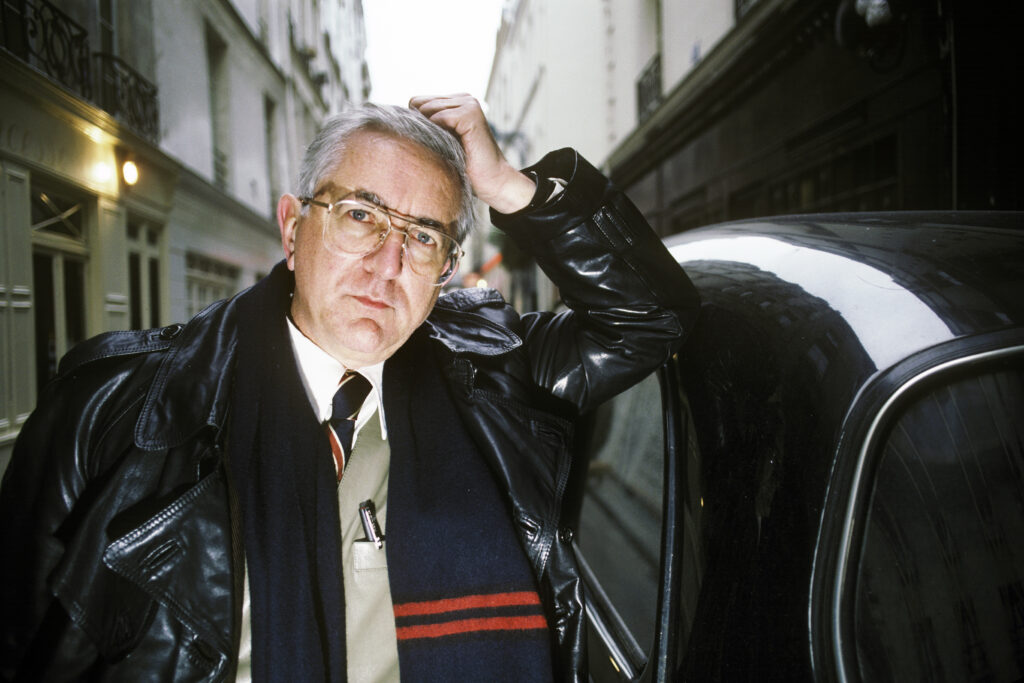
Len Deighton, the prolific British spy novelist whose best-selling books of betrayal and deception skewered espionage services in the East and the West, and sharply mocked English social strictures, reflecting his own rise from a childhood far from privilege, died March 15. He was 97.
His literary agent, Tim Bates, confirmed the death but did not cite a cause.
The son of a chauffeur and a private cook for a wealthy London family, Mr. Deighton was a military photographer, pastry chef, airline cabin steward and commercial artist before deciding on a whim to attempt a spy novel after years of studying the genre during work-related layovers from Cairo to Hong Kong. The result, “The Ipcress File,” written tautly and with a deft satiric touch, became a phenomenon on its release in 1962 amid the James Bond craze.
Unlike the agents created by writers such as Ian Fleming, John le Carré and Graham Greene — characters who moved in the upper echelons of the intelligence field — the nameless protagonist of Mr. Deighton’s early spy novels was a working-class man who indulged in insolence and wisecracks as he set out to pull defectors from behind the Iron Curtain, root out moles and thwart criminal madmen.
Mr. Deighton’s reluctant hero took the bus or drove a Ford Zephyr from the secret service motor pool, not an Aston Martin. He fussed about filling out expense forms in his dingy London headquarters, was selected for certain assignments because of his gourmand’s physique (he was assigned to Helsinki because he was “the one best protected against cold”) and tangled with Oxford- and Cambridge-educated colleagues, remarking, “What chance did I stand between the communists on the one side and the establishment on the other?”
Driven by what he admitted was a “monumental inferiority complex,” Mr. Deighton wrote some 20 spy novels and more than a dozen works of nonfiction (some with co-authors) as well as screenplays, television scripts and travel guides.
His best-selling novels included the “Ipcress” sequels “Funeral in Berlin” (1964) and “Billion Dollar Brain” (1966). They were turned into films starring Michael Caine as the droll Cockney protagonist, who was christened Harry Palmer for the screen.
Mr. Deighton dismissed writing as a “goof-off profession,” but he said he thrilled at the impact his novels had on readers. “When you make a book, it’s like making a hand grenade,” he told the Telegraph. “It’s a dull process but when you throw it, the person at the other end gets the effect.”
His spy works are marked by elliptical narratives short on explanatory details, reflecting the mysteries of espionage, yet filled with unforgettable moles, traitors and other characters who double- and triple-cross one another.
“Deighton’s wry and ironic recognition of the realities of espionage and the crackling energy that motivates his fiction place him in the first rank of spy novelists,” critic George Grella wrote in the 1985 edition of “Twentieth Century Crime and Mystery Writers.” “He writes thrillers that are witty, thoughtful, authentic, and entertaining, a rare combination of merits.”
In his later years, Mr. Deighton’s shyness and his pivot to historical fiction and nonfiction works left him more removed from public awareness. “I’ve never written books for people more clever than I am, or more stupid,” he once said. “I’ve always tried to direct things at people like me.”
Leonard Cyril Deighton was born in London on Feb. 18, 1929. His family lived in a mews apartment above a garage, near Montagu Square in London’s Marylebone neighborhood. His parents were in the employ of the family of a curator at the British Museum.
“I’m very fond of telling people I grew up in a house with 15 servants,” he told Thames TV. “It’s just that my father was one of the servants.”
Mr. Deighton’s poor grades led to frequent rows with his father — until his father, one day, promised not to punish him if he saw him reading of his own volition. “That really did push me into reading books,” he told the Telegraph. “I played truant all the time and I usually went to the Marylebone Reference library and I would just sit there all day long and read. A terrible kind of sedentary childhood I had, when I think about it.”
Seeking refuge from his father’s temper, he would also retreat to watch his mother cook, sparking a lifelong interest in cuisine — the subject of five of his nonfiction books. One of the neighbors for whom Mr. Deighton’s mother provided occasional service, Anna Wolkoff, opposed British involvement in World War II and was known for her antisemitic, pro-Nazi sympathies. She was suspected of being a spy for Germany.
“It was in early May 1940 that I heard cars arriving in the middle of the night,” Mr. Deighton recalled on the Deighton Dossier website. “Crammed shoulder to shoulder with my parents, I leaned out of the window. There were two police cars in the mews and Special Branch officers were banging on her street door. They bundled her into a car and took her away to face charges of espionage.” (She was sentenced to 10 years in prison but was released in 1947, following the war.)
After finishing school at 16, Mr. Deighton spent a brief period as a railway clerk before serving in the Royal Air Force for two and a half years. He trained in photography to capture Russian troop movements from the air. He later received a scholarship to attend the Royal College of Art, working on the in-house magazine as an illustrator.
Mr. Deighton dabbled in many professions — porter, pastry chef, press photographer — before settling into the advertising industry, largely as a commercial artist. He designed covers for British editions of books by Mordecai Richler, Iris Murdoch, George Plimpton and Anthony Sampson. His most famous book cover was for the British first edition of Jack Kerouac’s “On the Road.”
As an interlude, he spent part of 1956 and 1957 flying around the world as a cabin steward for BOAC, the British airline, before returning to work as an illustrator. Mr. Deighton did freelance work for House & Garden and drew “cookstrips” (recipe graphics) for the Observer, combining his love of illustration with his favorite French recipes.
Mr. Deighton has said he was ignorant of the process of writing when he began “The Ipcress File.” Thanks to a cocktail party encounter with a literary agent, he got the manuscript to a London publishing house, which wanted to capitalize on the recent release of the first Bond film, “Dr. No.”
“Ipcress” sold millions of copies, and Bond film co-producer Harry Saltzman backed the film adaptation of “The Ipcress File” (1965). Caine, then best known for his memorable supporting role in “Zulu” (1964), donned thick black glasses to play Harry Palmer, a role he would reprise in “Funeral in Berlin” (1966) and “Billion Dollar Brain” (1967).
Mr. Deighton adapted for the movies his 1968 novel about con artists, “Only When I Larf,” and he also contributed to the screenplay of the 1969 anti-war musical “Oh! What a Lovely War.” According to one account, he earned the crew’s admiration when he hot-wired 20 cars to get them out of the way of a shot.
He also produced illustrated cookbooks and wrote a travel guide before Playboy magazine hired him late in the decade as a jet-set travel editor. He said he partook abundantly of the Swinging Sixties lifestyle he was supposed to promote but quickly soured on it. “Two things destroy writers: praise and alcohol,” he remarked. He subsequently cast a critical eye on the film industry with his 1972 novel “Close-Up.”
In the 1980s and mid-1990s — during the final stretch of the Cold War and the immediate aftermath — Mr. Deighton turned to a different protagonist for a series of spy trilogies, “Berlin Game” (1983), “Mexico Set” (1984) and “London Match” (1985); “Spy Hook” (1988), “Spy Line” (1989) and “Spy Sinker” (1990); and “Faith” (1994), “Hope” (1995) and “Charity” (1996).
In these nine novels, protagonist Bernard Samson is a grumbling, middle-aged British spy who suffers marital as well as political betrayal when his wife defects to East Germany. The style is more expansive and complex than Mr. Deighton’s previous works, no longer bereft of explanation but needle-sharp in social critique.
For more than four decades, Mr. Deighton moved restlessly among homes in Ireland, France, Portugal, Austria, the island of Guernsey and California. His first marriage, to illustrator Shirley Thompson, ended in divorce in 1976 after years of estrangement. In 1980, he married the daughter of a Dutch diplomat, Ysabele de Ranitz, and they had two sons, Alex and Antoni, whom he insisted on having educated outside England.
“The moment you step across the threshold of any school in England you’ve put on a uniform for the class war,” he told Thames TV. “Everyone in England has been assigned rank badges for the class war.”
In addition to his wife and sons, survivors include five grandchildren.
Mr. Deighton wrote military histories, historical novels and nonfiction works on such topics as the airplane engine and the fountain pen.
In a 2009 retrospective, BBC Radio 4 called him a “polymath” whose range of interests was “exhaustive.” His novels are obsessive in their attention to detail, including precise descriptions of wall safes, gun specifications and the effects of poisons. He learned scuba diving for one early novel, “Horse Under Water” (1963), and learned to fly a helicopter before writing “Billion Dollar Brain.”
For all his renown, Mr. Deighton preferred, later in life, to remain the nondescript man in the figurative shadows. He loathed giving interviews and once said he liked to be “as unnoticeable as the man behind you in the fish and chip shop.” He neither coveted nor garnered awards and honors from social or literary gatekeepers.
“To allow someone to give you a knighthood is to admit that there is someone who is allowed to appraise you on a scale which you are going to agree with,” he told the Telegraph. “The audacity of it!”
The post Len Deighton, best-selling novelist with wry take on espionage, dies at 97 appeared first on Washington Post.