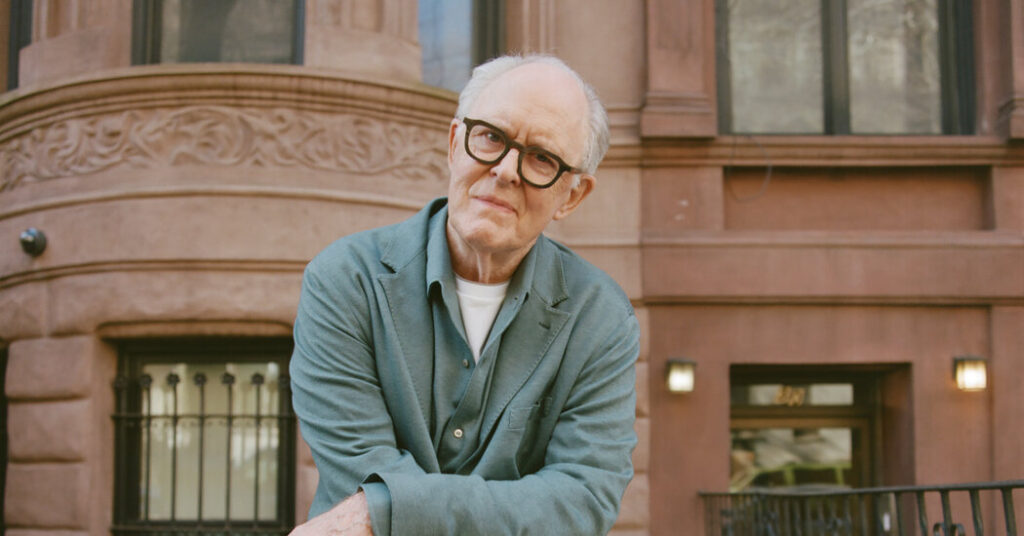
One of the privileges of being a very famous and extremely genial actor is that you might find yourself, as John Lithgow did at 9:30 on a recent Wednesday morning, being welcomed to the Metropolitan Museum of Art on the one day a week it is closed to visitors.
Susan Alyson Stein, the Met’s curator of 19th-century European painting, was walking him privately through the small but astonishing Helene Schjerfbeck exhibition, which includes a series of self-portraits, made over the course of 60 years, that could rip your heart out with their unsparing depictions of stoicism, rage, delight and decrepitude.
Lithgow, who has lately “dwindled” from 6-foot-4 to 6-foot-3 but maintains a big man’s big personality, bubbled with interest as he loped from canvas to canvas. A collector of art and also of curators, he occasionally asked Stein, who has led him on many such tours, about the painter’s biography and method and world. I wondered if he was making mental notes on how character arises from circumstance to produce, as he has produced, so many extremes of feeling. But later he told me that while certainly noticing Schjerfbeck’s “combination of great technique and deeply felt emotion” he was mostly thinking wistfully about the art he might have made if he’d chosen that life “and been good enough.”
He’s undoubtedly good, as a quick guided tour of his phone’s photo gallery demonstrated. (For years he has drawn or painted his co-stars and castmates, presenting their portraits as parting gifts.) But “artist” is just another of the roles he has donned and discarded since first tottering onto the stage at age 2. Now 80, having performed on Broadway and television since 1973, and on film starting a few years later, he finds himself approaching what he describes as the end of his career by reaching as far afield as possible.
Which is saying something for a man who has played (to skim a list stretching toward 200 roles) King Lear, Lord Farquaad, Dr. Lizardo, the Trinity Killer, Winston Churchill (twice), Roberta Muldoon, Bill Clinton, J.J. Hunsecker, a sex-bamboozled diplomat, a dance-banning reverend, a corrupt cardinal and the alien Dick Solomon.
That last role, which he performed for six seasons starting in 1996 on the sitcom “3rd Rock From the Sun,” may be the one he’s still most famous for 30 years later; as he left the Met, a guard shyly stopped him to say how much she loved him on the show. He loved the show, too, he told me, for offering the chance to create the kind of outrageous character he can hardly imagine himself playing but that other people “can’t imagine being played by anybody else.”
Yet when you’ve acted your way to the end of every available limb, where do you go next? Especially when the world in which you learned to love performing, a world that valorized actors who could play anyone and everyone, has changed so radically?
Many of the roles Lithgow most treasures are exactly the ones some people would now say that he, “a pretty ordinary cisgender straight guy,” should never be cast in. His sensitive, Oscar-nominated portrayal of Muldoon (the transgender former football player in “The World According to Garp”) would surely go to a trans actor today, and though he remains proud to have had the chance to turn his inhabitation of her “into drama that deeply moves people” and “broadens their sensibilities,” he accepts that.
Still, he keeps pushing himself toward contradiction, difference and even reputational danger as his choices invite criticism. In the Australian film “Jimpa,” available digitally next week, he plays the gay grandfather of a trans grandchild; yet as Dumbledore — also gay — in the upcoming television version of the Harry Potter books, he has associated himself, albeit indirectly, with the author J.K. Rowling, whose social media comments over the years have been seen by many as transphobic. The play “Giant,” now in previews on Broadway, ties that Lithgovian knot even tighter; he stars in it as Roald Dahl, another hugely successful and divisive children’s book author, this one hair-raisingly antisemitic.
Why, with nothing left to prove, does he make such a beeline for such potentially divisive gigs?
“I am fascinated by every variety of human experience and want to understand it,” he said. “I’m in the empathy business.”
The 2-year-old Lithgow would have been too young to notice, but his stage debut in 1947 established the pattern. In “Drama,” his 2011 memoir, he writes that the play he appeared in was a “vaguely Japanese” adaptation of “The Emperor’s New Clothes,” for which someone drew “dark diagonal eyebrows” on his face in an attempt, then common in the theater but now understood as racist, to suggest that he was Asian. Ten years later, when his scout camp performance as a damsel in distress was met with “earsplitting” laughter, “my fate was probably sealed,” he adds. No accident that his book’s subtitle is “An Actor’s Education”: He learned from such experiences to be the kind of performer who found his power playing anyone but himself.
The idea of versatility as a virtue was in the air of his upbringing, much of which took place onstage. His was a theatrical family, in both senses. His father established and ran a series of classical repertory companies whose precipitous closures led to Joad-like relocations. At one point, like an army brat but with Shakespeare and Ibsen on his résumé, Lithgow attended three schools in two states in one year.
That’s how he became what he calls a “pleaser”: someone who to this day memorizes, immediately, everyone’s names on every new job — including the many children on the “Harry Potter” shoot. Noting that, Francesca Gardiner, the series’ showrunner, called him “a great human.” Sophie Hyde, the director of “Jimpa,” said, “Charm and lovability ooze out of him.” Nicholas Hytner, the director of “Giant,” offered this itemization: “phenomenal warmth, sympathy, enthusiasm, openness.”
“Little do they know,” Lithgow said.
He is very hard on himself. (“Drama” sometimes reads like a public self-flogging.) Unlike his father, whom he resembles in superficial ways — tall, plummy-voiced, twinkly, encyclopedic — he says he possesses the “son-of-a-bitch chromosome” you need to survive in the theater. That’s not the same as ruthlessness, though; when retelling a story about his unkindness at age 13 to an outcast girl who tried to befriend him, he started to cry. “Even now it pains me,” he said. “That’s just too old to be so vile.”
Well maybe not yet too old. In his early 20s, to evade the Vietnam draft, he played “the role of John Lithgow” for his examiners, painting himself as an “unrecruitable psychological basket case”; when asked if he was gay, which would bar him from serving, he said he often “thought about” his college roommate. The performance, he writes, was a triumph, though it left him feeling deeply ashamed.
So did almost the entirety of his busy 1970s, when he says he slept with actresses in eight of the 20 plays he performed in, culminating in an affair with Liv Ullmann that broke up his first marriage. (His second — to Mary Yeager, a now-retired professor of economic and business history — has lasted ever since.)
Still, the misbehavior of his youth eventually taught him two important lessons. “Good people are people capable of bad things,” he told me. And, more problematically, “bad people are capable of good.”
Which of those lessons is dominant in “Giant” is the kind of conundrum Lithgow loves to explore. The play, by Mark Rosenblatt, drops the audience into a fictional 1983 lunch meeting in which Dahl — the beloved author of children’s classics including “Charlie and the Chocolate Factory, “Matilda” and “The BFG” — faces down representatives of his London and New York publishers. The true part is that Dahl has just reviewed a book about the 1982 Israeli invasion of Lebanon, which sought to halt years of rocket attacks by the Palestine Liberation Organization and resulted in the deaths of thousands of Lebanese civilians.
The line between antisemitism and anti-Zionism, let alone mere disapproval of the Israeli government’s actions, is perennially blurry and, at this moment, electrified. But Dahl’s review stepped definitively, almost gleefully, over it. When his representatives beg him to issue a retraction, not least because his book “The Witches” is imminently to be published, he instead doubles down on his hatred of Jews. The play incorporates verbatim statements like this one, from a 1990 interview with The New Statesman: “Even a stinker like Hitler didn’t just pick on them for no reason.”
Does it not frighten him, I asked Lithgow as we sat in the cheerful living room of his Upper West Side apartment, to utter such hateful things onstage?
“Frighten me, no! It excites me. Red meat to a tiger. That’s the perversity of us actors. You wait forever for a role like this, full of sadism and monstrosity and hideousness. It’s the most hyperextended I’ve ever been in any performance,” he said — a wild statement from a man who, in the 2024 horror film “The Rule of Jenny Pen,” played a snaggletoothed psychopath victimizing residents of a nursing home.
What will make his Dahl even more hideous to some, and more thrilling to others, or both at once, is that Lithgow hyperextends in two directions. He certainly goes full tilt on the monstrousness, not merely uttering but bellowing Dahl’s worst slurs or impishly giggling about them. Yet also, Lithgow said, “I looked, like a Geiger counter, for those moments when he could break your heart,” including one in which a toy box prompts a sudden memory of his firstborn, who died at 7 of measles encephalitis.
Lithgow further complicates the character just by being Lithgow. His genius for “instantly putting an audience at ease,” as Hytner, the director, described it, allows him “to use his charm and wit and mischief to make the violence of Dahl’s prejudice and cruelty all the more powerful.”
Turning moral disasters into acting triumphs — Lithgow won the 2025 Olivier Award for the role in London — is as at least as old as Shakespeare; the aims of drama are not the same as those of justice or civility. When I asked Hytner whether Lithgow’s performance might force people to accept that a monster could write a masterpiece, and that the two things are unrelated, he simply said, “Good.”
He meant that people and art and even countries, being complex, should be dealt with complexly. Theater should model, not avoid, that approach.
It is in that light that Lithgow sees his appearance in the “Potter” series, which HBO plans to run for seven seasons over the course of a decade, starting in 2027. He has never met Rowling, nor does he agree with her views on transgender issues. And the story itself is “clearly on the side of the angels, against intolerance and bigotry,” he said. Moreover, he feels that his performances in “Garp” and “Jimpa” — and as half of an older gay couple in the 2014 film “Love Is Strange” — should be seen as expressions of his interest in queer culture, not as heedless appropriations of it. He assumed his loyalties were clear.
Certainly, he jumped headfirst (and at one point fully naked except for a leather harness) into “Jimpa,” which Hyde, the director, said a number of gay actors had turned down. Though his character is resistant to the newfangled terminology of his trans grandchild — he calls the teenager his “grandthing” — their mutual love is obvious. The same applied to Lithgow’s interactions with the mostly queer cast and crew. In an interview with Out magazine, Aud Mason-Hyde, who plays the grandchild and, like the character, is trans, called him “such a beautiful human to make work with.”
But Mason-Hyde found Lithgow’s decision to join the Potter series “disconcerting,” telling Out “there’s an element of this that feels vaguely hurtful.” The social media reaction has been less gentle. The social media reaction has been far less gentle, with some posts expressing outrage and encouraging boycotts.
Stung, Lithgow considered quitting the series but decided not to, and accepts without rancor that in “every interview I will ever do for the rest of my life this will come up.”
Whether actors inherit the moral onus of authors is now a vexed question. Sophie Hyde, the “Jimpa” director as well as Mason-Hyde’s mother, told me that despite her feelings about Rowling, she appreciates that Lithgow “is an adult” and has a right to make an artistic choice.
“John’s work comes from a place of deep empathy and humanity, and that bigger political conversation is not one he’s engaging in.” As for the blowback, she added: “Sometimes you have to think about who you’re working with and for, not who you’re working against.”
Surely there’s no question where Lithgow stands politically. He’s written three books of light verse excoriating Donald J. Trump. The second, “Trumpty Dumpty Wanted a Crown,” published in 2020, includes couplets like this one: “He wanted a robe made of ermine and velvet. / The Constitution? He wanted to shelve it.”
Such polemics he leaves on the page. The stage and the screen are not for certainties but rather, he says, for “the little nooks and crannies” between them — and also for redemption.
When I asked if even Dahl is worthy of that, Lithgow, though finally as unsparing as those Schjerfbeck self-portraits, used his best oracular tones to answer, with what sounded like awe and hope, yes: “Everybody is.”
Jesse Green is a culture correspondent for The Times.
The post The Man Who Would Go Anywhere appeared first on New York Times.