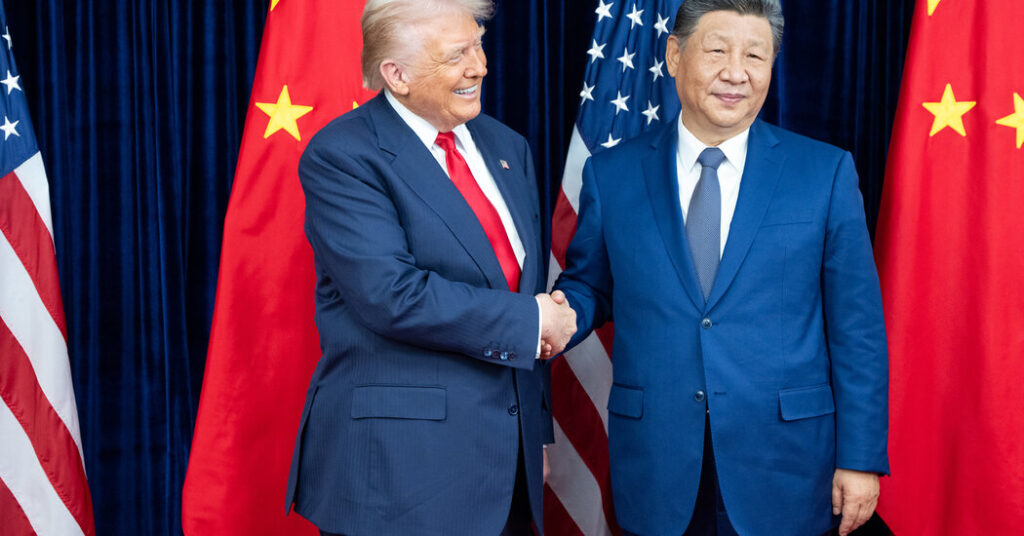
Hours after President Trump made a request to delay a high-stakes summit with China’s leader, Xi Jinping, it remained unclear when the two leaders would meet.
On Tuesday, reporters in Beijing pressed China’s Foreign Ministry with questions about the meeting, which was scheduled for later this month in the Chinese capital. But Lin Jian, a ministry spokesman, replied with the same answer each time, saying that Beijing was still discussing the timing of a visit and that he had “no further information to add at this time.”
Speaking at the White House on Monday, Mr. Trump said he needed to stay in the United States instead of making a planned trip to Beijing. He said he requested a delay of “a month or so.”
“We’ve got a war going on. I think it’s important that I be here,” Mr. Trump said.
Trump administration officials met in Paris on Sunday with their Chinese counterparts for two days of discussions to lay the groundwork for a meeting between Mr. Trump and Mr. Xi. The leaders were expected to extend a yearlong trade truce that was agreed upon at a meeting in October.
But Mr. Trump himself had cast doubts on his planned trip. He had threatened to call off his visit if China failed to contribute warships to help escort ships through the Strait of Hormuz, a narrow waterway through which as much as one fifth of the world’s oil passes. Mr. Trump has called on other countries to help reopen the strait, which has been effectively choked off by fighting between Israel, the United States and Iran.
The delay complicates what China’s top diplomat, Wang Yi, has described as a “big year for China-U.S. relations.” Speaking at a news briefing after the United States and Israel attacked Iran, Mr. Wang indicated that a series of planned “high-level” exchanges would not be derailed by U.S. and Israeli attacks on Iran, a strategic partner to Beijing.
Postponing the meeting was interpreted in China as an indication that Mr. Trump was facing growing concern that the war was having a negative impact on domestic politics and the economy, said Wu Xinbo, the dean at the Institute of International Studies at Fudan University in Shanghai. It would also give Beijing some space to manage its relationship with Iran, he said.
“From the Chinese perspective, it’s better to receive Trump after the war on Iran is over,” said Professor Wu. “While the U.S. is fighting Iran, for us to roll out the red carpet for Donald Trump puts China in an awkward position because Iran is China’s partner.”
Mr. Lin of the Foreign Ministry also said on Tuesday that China would provide emergency humanitarian assistance to Iran, Jordan, Lebanon and Iraq.
Murphy Zhao contributed reporting from Hong Kong.
Alexandra Stevenson is the Shanghai bureau chief for The Times, reporting on China’s economy and society.
The post China is Tight-Lipped on Trump’s Request to Delay His Xi Summit appeared first on New York Times.