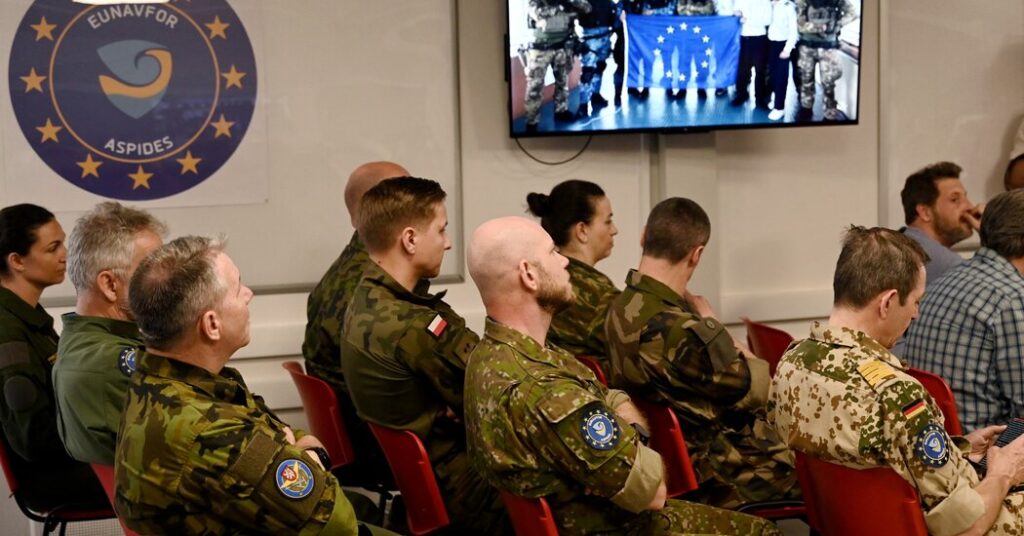
President Trump is demanding that America’s allies in Europe help reopen the Strait of Hormuz, a critical Middle Eastern shipping route that Iran has effectively blocked.
European leaders have pushed back strongly on getting more deeply involved in the conflict with Iran. The European Union floated the possibility of expanding a small maritime operation created to help the United States protect the Red Sea to also police the strait — but for now that idea appears to be off the table.
Here’s a closer look at that operation, known as Aspides, and Europe’s other options when it comes to the Strait of Hormuz.
The E.U.’s operation defends ships in the Red Sea.
Operation Aspides was started in February 2024 to protect commercial vessels in the Red Sea from attacks by Iran-backed Houthi militants in Yemen. To date, it has been limited. The program has an operating budget this year of about 15 million euros ($17.2 million), and it has in the past included three or four main ships at a time. With tensions rising in the Middle East, President Emmanuel Macron of France last week pledged two more French vessels.
Aspides has worked alongside a larger, American-led Red Sea operation, called Prosperity Guardian, which involved more ships, including some from European nations.
Benjamin Jensen, a senior fellow at the Center for Strategic and International Studies, said in an email that the operation “provides a ready-made template” for escorting commercial traffic through the Strait of Hormuz.
In addition to being relatively small, though, Aspides was created to be purely defensive — its name comes from the Greek word for “shields.” That has made it less assertive than the American operation, whose vessels could hit enemy ships without first being fired at, said Cinzia Bianco, a visiting fellow at the European Council on Foreign Relations.
Europe says it won’t expand the operation, for now.
Brussels on Tuesday shot down the idea of expanding Operation Aspides, at least at this point. “For the time being, there was no appetite in changing the mandate of the Operation Aspides,” Kaja Kallas, the European Union’s top diplomat, said after a gathering of foreign ministers on Monday. “For now.”
European officials have pointed to the operation’s limitations in the Red Sea in arguing against its being expanded.
“Aspides is not effective,” the German foreign minister, Johann Wadephul, told the public broadcaster ARD on Sunday evening, ahead of the E.U. debate. “And therefore I am very skeptical whether an expansion of Aspides in the Strait of Hormuz could provide more security.”
Ms. Bianco said that what constrained defensive maritime operations like Aspides — the constraint she thinks Mr. Wadephul was referring to — was practical reality.
Naval escorts for merchant ships cannot cajole commercial operators to sail through dangerous waters, especially when crews and ship insurers deem the risk too significant. It takes only one relatively cheap hidden explosive to make a waterway unsafe, but it takes a lot of resources to sweep for mines.
Expanding would be politically tricky.
There are practical reasons the United States might want members of the European Union to contribute to efforts in the strait. European forces have mine-sweeping capabilities that could be useful there, said Ian Lesser, who leads the Brussels office of the German Marshall Fund, a think tank.
European officials are loath to become embroiled in the conflict and sending ships to reopen the strait could pull them in. But they have spent months trying to keep Mr. Trump placated, hoping to keep him engaged in the war in Ukraine and to avoid escalating trade tensions.
Ms. Bianco suggested that another program, European Maritime Awareness in the Strait of Hormuz, could provide an alternative. It is already specific to the region, and it operates through a coalition of European countries, rather than via the full 27-member E.U.
Even then, she said, Europeans would most likely want to wait until tensions had cooled.
The question is how the United States might respond if the European Union maintains its wait-and-see approach.
“We’re at a moment in the trans-Atlantic relationship where nothing stays in its lane,” Mr. Lesser said, noting that failing to appear helpful risked trouble on trade policy or in other arenas. “Europe is extremely aware of this.”
Jeanna Smialek is the Brussels bureau chief for The Times.
The post Europe Has Helped the U.S. Protect Shipping. The Strait of Hormuz Is Different. appeared first on New York Times.