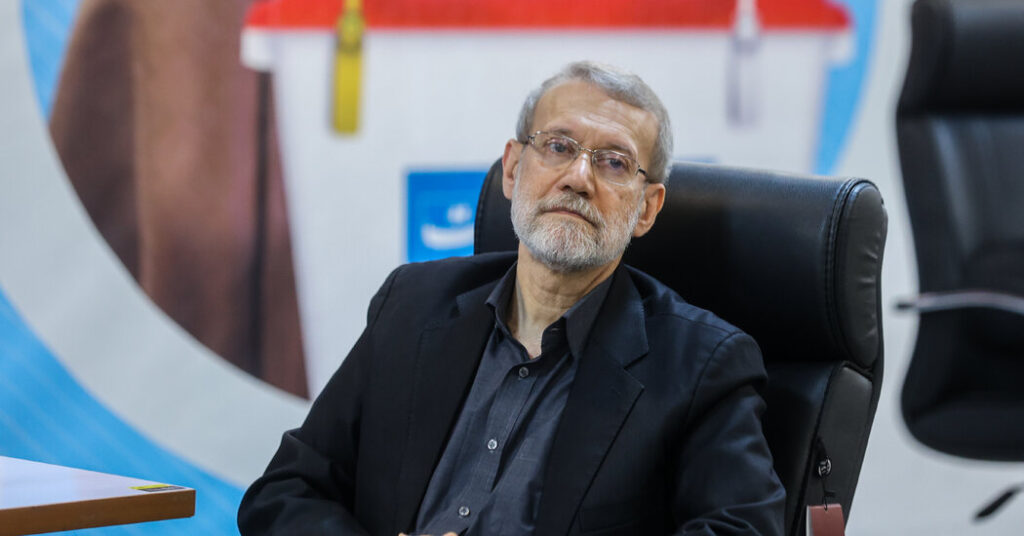
Ali Larijani, Iran’s top national security official and de facto leader, is the latest senior Iranian figure to be targeted since the start of the U.S.-Israeli war with Iran on Feb. 28.
Mr. Larijani, 67, who Israel’s defense minister said on Tuesday was believed killed in an overnight strike, has in effect been running the country behind the scenes. Since Feb. 28, when Iran’s supreme leader, Ayatollah Ali Khamenei, and a number of other senior officials, were killed in U.S.-Israeli strikes, Mr. Larijani emerged as a defiant public voice of the Iranian government, regularly condemning the United States and Israel on social media.
There has been no official comment so far from Iran on Israel’s claim that Mr. Larijani was killed.
A trusted confidant of Ayatollah Khamenei, Mr. Larijani was among a group of officials whom the supreme leader tasked with devising a plan to ensure the Islamic Republic would survive if he were assassinated, according to senior Iranian officials and members of the royal guards.
The scion of an elite political and religious family, Mr. Larijani served for 12 years as the speaker of Parliament. In 2021, he was tasked with negotiating a 25-year comprehensive strategic deal with China that was worth billions and delivered an essential lifeline for an Iranian economy battered by Western economic sanctions.
Before the U.S.-Israeli assault began last month, Mr. Larijani’s portfolio grew. He was in charge of putting down recent protests that demanded the end of Islamic rule, deploying lethal force to crush the demonstrations. He kept a lid on dissent and was the key liaison with Iran’s allies including Russia, as well as regional actors like Qatar and Oman.
He also oversaw nuclear negotiations with Washington, and had devised plans for managing Iran during a potential war with the United States.
Mr. Larijani often acted as the public face of the Iranian government, sitting for television interviews with Iranian and foreign news outlets. His social media presence includes selfies with other Iranians, visiting a shrine and waving from the door of an airplane.
Mr. Larijani’s rise partly sidelined Iran’s president, Masoud Pezeshkian, a doctor who was seen as a moderate figure within the Iranian leadership. Mr. Pezeshkian appeared resigned to deferring authority to him, telling a cabinet meeting that he had suggested to Mr. Larijani that internet restrictions should be lifted because they were harming e-commerce, Iranian media reported. The admission that the president needed Mr. Larijani’s authorization to get things done was a sign of his power.
Even though Mr. Larijani was one of Ayatollah Khamenei’s closest advisers, he was not a likely candidate to succeed him as supreme leader because he was not a senior Shiite cleric — a fundamental qualification for any successor. In the end, Mojtaba Khamenei, a son of the slain supreme leader, assumed the role.
On Tuesday, after reports that Israel had targeted Mr. Larijani, his X account published an image of a handwritten statement in honor of Iranian sailors who had been killed in a U.S. attack. It was not clear when the statement had been written, who wrote it or why it was published at that time.
Farnaz Fassihi is the United Nations bureau chief for The Times, leading coverage of the organization. She also covers Iran and has written about conflict in the Middle East for 15 years.
The post What to Know About Ali Larijani, Iran’s Top Security Official appeared first on New York Times.