The 17-year-old sat in a hotel room, running a high-stakes logistics hub from his smartphone. He scrolled through listings of weapons for sale on WhatsApp and fielded requests like a call-center operator, dispatching orders in real time: Kalashnikovs, AR-15-style rifles and lots of ammunition.
The pace of business has become relentless, said the arms smuggler, the Arizona-born son of a local cartel cell leader. Though still in high school here in Phoenix, he is now handling as many as 200 firearms orders a week, roughly double what he shipped to Mexico before President Trump returned to the White House and pressed for a crackdown on the cartels.
Moving the weapons into Mexico is easy, he said, despite increased surveillance and enforcement on both sides of the border. “No one stops you unless you run a red light,” he said.
As the Trump administration pushes the Mexican government to do more against drug cartels, an unintended beneficiary has emerged from the U.S. pressure campaign: the weapons smugglers who supply guns to the Sinaloa Cartel, the criminal powerhouse behind much of the fentanyl flooding American streets.
Mexican and U.S. authorities have poured billions of dollars into stemming the flow of drugs, particularly fentanyl going north. Yet gun traffickers have quietly moved what they say is an unprecedented amount of weapons south, arming the very criminal group the U.S.-Mexico effort was meant to weaken.
Over the past year and a half, the demand for weapons has exploded as the Sinaloa Cartel wages a three-front war: confronting an intensified offensive by the Mexican government, battling rival factions within its own ranks and stocking up for the prospect of U.S. military intervention.
I spent weeks interviewing seven cartel operatives directly involved in buying and delivering firearms from the United States. They are all tied to the Sinaloa Cartel, one of the world’s most powerful criminal groups. Two of the dealers are based in Arizona and the five others operate in Sinaloa state, the cartel’s stronghold.
The smugglers spoke on the condition of anonymity, fearing retaliation from law enforcement and their bosses. Their accounts provide chilling details of how weapons sold in American gun shops and at gun shows — and increasingly through websites and phone apps that operate like open marketplaces — are funneled to Mexican cartel members and used in some of the country’s most violent crimes.
Guns are often stripped into parts and concealed inside truck panels or hidden compartments in vehicles before being transported south, the smugglers said. Other times, they are tucked inside private planes or lashed to the hulls of speedboats carving through the Pacific. For small shipments, drivers sometimes tape them to their bodies or stash the weapons in a trunk and throw a blanket over them.
Mexican authorities estimate that as many as 500,000 guns are smuggled from the United States into Mexico each year. Christopher Demlein, a former A.T.F. agent who specialized in covert gun-trafficking networks, said the figure could be as high as one million guns smuggled annually.
Spurred by Mr. Trump’s threats of punishing tariffs against Mexico and U.S. military strikes south of the border, the Mexican government has gone after the cartels with a barrage of arrests, drug seizures and lab busts, as well as handing over dozens of high-level drug traffickers to the United States.
In one of the most significant blows to organized crime in years, Mexican forces last month killed Rubén Oseguera Cervantes, known as El Mencho — leader of the Jalisco New Generation Cartel, the Sinaloa Cartel’s main rival — in an operation officials touted as proof of their intensifying crackdown.
But Mr. Trump has vowed to wage his own campaign against cartels inside Mexico, calling the country “the epicenter of cartel violence.”
President Claudia Sheinbaum of Mexico has rejected any U.S. military intervention and has said the United States needs to do more on its side of the border, by stopping American guns from flooding her country and causing such mayhem.
The U.S. border controls are designed primarily to stop inbound threats such as drugs and weapons rather than to monitor outbound traffic, according to U.S. officials and experts.
But in 2020, the U.S. government started a federal task force to intercept arms trafficking from the United States to Mexico. In the last 14 months, the Bureau of Alcohol, Tobacco, Firearms and Explosives said, it has seized more than 4,300 firearms bound for Mexico — a tiny fraction of the hundreds of thousands of weapons estimated to cross each year.
In 2021, the Mexican government sued major American gun manufacturers, arguing that they fueled cartel bloodshed, but the Supreme Court dismissed the case last year
“If those weapons are prevented from entering Mexico, these groups would not have the high-powered arms they use to carry out their criminal activities,” Ms. Sheinbaum said this month at a news conference.
Mexico’s security minister, Omar Harfuch, the country’s top official tapped to weaken the cartels, recently told The New York Times that he has pressed his American counterparts to further investigate the sources and suppliers of military-grade weapons not sold in gun stores. About 80 percent of weapons seized by Mexican authorities come from the United States, he said at a recent news conference.
Mr. Harfuch said that both Sinaloa Cartel and its rival Jalisco New Generation Cartel are increasingly armed with weapons like grenade launchers, grenades, machine guns and assault rifles.
“That is what we are dealing with here,” he said. “If it became more difficult for them to have that type of weapon, it would definitely be a different fight.”
The Assembly Line
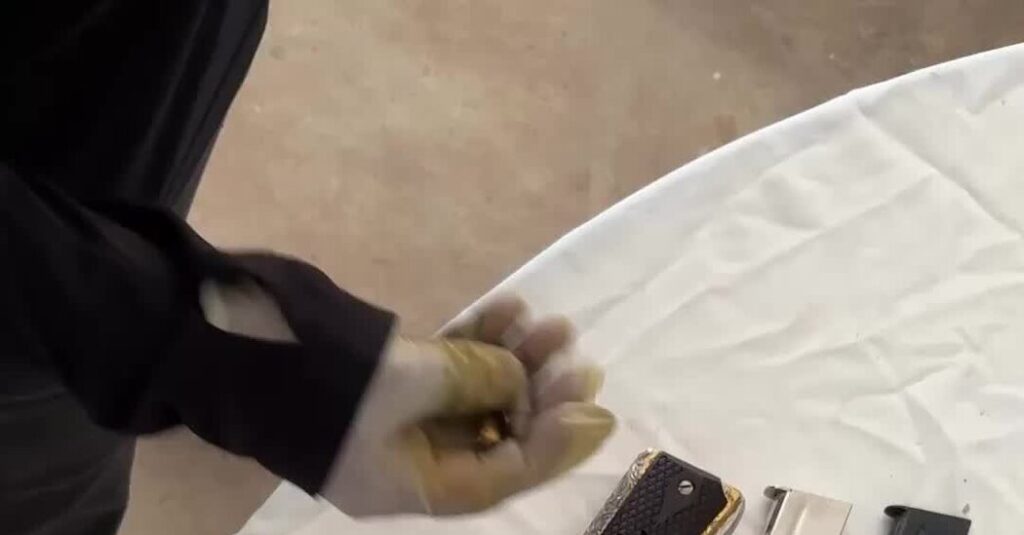
On a recent afternoon, two men in black masks leaned over a table. One scrubbed a Colt pistol with a toothbrush, working grime from its seams. The other dripped cooking oil onto the metal and polished a second handgun, engraved with swirling gold-toned patterns.
One of the men, a 28-year-old operative, said he works for the Sinaloa Cartel faction called the Mayitos, which is aligned with the cartel’s co-founder Ismael “El Mayo” Zambada García. A longtime close partner of Joaquín “El Chapo” Guzmán Loera, El Mayo was abducted in 2024 by one of El Chapo’s sons and handed to U.S. authorities — a stunning betrayal that plunged the cartel into violent internal conflict.
For nearly a decade, the operative has occupied a critical position in the trafficking chain: He makes sure the guns work. He receives them, cleans them, modifies them and redistributes them across the state, delivering weapons to cartel lieutenants and cell leaders.
Shipments that once arrived sporadically now come every couple of weeks, he said, carrying hundreds of firearms at a time.
Only a week earlier, he said he and his partner had driven to a remote landing strip about an hour south of Culiacán, the capital of Sinaloa state, to unload a plane carrying roughly 1,500 weapons.
Following pressure from the Trump administration, Mexico has deployed thousands of National Guardsmen and military forces to Sinaloa state and has increased highway checkpoints across the country, making roads riskier for some traffickers.
So, the operative’s smuggling cell has begun shifting to air transport, he said, increasingly using private planes and landing strips long relied on for drug shipments.
Short on cash after months of fighting and reduced drug production, his faction has been forced to adjust, he said. Its members were so desperate for guns, he said, that his bosses recently began trading fentanyl for weapons with one of their main U.S. suppliers: the powerful California-based street gang known as the Mexican Mafia.
“All the money that comes in is being spent: on payroll, food, vehicles for the fighting, on paying off authorities,” the operative said of his faction.
“The main focus for them at the moment is guns, not the drugs, because of the war,” he added.
Mexico’s War Machine
Mexican cartels have shaped their weapons pipelines into a disciplined, compartmentalized machine. Bosses send orders to a small circle of specialists in Mexico whose only job is to arm the cartel.
The trail then extends into the United States, where a network of trafficking coordinators and lieutenants operate insulated smuggling cells across multiple states. U.S. investigators say that when a single link of the chain is exposed, it leads nowhere else.
American citizens or residents legally able to buy guns are paid to buy firearms from licensed dealers at stores and gun shows, often with little knowledge of the larger operation they are feeding. Each buyer is given a narrow task: Walk in, buy an AR-15 or a .50-caliber rifle, hand it off.
That design has made the pipeline increasingly resilient. U.S. investigators and security experts say the gun trade has grown faster, harder to disrupt and more firmly rooted in the United States.
But recently, enforcement has ramped up in states like Arizona, and U.S. smugglers have had to adjust their methods. (Sixty-two percent of firearms recovered in Mexico and traced to a U.S. purchaser from 2023 to 2024 came from Arizona, according to A.T.F. data.)
The two Phoenix-based smugglers said they have now begun bribing gun store employees, managers and owners. Some of them, the smugglers said, inflate prices to skim profits, collect a 10 percent kickback as a bribe, falsify records and reuse information from past customers to conceal off-the-books sales.
The guns are then consolidated in safe houses, often disassembled to make them easier to conceal, and the parts are moved south in double-walled compartments in fishing boats and cargo trucks.
One smuggler said the border is so porous that cartel members sometimes tape gun parts and sometimes even entire firearms directly to their bodies and walk them into Mexico.
The two smugglers said they rely on Arizona’s deeply rooted gun culture and lax gun laws to obtain weapons. More and more, they are also leaning on WhatsApp group chats and private Facebook groups that operate like digital supermarkets. These networks are made up only of trusted contacts. To stay under the radar, organizers often delete old chats and create new ones, making sure only verified people have access, the smugglers said.
“Here in Phoenix people are obsessed with guns,” said the 17-year-old smuggler. He showed this Times reporter a WhatsApp group where firearms were advertised and stopped on a photo: three military-style rifles laid out on a mattress, a baseball cap resting beside them.
“We look at those posts and say, ‘oh that one’s good to send down south,’” he said.
Meta, the owner of Facebook and WhatsApp, says it does not allow the purchase, sale or trade of weapons on any of its platforms, though the smuggler demonstrated just how easily those rules are bypassed. Arizona’s regulations allow private and online gun sales without background checks or record-keeping.
That evolving digital marketplace mirrors federal findings.
In its latest report, the A.T.F. said officials are now investigating online and app-based platforms as often as gun shows, flea markets and auctions, reflecting a trafficking landscape that has moved increasingly into private digital spaces.
Mr. Demlein, the former A.T.F. agent, said the weapons pipeline from American retailers to cartels is more structured and tightly controlled than drug trafficking networks. Drugs, he said, are abundant and easily replaced, making even big seizures largely inconsequential. Firearms are different, he argued. Mexico’s major criminal groups treat them as a strategic lifeline.
Mr. Demlein said that the United States has misread the threat.
“We’ve put billions into the drug war and a fraction of that into weapon trafficking,” he said. “If they lose their guns, they lose the war. It’s game over.”
The Smuggler
The 40-year-old smuggler doesn’t go by a name, only a number that he has used as a moniker for years. For more than a decade, he said, he has bought weapons in the United States and moved them into Sinaloa state in northwest Mexico for Los Chapitos, the faction of the cartel led by the sons of El Chapo.
He was pulled into the business by an uncle, he said. The day he’s gone, his son will keep it going. That’s how the business survives: generationally.
The Sinaloa Cartel war has sent the demand for what he called “metal” soaring, with orders now coming in faster and in larger quantities.
This smuggler works with suppliers in the United States, including one American citizen he has known for 12 years who is responsible for buying the guns, both secondhand firearms and brand-new military-grade weapons.
Recently, he’s been moving about 240 firearms a month over the border, double the volume he moved a year ago, he said. The Kalashnikov rifle — widely used by armies, insurgent groups and paramilitary forces around the world — is what everyone wants, he said. The Barrett .50-caliber sniper rifle is also in high demand, he said, because it can punch through vehicles and fortified positions.
Bribes are essential, the smuggler said. His American counterpart handles payments to U.S. officials, including from Customs and Border Protection and others, to ensure the shipments cross without interference.
Asked about accusations of agents taking bribes, the agency said in a statement that C.B.P. agents and officers “enforce our nation’s laws along what is now the most secure border in history.”
The smuggler moves weapons along two main arteries.
One begins in Phoenix or whichever city is quiet that week. There, the guns are loaded into the hidden compartments of trailer trucks and vehicles and driven to Nogales, Mexico, by an American. Then a Mexican driver takes over, the smuggler said.
In northern Mexico, he said, the trailer is switched, the paperwork reset and the shipment sent south by road to Tijuana, then across the Baja California peninsula, according to the smuggler. From there, the cargo is loaded onto speedboats and ferried across the Gulf of California to Topolobampo, a commercial port on the coast of northwestern Sinaloa. Then it goes to different states by land.
If the final destination is Culiacán, the route is shorter. Phoenix to Nogales by road, then straight down the highway, according to the smuggler.
“If you pay, it passes. If you don’t, it doesn’t,” he said. “It’s as simple as that.”
Paulina Villegas is a reporter for The Times based in Mexico City, where she covers criminal organizations, the drug trade and other issues affecting the region.
The post Inside the Supply Line Delivering American Guns to Mexican Cartels appeared first on New York Times.