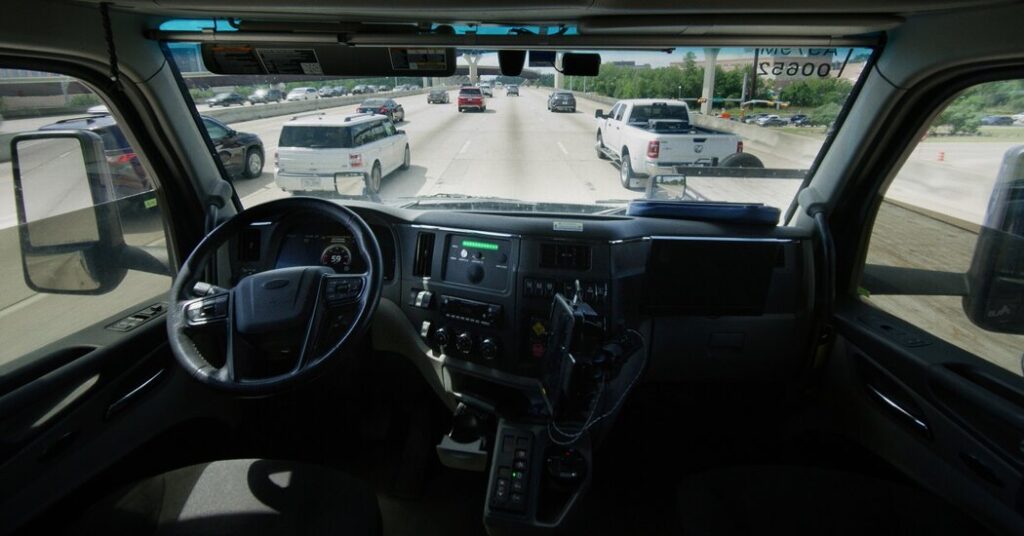
It looked like just another big rig rolling down a Texas interstate, a sight that inspired a thousand country songs. But this delivery last May was different, because there was no driver at the wheel.
The operator, Aurora Innovation, said it was the first fully autonomous commercial trucking operation of its kind on U.S. highways.
The company’s runs between Dallas and Houston on the I-45 corridor quickly racked up 1,200 miles on the road for customers including FedEx and Uber Freight.
But less than three weeks after they started, those history-making runs paused. Paccar, maker of the Peterbilt trucks on the route, asked that Aurora put a person back in the cab. Aurora’s autonomous drives resumed, but with an “operator” (Aurora says its operators are less engaged than safety drivers would be) on board. Paccar declined to answer questions about why it had called a halt.
There’s no question that finally putting driverless semi trucks into regular interstate runs will be a turning point for the industry. A driver’s salary is 26 percent of the per-mile cost of operating a truck, Truckers Report says, while other studies have found it to be around 40 percent. Going driverless would result in considerable savings for the U.S. freight-truck business, which generates more than $900 billion in annual revenue.
An acute driver shortage — frequently mentioned as a motivation for going autonomous — is no longer a major factor in the United States, though some cite a global shortage last year of 3.6 million drivers. “Currently there is not a big U.S. shortage,” said Bob Costello, chief economist at the American Trucking Associations. “We’ve seen demand fall so much in recent years.”
A consensus is emerging that fully autonomous Class 8 trucking on major highways will arrive in 2027, with multiple companies prepared to roll out fleets, mostly in Texas, beginning later this year. (Trucks are classified from 1 to 8 and 8 is the biggest.)
There have been obstacles, including “phantom braking” — the problem of autonomous systems, particularly those driven solely by cameras, “seeing” nonexistent obstacles, leading them to stop abruptly and potentially cause an accident. And given the size and the weight of the trucks, the impact of such collisions could be quite severe.
Sam Abuelsamid, vice president for market research at Telemetry, said that with the new systems “that include radar and lidar in addition to cameras, you can’t rule out phantom braking, but it’s much less likely.”
Aurora recently began a 1,000-mile route between Fort Worth and Phoenix for Hirschbach, a refrigerated goods carrier. The run exceeds what human drivers are able to do without stopping because of work-hour limitations. The company is hauling freight for Driscoll’s (the berry company) in Laredo, Texas, and for Detmar Logistics’s work at a mining site in the state. Aurora, which says it has validated operations in heavy wind, rain and fog (and expects to get validation soon for light snow), plans to resume fully autonomous runs this year.
“By the end of this year, we will grow from a handful of autonomous trucks on the road to more than 200,” said Chris Urmson, the chief executive and a founder of Aurora. “And by the end of 2027, it will be thousands.” Aurora’s next-generation technology, which the company says is half the price of its current hardware, will be installed on the Class 8 International LT semi and other truck platforms.
A rival company, Kodiak AI, is making interstate runs with 15 trucks for customers including J.B. Hunt and Werner Enterprises from a Texas hub. The trucks go to Houston, Oklahoma City and Atlanta and have safety drivers, for now.
Kodiak first went fully driverless off the big highways. With a partner, Atlas Energy Solutions, the company has 10 trucks delivering industrial sand on rural roads to well sites in the Permian Basin. Atlas owns the trucks, and Kodiak provides its technology at a fixed rate.
Don Burnette, the chief executive and founder of Kodiak, whose partners include Bosch and Roush Performance, said it would have self-driving semis with no drivers on long-haul routes in the second half of this year.
No customers or routes have been confirmed, but Dallas to Houston is a strong possibility. “We feel confident we can go on to the next stage, and scale the business quickly,” he said.
In California, PlusAI produces autonomous software that is going into factory-built International trucks that are set to drive on Texas roads in 2027. Its partners include a truck-making subsidiary of Volkswagen called Traton Group (with Scania, MAN and International), as well as Iveco and Hyundai. Shawn Kerrigan, the chief operating officer and a co-founder of PlusAI, said the industry’s momentum was in Texas, with the routes, the weather and the favorable regulatory environment.
Volvo, based in Sweden, has driverless trucks for European mining operations that, like Kodiak’s, take place far from busy interstates. Another Swedish player, Einride — whose trucks don’t even have a cab for drivers — is moving cargo locally for GE Appliances in Tennessee.
Volvo Autonomous Solutions is also working with Aurora and Waabi to put self-driving semis on the road in the United States in 2027.
Nils Jaeger, president of Volvo Autonomous Solutions, said Volvo planned to build “hundreds” of trucks in 2027 with either Aurora or Waabi aboard, and move forward into full commercial deployment. “We’re not competing to be the first out,” he said. “But we’re close.”
Waabi is also teaming with Uber on a fleet of robotaxis. Raquel Urtasun, Waabi’s founder and chief executive, said the company planned to deploy a Volvo truck fleet in Texas on the same timeline as Aurora’s. “We are not behind on this path,” she said. “We’ll see who launches first.”
As autonomous trucking moves forward, some experts are calling for caution. Prominent among them is Missy Cummings, a former adviser to the National Highway Traffic Safety Administration and current director of the Mason Autonomy and Robotics Center at George Mason University.
“There is no identified solution on the horizon for the problem of phantom braking,” said Dr. Cummings, who was one of the Navy’s first female fighter pilots. “And it will not be addressed soon, because nobody wants to admit that it’s happening.”
She said the phantom braking problem was likely to be worse for Class 8 semis than for robotaxis, because of the trucks’ size and weight.
Dr. Cummings said operators were downplaying the extent to which they used their own remote operators to control the trucks. She said that when autonomous companies used sometimes unreliable cellphone signals for remote operations, latency — delays in transmitting — can be a huge issue, particularly if the operator is far away. Mr. Jaeger of Volvo said remote operations were primarily used for monitoring the trucks. “Relying on remote control for driving,” he said, “is definitely the wrong way to go.”
Mr. Abuelsamid of Telemetry agreed. If the truck encounters an unfamiliar situation, such as a road with a workman directing traffic, the operator might suggest a new route, he said. “One-to-one remote operating doesn’t scale,” he said. “As the companies ramp up and gain confidence in their systems, they’ll reduce the number of vehicles for each monitor. Otherwise, they won’t have a business.”
The post Driverless Big Rigs Are Coming to American Highways, and Soon appeared first on New York Times.