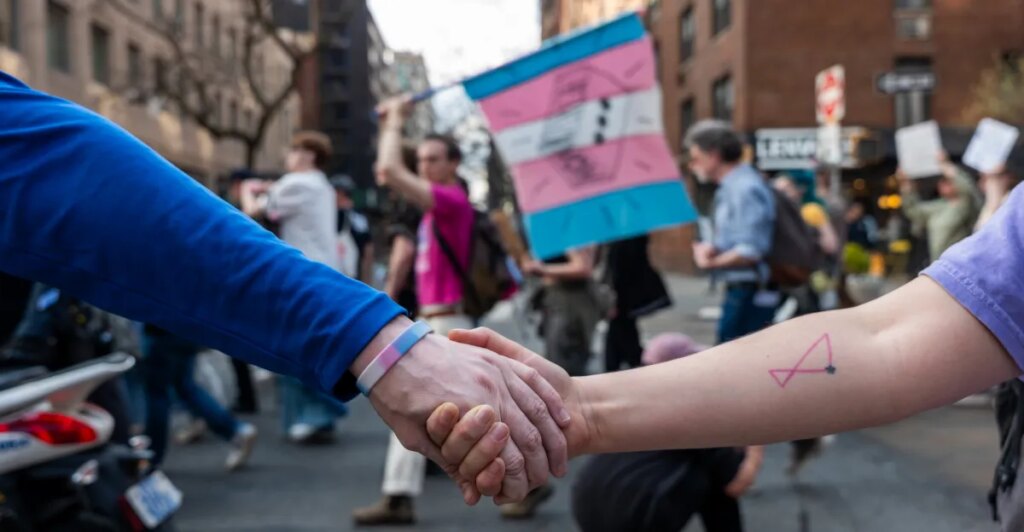
For much of the past eight years, the political fight over transgender rights in America has centered on two questions: whether trans women and girls should play on sports teams matching their gender identity, and whether minors should have access to gender-related medical treatment.
Those debates aren’t over, but the policy and legal fights are expanding fast — and the leaders who should be responding to the new fights still haven’t figured out how to talk about the old ones.
In the past two months alone, Kansas became the first state to retroactively invalidate the driver’s licenses of transgender residents, affecting some 1,700 people. Idaho advanced bills expanding the state’s bathroom bans beyond schools to government buildings and private businesses, introducing criminal penalties for the first time and allowing citizens to sue businesses that permit trans people to use restrooms matching their gender identity. Utah began weighing whether to remove trans people from the state’s anti-discrimination protections, and Oklahoma is considering extending its ban on gender-related medical care to include adults.
The Supreme Court has also been moving aggressively. Earlier this month, the Court effectively ordered California public school to inform parents when their children are transitioning at school, even if the students want to keep their gender identity private. (My colleague Ian Milhiser called this “one of the most consequential constitutional decisions the Roberts Court has ever handed down.”)
How states are restricting trans rights — even for adults
- Iowa removed protections for gender identity from state civil rights law in 2025.
- Kansas passed a law in 2026 including, among other provisions, that driver’s licenses and birth certificates for transgender people be reissued to match their biological sex at birth
- West Virginia passed legislation in 2025 defining “male” and “female” under state law, requiring people to use facilities at state-owned buildings that match their biological sex
- Wyoming passed similar restrictions in 2025 governing public buildings, as did Arkansas and Texas
- At least nine states have proposed measures dealing with trans issues on the ballot in this fall’s elections, most dealing with school sports or youth gender medicine
The justices also upheld Tennessee’s ban on youth gender medicine and are preparing to rule on bans on trans athletes this summer. Court watchers widely expect the sports restrictions to be upheld. At the federal level, the Trump administration restricted transgender people from updating the sex on their passports in early 2025, and the Supreme Court allowed enforcement of that policy late last year.
Meanwhile, the sports fight is headed to the ballot box. Voters in Washington state will decide this November whether to ban transgender girls from girls’ school sports, while similar measures are moving through the ballot qualification process in Maine, Colorado and Nevada.
The fight over transgender rights in America has entered a new and more dangerous phase. Roughly one percent of Americans identify as transgender — and their rights to identify themselves, access medical care, and move through public life are being narrowed and, in some cases, eliminated. The legal tools being used to do this could eventually affect far more people, reshaping how the government draws lines based on sex for everyone. And the leaders who should be responding can’t agree on what to do about it, in part because they don’t agree on how we got here.
Two theories of the case
Ask Democrats how the fight over trans rights got to this point and you’ll get two very different answers, though they start from the same place. Transgender Americans made significant gains through the 2010s, with growing public visibility, expanding legal protections, and a cultural shift toward acceptance so broad that Joe Biden called transgender rights “the civil rights issue of our time” as early as 2012.
But a contingent of right-wing social conservatives were searching for a new galvanizing cause after badly losing the fight against same-sex marriage, and trans rights became the target. Organizations like the Alliance Defending Freedom, a conservative Christian legal organization, provided legal counsel to state lawmakers, and conservatives discovered that bans on trans girls in school sports—framed around “parents’ rights”—were a uniquely effective wedge. From there, the playbook expanded to youth medicine and beyond.
The debate now is whether Democrats’ response, or lack of one from roughly 2021 onwards, made it easier for those activists to succeed. This isn’t just a fight among political insiders. How Democrats choose to engage with what’s happening in state legislatures and at the Supreme Court could shape the legal and political landscape for transgender Americans for a generation.
In practice, Democrats have mostly tried to avoid the subject over the last five years. The party has broadly supported anti-discrimination protections for transgender people and opposed the most aggressive Republican legislation, but on the specific questions that dominated the political debate, most Democrats declined to stake out clear positions. The Biden administration proposed a Title IX rule in 2023 that would have rejected blanket bans but allowed schools to restrict trans athletes’ participation in some cases — a genuine middle-ground stance — but the president never spoke about the rule publicly. The Harris campaign didn’t raise transgender rights either, even as Republicans made them a centerpiece of their attacks against her.
Today one side — mostly moderate Democrats and those who believe the party needs to meet voters where they are on culturally contested issues — says the Democrats’ refusal over the last half-decade to take a clear stand on trans athletes and youth gender medicine has made it far easier for conservatives to paint the party as extreme and push through the kinds of restrictions aimed at excluding trans people more broadly from public life. These critics blame progressives, party strategists, and advocacy groups for creating an environment hostile to compromise.
In their view, Democrats could have said, for instance, that trans girls shouldn’t compete against other girls in highly competitive sports where physical advantages matter, like high school track. But often fearing backlash, leaders deflected or disputed evidence of meaningful athletic advantages.
“The standard political communications wisdom is, ‘Explaining is losing, so just say as little as possible and pivot to a better topic,’” said John Neffinger, a Democratic strategist who’s advising candidates ahead of the 2026 midterms. “In 2024, Republicans recognized Democrats’ strategy — ‘Oh, they won’t give a straight answer here no matter what’ — so they spent $200 million calling those questions over and over so everyone could see us squirm.”
Lanae Erickson, senior vice president for social policy at Third Way, a centrist think tank, put it more bluntly. “The silence killed us,” she told me. “It created this political narrative that trans issues were poisonous for Democrats, that we were out of step with public opinion — and that eroded a lot of support among moderate Democrats.”
The result, she said, is that Republicans are now so unified on trans issues that even a proposal to jail parents for ten years for allowing their children to receive gender-affirming care barely draws dissent within the party — something she said would have been unthinkable a few years ago.
The other camp, with more progressive Democrats and civil rights organizations, sees the situation very differently. For them, the problem isn’t that Democrats failed to stake out a middle ground on youth gender medicine or trans women swimming at the college level — it’s that there is no middle ground to hold. Every political concession, every media story scrutinizing contested science or public opinion, simply becomes grounds for the next escalation. And treating these as attacks on trans people specifically, rather than as part of a broader assault on individual autonomy that includes reproductive and LGBTQ freedom, is missing the forest for the trees.
Gillian Branstetter, a communications strategist at the American Civil Liberties Union, argues that the issues many Democrats want to treat as separate — sports, youth medicine, bathrooms, identity documents — are legally and politically interconnected, and the idea that you could sacrifice rights in one area to protect them in another reflects a fundamental misunderstanding of discrimination law and what’s at stake.
Organizations like the Alliance Defending Freedom, she added, have been working backward from a broader goal of weakening the legal standard for sex discrimination — making it easier to treat men and women differently— and trans cases should be understood as one form of leverage to get there.
Branstetter, who is transgender, put it in personal terms. “I have watched these attacks on trans people grow more and more extreme year after year,” she said. “The moment you’re adopting your opposition’s framing, you’re already conceding defeat. Instead of showing me what you’ll give up, tell me what you’ll defend.”
Why the political fight is the legal fight
This all might seem like an inside-the-Beltway debate with little to say about the realities of being transgender in America today. But the Democratic messaging dispute is connected to real-world policy changes affecting trans people’s lives.
The legal trajectory of trans rights is not predetermined. Despite the Supreme Court’s recent rulings, legal scholars I spoke with stressed the Court always has choices about how far to interpret past decisions. Jessica Clarke, a law professor at USC who has filed amicus briefs in both the youth medicine and athlete ban cases, warned that a seemingly moderate ruling on sports could still do “significant damage” to equal protection law far beyond transgender rights.
But other approaches, she told me, could allow the Court to treat sports as a “one-off” — a narrow ruling without implications for identity documents, employment, healthcare, or public accommodations.
There is early evidence that containment is possible. Clarke noted that many lower courts have interpreted last year’s Skrmetti decision, which upheld Tennessee’s youth medicine ban, narrowly, applying it only to state-level bans on gender-affirming care for minors and not extending it to other areas of law affecting trans people. The dominoes, in other words, have not fallen.
And whether they fall may depend less on legal doctrine than on politics. The Court does not operate in a vacuum. When state legislatures pass increasingly restrictive laws and face little political backlash, it signals to the judiciary that there is public appetite for going further. If midterm ballot initiatives restricting trans rights pass in blue states, it could lend conservative activists more bipartisan legitimacy. And when one political party refuses to articulate a clear position, the silence can look like agreement.
Public opinion has shifted, too. Over 60 percent of voters now support requiring trans athletes to compete by “biological sex,” 52 percent support bathroom restrictions, and even Democrats are evenly split on sports, a major reversal from just a few years ago.
This is the environment Branstetter is warning about. If these issues can’t be siloed, then concessions in one area won’t hold the line in others. Although legal scholars I spoke with say discrimination law has more flexibility than her framing suggests, Branstetter’s political logic is harder to dismiss.
Erickson, of Third Way, warns about the opposite problem. If Democrats had spent the last eight years articulating a clearer position on sports and youth medicine, the political environment around these court cases could look quite different — and state legislatures might think twice about how far they could push.
There is precedent for the Court pulling its punches when the political environment seems inhospitable. The justices have had multiple opportunities to restrict mifepristone since Roe’s overturn and have declined each time, in part because the politics of abortion access have shifted sharply in favor of access. No equivalent political cost has materialized on trans rights, and the fight has already moved into territory neither camp has a strategy for.
What comes next
There are signs the Democratic Party is beginning to change its tune.
In Virginia’s 2025 gubernatorial race, Abigail Spanberger faced relentless attacks on trans issues — by one estimate, her opponent spent 57 percent of their advertising budget on anti-transgender ads. Rather than dodge, though, Spanberger’s campaign spent $6 million responding to them, running segments that leaned on her credibility as a mom with daughters in Virginia public schools, acknowledged concerns about safety, and positioned her as someone who stands for all Virginians. It wasn’t a detailed policy rebuttal so much as a refusal to let the attacks define her.
She won by a large margin, and her more proactive approach is now being held up as a model by campaign consultants and even major LGBTQ rights organizations like the Human Rights Campaign, which released a messaging playbook for 2026 candidates based in part on Spanberger’s example. “The fatal flaw that we made was that many candidates didn’t respond” to attacks, HRC’s president, Kelley Robinson, told The Washington Post.
Meanwhile, potential 2028 presidential contenders like Gavin Newsom and Pete Buttigieg are staking out positions on trans athletes they would have steered clear of two years ago, and Democratic strategists say candidates are increasingly being told they need to engage rather than change the subject.
But in many ways, this is all responding to earlier battles, while the legal, political, and even scientific ground continues to shift.
The Trump administration’s day-one executive order directed federal agencies to recognize only two sexes and bar gender self-identification on federal documents, a sweeping federal policy that set the tone for what followed in state legislatures. The American Society of Plastic Surgeons advised last month against gender-related surgeries for minors, and the American Medical Association agreed days later that such procedures should generally be deferred to adulthood — moves that followed a $2 million jury verdict in the first successful malpractice case involving a gender transition.
The ballot initiatives this fall may force a larger reckoning that Democratic hesitancy has so far delayed. Erickson compared the referendums to Proposition 8, the 2008 California ballot measure that banned same-sex marriage, which passed the same night Barack Obama won the presidency. The result shocked the political establishment, which had assumed public opinion was more progressive on gay rights than it turned out to be.
Meanwhile, social conservatives are full speed ahead. When I asked whether the goal of the current wave of legislation is to establish in law that transgender identity does not exist, Matt Sharp of the Alliance Defending Freedom declined to answer. He also declined to address questions we posed about the Kansas license revocations and the expansion of restrictions to adult trans people. He responded only with a statement that American laws should “reflect the biological truth that every person is created female or male.”
Both camps agree Democrats got it wrong, but they can’t agree on what to say instead. Republicans and the courts, though, aren’t waiting for them to figure it out.
The post The fight over transgender rights in America has entered a new phase appeared first on Vox.