It took only a few days of Iranian attacks before the Persian Gulf states, which have long relied on American security guarantees, decided they needed more help.
Despite the presence of major U.S. bases, or because of them, Iran fired a barrage of missiles and drones at the Gulf. And the costly American-made interceptors these nations relied on were in short supply globally.
So Saudi Arabia reached out to Ukraine, a nation with experience fending off Russian drones modeled on Iranian ones. The United Arab Emirates got help from France and Australia. And several Gulf governments asked Italy to provide anti-drone and antiaircraft systems.
The Gulf’s authoritarian leaders, close American allies, have long questioned the value of their American security guarantees. Now, they are in the cross hairs of a regional war that their ally, the United States, started. And complaints about the limited value of American protection are growing louder.
“The Gulf countries are expressing very strong concerns about the evolution of the crisis and have expressed the need to urgently strengthen their defense capabilities,” Italy’s defense minister, Guido Crosetto, told lawmakers in his country last week.
The foreign minister of Oman, Badr al-Busaidi, told local journalists last week that it was time for the Gulf countries to reconsider their defense strategies, pointing to a growing debate in the region, Oman Daily newspaper reported.
All of the Gulf countries have security partnerships with the United States. Saudi Arabia, Qatar, Kuwait and Bahrain are designated as “major non-NATO allies,” while the Emirates is designated as a “major defense partner.” Bahrain and Qatar have also received additional defense pledges from the United States.
A White House spokeswoman, Anna Kelly, defended the war as necessary to ensure the safety of U.S. allies in the Gulf, among other reasons. The frequency of Iranian drone and ballistic missile attacks had decreased by more than 90 percent since the war began, evidence that the war was “crushing their ability to shoot these weapons or produce more,” she said.
“President Trump is in close contact with our partners in the Middle East, and the terrorist Iranian regime’s attacks on its neighbors prove how imperative it was that President Trump eliminate this threat to our country and our allies,” she added.
President Trump has described the campaign as an effort to unseat the Iranian regime. While that goal may theoretically be attractive to some of the Gulf countries that view Iran as a persistent threat — chief among them Saudi Arabia — they nonetheless lobbied President Trump ahead of Feb. 28 to choose diplomacy over war.
They worried that successful regime change was not feasible and that a failed state in Iran would become a disaster for them. They also feared that Iran’s retaliation would rain down on them, endangering their reputations as safe havens and chasing away investors.
Indeed, since the U.S.-Israeli bombing campaign began on Feb. 28, more than 1,300 civilians have been killed in Iran, according to the country’s U.N. representative. Iran has retaliated by firing more than 3,000 missiles and drones at the six Gulf states.
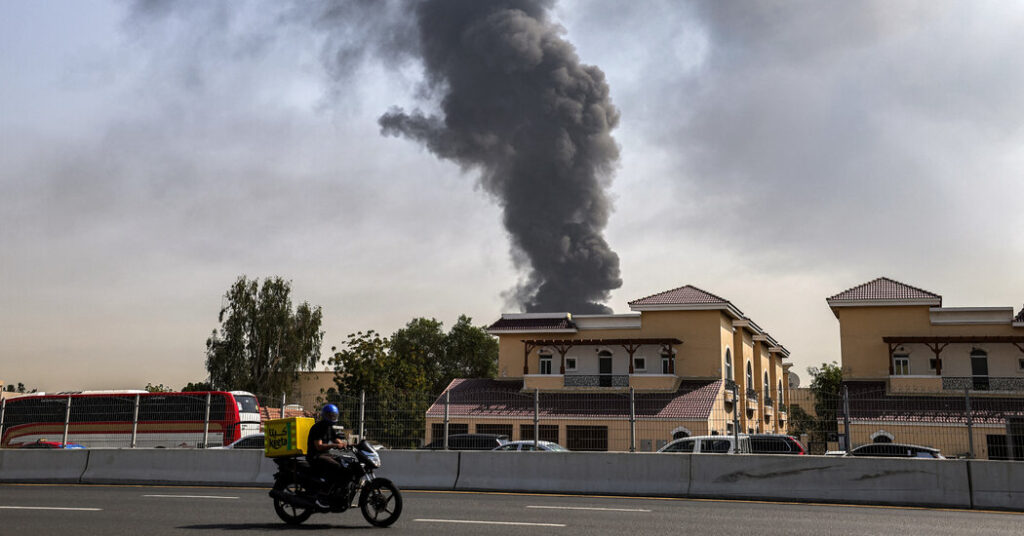
Iranian officials say that they are targeting American military installations and other American interests. The attacks have also caused widespread damage to civilian infrastructure in the Gulf, including airports, hotels and a water desalination plant. They have also killed at least 14 civilians around the Gulf, mostly migrant workers.
“It’s becoming more and more clear that what is guaranteed is that there are no guarantees,” said Abdulaziz Alghashian, a Saudi scholar and senior nonresident fellow at the Gulf International Forum, a research organization.
The economic cost of the conflict has been enormous.
Qatar and the Emirates, major aviation hubs, have been forced to suspend or severely reduce flights. Tourists have fled over land borders.
Gulf energy industries — the main source of government revenue — have taken a huge blow as Iran targets the region’s refineries and oil fields. Qatar, one of the world’s largest producers of liquefied natural gas, halted production indefinitely after its energy facilities were damaged.
The attacks have effectively choked off the Strait of Hormuz, a vital waterway through which ships carrying their oil and natural gas must pass to reach customers.
For officials in the United Arab Emirates, the fact that Iran is still able to use the strait to ship its oil while Arab Gulf countries are unable to use it safely because of Iranian attacks is a huge concern, said Nadim Koteich, an Emirati-Lebanese commentator who is close to the government.
Dissidents from the Gulf countries have long condemned the way their region’s royal families have entwined their interests with the United States.
“American bases in Saudi Arabia must be closed,” Maryam Aldossari, the spokeswoman for a Saudi opposition party in exile, wrote on social media this week. “They exist only to protect Israel while putting our civilian lives at risk.”
But since the war began, pro-government businessmen and even some officials inside the Gulf countries have also begun to raise questions about the value of their ties to the United States.
“President Donald Trump, a direct question: Who gave you the authority to drag our region into a war with Iran?” Khalaf al-Habtoor, an Emirati billionaire, wrote on social media earlier this month. “Did you consider the collateral damage before pulling the trigger? Did you not think that the countries of the region would be the first to suffer from this escalation?”
The Gulf governments do not move in lock-step, pursuing different policies toward Iran and Israel — and in some cases, they have significant tensions with one another.
Some appear to have a higher tolerance than others for a prolonged war. And some say they are happy with the American support they have received.
In the Emirates, the war has not led officials to reconsider their relationship with the United States, Reem al-Hashimy, a minister of state, said in an interview with ABC News, the Australian broadcaster.
“Quite the contrary,” she said. “Our relationship with the U.S. is a longstanding strategic partnership. It’s a partnership that doesn’t falter in moments of crisis.”
But in the days after the war began, the Gulf countries quickly began to face the reality of dwindling stockpiles of the interceptors to thwart missile and drone attacks.
Qatar asked if the United States could send more, according to two people briefed on the request. The Qatari government did not respond to a request for comment.
U.S. Central Command, which is in charge of operations in the Middle East, did not respond to questions about the interceptor request, nor did Ms. Kelly.
Defense Secretary Pete Hegseth has insisted that Iran cannot outlast the U.S. ability to fend off the barrage of Iranian strikes fired at American allies.
But while the White House has plans to increase the production of interceptors, they are a “finite resource,” said Elizabeth Dent, a former defense official and a senior fellow at the Washington Institute for Near East Policy, a research organization.
Many countries around the world have been approved to receive them, but are facing a production backlog — particularly after the war in Ukraine created an urgent need, she said.
In the midst of this quandary, the Gulf governments have sought to project strength.
The Emirati foreign ministry said it maintains “a robust strategic stockpile of munitions, ensuring sustained interception and response capabilities over extended periods,” adding that the Emirates was “fully prepared to address any threats.”
Speaking to Emirati state television after meeting injured people at a hospital, Emirati President Sheikh Mohammed bin Zayed delivered a message to his country’s “enemies.”
“The Emirates has thick skin and bitter flesh,” he said. “We are no easy prey.”
Ismaeel Naar, Michael D. Shear, Elisabetta Povoledo, Ana Castelain, Rania Khaled, Jeanna Smialek, Lara Jakes, Kim Barker Eric Schmitt, Edward Wong Aaron Boxerman and Choe Sang-Hun contributed reporting.
Vivian Nereim is the lead reporter for The Times covering the countries of the Arabian Peninsula. She is based in Riyadh, Saudi Arabia.
The post Sucked Into War, Gulf Countries Face the Limits of U.S. Security Guarantees appeared first on New York Times.