Why was it sunny and warm one morning in New York, only to be snowing by the afternoon? Why did the Great Lakes face tornadoes one day and blizzard conditions not long after? Why can’t the temperature make up its mind?
The answer is simple: It’s March.
The month has long been notorious in meteorology circles as the volatile transition from winter to spring, bringing rapid shifts in temperature. You’ve probably heard the proverb: It’s the month that comes in like a lion and goes out like a lamb.
But even by March standards, this one has been especially harsh, and no corner of the country seems to have been spared the chaotic weather.
In Michigan a tornado that killed three people two weeks ago was rated a 3 on the 5-point Enhanced Fujita scale, the earliest in the calendar year a tornado of that intensity has struck the state.
Up and down the East Coast, daily record highs were shattered as temperatures soared. Then the script flipped, and some places, like Richmond., Va., set another record, this time for the fastest temperature drop in a day.
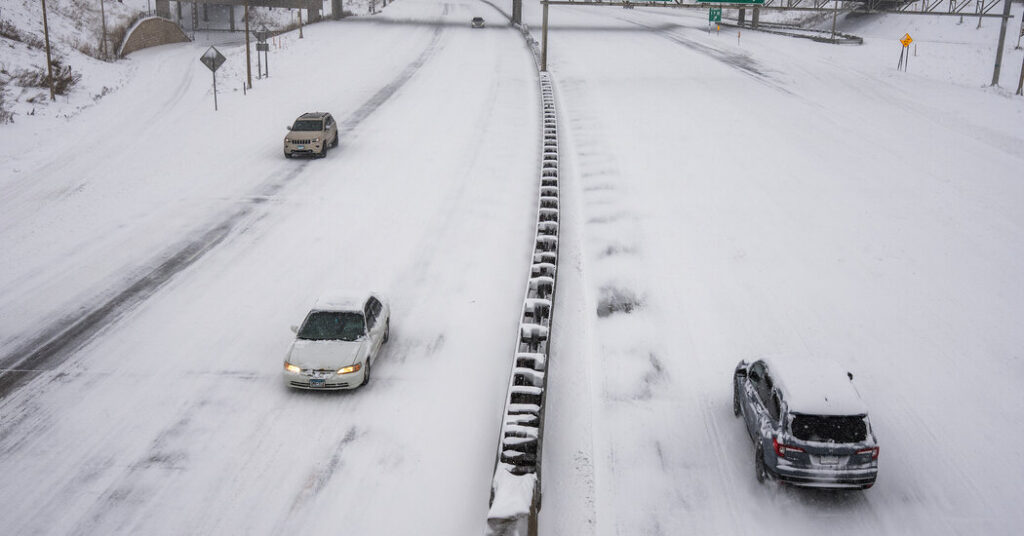
The two feet of snow that a blizzard dropped across the Upper Midwest last weekend made that storm one of the top 25 on record there, and the same system that caused it sent damaging winds and tornadoes farther south. In Colorado, powerful winds forced highways to close, while in Nebraska they fanned one of the largest wildfires in state history. On the West Coast, a rare snowstorm hit Seattle, and Los Angeles set records for March heat.
The most dangerous threat from storms appears set to ease for the rest of this week, but a new pattern is settling in. East of the Rocky Mountains, cold Arctic air will plunge as far south as the Gulf Coast, while the desert Southwest and California coast will bake in summerlike heat.
So, is this just typical March madness, or is something different happening?
The Science of the ‘Waviness’
“March is known to produce plenty of wild weather — sometimes lion-like, sometimes lamb-like, often a bit of both,” said Jennifer Francis a senior scientist at the Woodwell Climate Research Center in Massachusetts. “But this jet stream pattern is a wacky one.”
Picture the jet stream as a divider, “a boundary between colder air to the north and warmer air to the south,” said Trent Ford, the state climatologist for Illinois.
This contrast in temperatures creates a “waviness” in where the jet stream sits, which dictates day-to-day changes. When that wave gets stuck or grows more extreme, wild swings will dominate the weather, as they have this month.
“In that way, the recent weather extremes — severe weather in the Midwest, high snowfall in the Great Lakes, record-breaking temperatures in the East, and fires in the Plains — are not unheard-of this time of the year,” Mr. Ford said.
But there is always a “but” when scientists discuss weather extremes.
The pressure patterns right now — the “H” for high pressure and “L” for low pressure seen on weather maps — have been unusually strong even for March, leading to more dramatic shifts.
“For example, here in central Illinois, we went from tornado warnings on Sunday night to waking up to an inch or more of snow on Monday morning,” Mr. Ford said.
Is climate change also playing a role in the weird weather?
While tying a single weather event to climate change requires analysis, scientists say that the warming atmosphere increases the likelihood and intensity of both heat waves and persistent droughts. A warmer atmosphere also holds more water, which leads to stronger and more powerful rainstorms and flooding events.
“Anything that is considered extreme weather is some combination of the overall climate changes and the fluctuations in weather we have anyway,” said Mark A. Cane, a senior research scientist at the Lamont-Doherty Earth Observatory at Columbia University. “When the two line up, you get an extreme.”
Dr. Cane said that climate change had not increased the frequency of extreme weather events but that it had made them more intense. “The mean has shifted,” he said.
Michael Rawlins, professor of climatology at the University of Massachusetts at Amherst, said that while this winter had been cold in the eastern United States, the number of record high temperatures across the country was far outpacing the number of record lows, and that the onset of warm weather would be coming earlier.
Phoenix is expected to top 100 degrees this week, breaking a record for the earliest date to reach that milestone there. San Francisco, which rarely sees 80 degrees in the height of summer, is forecast to top that temperature every day until Friday.
Cassie Greer, a weather and climate expert for Ramboll, a Danish environmental consulting firm, wasn’t able to drive from Kansas City, Mo., to Chicago to visit family. A severe blizzard closed Interstate 80 in Iowa, stranding motorists throughout the Midwest.
“March is always turbulent, and it is when we’re starting to see the jet stream become more active,” Ms. Greer said. “But there are some dynamics out there that are making this one a little bit more unique.”
Ms. Greer said a warming atmosphere was affecting outbreaks of polar air that led to the blizzard across the Midwest this week.
“When you have that volatility in the jet stream” Ms. Greer said, “you’re going to be creating more of those colder pushes later in the season.”
Judson Jones is a meteorologist and reporter for The Times who forecasts and covers extreme weather.
The post March Has Always Been a Month of Weather Extremes. But This Is Ridiculous. appeared first on New York Times.