President Trump went to war against Iran without explaining his strategy to the American people or the world. It now appears that he may not have had much of a strategy at all.
Almost three weeks into the war, Mr. Trump has no apparent plan for bringing about the demise of the Iranian regime, something he had said he seeks. If his goal is more modest, such as the seizure of Iran’s nuclear materials, he has not offered credible ideas for accomplishing it. And he has failed to plan for a predictable side effect of a war in the Middle East: a disruption of oil supplies that causes a price spike and impairs the global economy.
The war has become an exemplar of Mr. Trump’s chaotic, ego-driven approach to the presidency. He has relied for advice on a smaller circle of aides than past presidents did when ordering military action and eschewed the careful process intended to surface objections and potential problems. He has made ridiculous and contradictory public statements, including a claim that the war has nearly achieved its goals. He has tried to mislead the world about the tragic deaths of dozens of Iranian schoolchildren, which were caused by a mistargeted American missile. Almost daily, he demonstrates why he cannot be trusted with the most consequential matters of government.
Despite all this, the war has had some tactical successes, and we believe it is important to acknowledge them even if they remain untethered to a strategy. Mr. Trump’s instincts about Iran were correct in a few ways. Its government is distinctly dangerous, having spent decades oppressing its own people, sponsoring terrorism, trying to destroy Israel, turning Lebanon into a failed state, protecting a horrific regime in Syria and pursuing a nuclear program. Mr. Trump also recognized that Iran’s regime was weaker than it pretended and could be weakened further through confrontation.
Over the past few years, a combination of economic sanctions imposed by the United States and allies and military attacks, mostly by Israel, has left Iran less capable of sowing regional problems. The value of its currency has plunged. Many of Iran’s leaders and nuclear scientists are dead. Its aerial defenses are mostly destroyed, and its missile stockpile is depleted. Two of its terrorist proxies, Hamas and Hezbollah, are degraded. Its client state in Syria has been overthrown by local rebels.
But in launching this war two and a half weeks ago, Mr. Trump asserted larger aims than containing Iran. “To the great, proud people of Iran, I say tonight that the hour of your freedom is at hand,” Mr. Trump said shortly after the first strikes. He has called for the unconditional surrender of Iran’s government and said that he must approve the country’s next leader. He has promised to make Iran great again.
Mr. Trump has not even begun to explain how he will accomplish any of these goals. His defenders have claimed that his coyness is a strategic gambit, to preserve his options and keep his enemy guessing. Increasingly, the truth appears to be that the president of the United States has started a war without any idea of how to end it.
Three strategic problems have become clear since the war began.
First, Mr. Trump repeated a mistake that American presidents have made for decades — in Afghanistan, Iraq, Vietnam and even Iran itself, in the 1950s — and imagined that regime change would be easier to accomplish and maintain than it was. In this instance, Mr. Trump’s hubris has been stunning. Air power alone almost never topples a government. Only troops on the ground can seize the instruments of state power and install a new leader.
In defiance of this history, Mr. Trump and Prime Minister Benjamin Netanyahu of Israel have conjured dreams of regime change. Sometimes there is loose talk of arming Iran’s Kurdish minority or hastening the return of Reza Pahlavi, the son of the late deposed shah, who now lives in an affluent suburb of Washington. Other times, Mr. Trump encourages Iran’s security forces to defect or its people to “take over” their government. There is no evidence that any of this is working. After Mr. Trump encouraged street protests in January, Iran’s regime massacred thousands of demonstrators and remained securely in charge of the country. Since then, protests have largely ended.
Second, it remains unclear how the United States will achieve a crucial goal: assuring that Iran’s murderous regime does not become a nuclear power. Its stockpile of highly enriched uranium is believed to be intact, in a tunnel complex under mountains near the city of Isfahan. If the war ends with Iran maintaining that stockpile, it will have a path to building a bomb. The military humiliations it has endured over the past few years give it an incentive to take the final steps toward a weapon that it has not previously taken.
When this war began, Secretary of State Marco Rubio acknowledged that ground troops might be the only way to capture the uranium. “People are going to have to go and get it,” he said. Yet when a Fox News Radio host asked Mr. Trump about uranium last week, he replied, “We’re not focused on that.” There are no easy answers here. But the scattered approach to war planning does not inspire confidence.
The third problem involves the global economy. Middle Eastern wars are notorious for causing economic turmoil by raising the price of oil. Iran had a clear way to repeat the pattern by throttling the traffic of ships in the Strait of Hormuz. Yet Mr. Trump tried to wish away this situation.
Before the war, his top military adviser, Gen. Dan Caine, warned him that Iran would likely respond by attacking ships in the strait and effectively closing it. Mr. Trump replied by suggesting that Iran’s government would capitulate before it could close the strait or that the U.S. military could keep the strait open, according to The Wall Street Journal. He was wrong, as should have been obvious. The price of oil has since jumped more than 40 percent.
His responses have had an air of desperation. He temporarily lifted oil sanctions on Russia, which is a gift to an enemy. Over the weekend, he resorted to pleading with Britain, France, Japan, South Korea — allies he has spent years disdaining — and even China to send naval forces to protect the strait.
War is uncertain, and it remains possible that any of these problems will begin to look less serious in the coming weeks. Perhaps an Iranian opposition will somehow emerge, and the current regime will fold as quickly as the Assad government in Syria did in late 2024. Perhaps special forces will remove the enriched uranium without casualties. Perhaps the U.S. military, whose performance continues to be mostly impressive, will work with allies to reopen the Strait of Hormuz. Indeed, we would welcome any of these outcomes.
The first weeks of this war do not inspire confidence, however. They instead suggest that the behind-the-scenes planning in the White House may have been as reckless as its public behavior. It did not seek congressional approval for the war, as the Constitution requires. It did not plan ahead with allies in Europe or East Asia. It offered the American people only superficial rationales for the war.
Throughout his business and political career, Mr. Trump has often sought to create his own reality. When the truth is inconvenient, he ignores it and tells self-serving falsehoods. It has often worked out for him. But war tends to be less amenable to spin than politics or marketing. The early reality of the Iran war is not cooperating with Mr. Trump’s bluster.
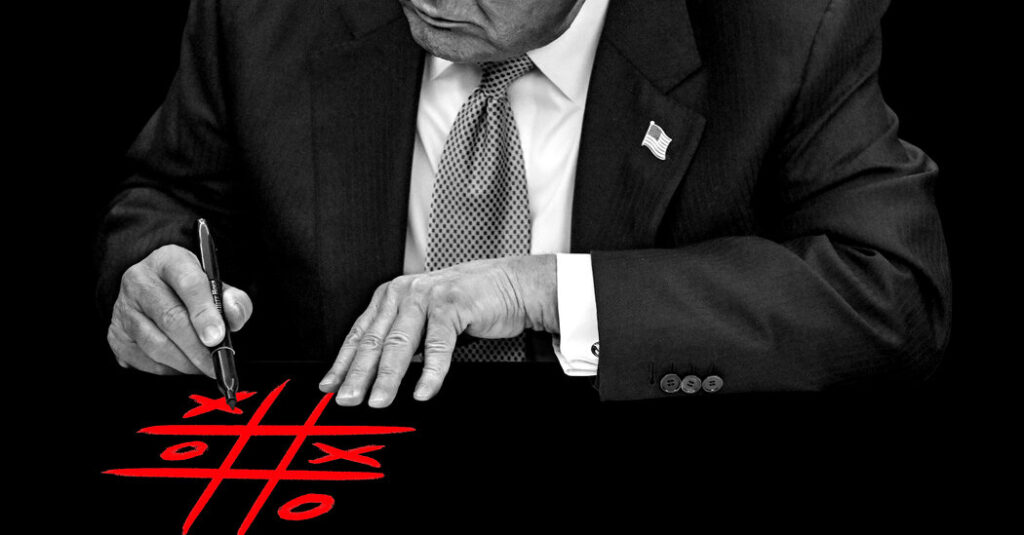
Source photograph by Kenny Holston/The New York Times.
The Times is committed to publishing a diversity of letters to the editor. We’d like to hear what you think about this or any of our articles. Here are some tips. And here’s our email: [email protected].
Follow the New York Times Opinion section on Facebook, Instagram, TikTok, Bluesky, WhatsApp and Threads.
The post Trump’s Dangerous Lack of a Strategy in Iran appeared first on New York Times.