To help control spiking oil prices during the war in the Middle East, the United States is turning to an unlikely source for help: a network of tankers with ties to the Iranian military.
On Thursday, as part of a temporary easing of sanctions placed on Russia after its invasion of Ukraine, the Treasury Department included a little-noticed provision that allowed ships and companies connected to Iran’s regime to transport and sell Russian oil on the open market. The Iranian-linked vessels are subject to their own U.S. sanctions, and have been operating as part of a so-called ghost fleet, illicitly transporting goods and energy for Russia, Venezuela and others.
The United States now needs this network to bring down the price of oil. Recent efforts by the United States and other nations, including to release strategic reserves to help bolster oil supplies, have done little to ease markets.
Because the price of oil has shot up nearly 40 percent since the U.S.-Israeli attacks against Iran began, the provision was designed to help feed the global market with much-needed supply. Persian Gulf nations produce a large share of the world’s oil, and the war has effectively halted its transport. The result is that the temporary exemption from sanctions — which aim to cut off people, businesses and other entities from the global financial system — now applies to the very people the United States is fighting.
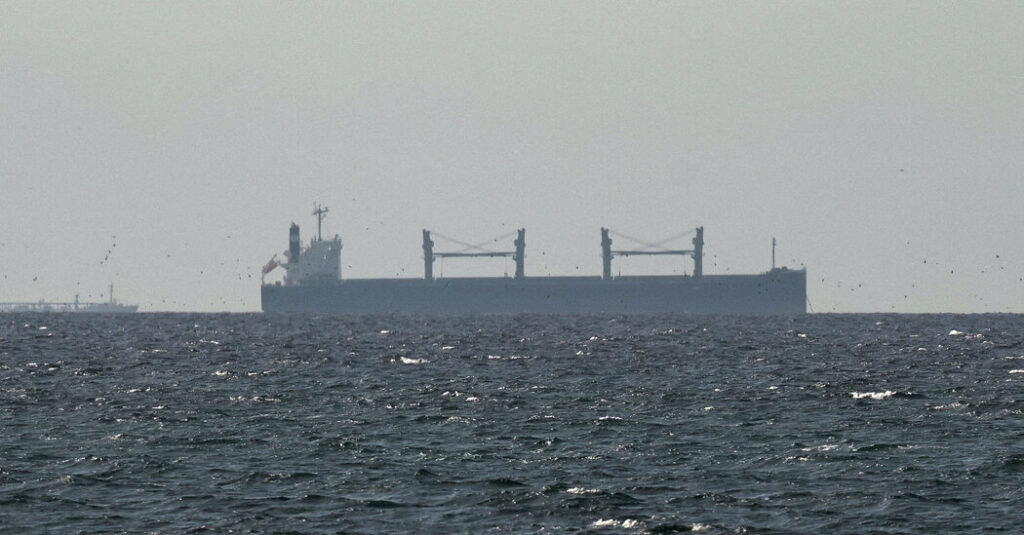
Among the exempt ships is the Myra, according to a New York Times analysis of shipping activity from Kpler, an industry data firm. The Trump administration imposed sanctions on the tanker in July for its role in what the Treasury Department described as a “vast shipping empire” that sold oil illicitly for Iran and Russia. Less than two weeks ago, the Justice Department sued to seize funds tied to the head of the shipping network, Mohammad Hossein Shamkhani, a son of a top political adviser to Iran’s supreme leader who was killed on Feb. 28.
The flip-flop on restricted ships, even a temporary one, illustrates the lengths to which the White House is going to contain the economic fallout from a war that seems to have little end in sight.
“Anything that destigmatizes this fleet is a big win for Russia and Iran,” said Robin Brooks, a senior fellow in the global economy and development program at the Brookings Institution. The temporary exemption inevitably benefits the broader system of ships and intermediaries that move restricted crude around the world, he said.
A Treasury Department spokesman referred The Times to a social media post by Treasury Secretary Scott Bessent, who said the United States was temporarily lifting sanctions on Russian oil already at sea to “promote stability in global energy markets.”
The United States and its Western allies have long turned to sanctions in an effort to punish Russia and Iran economically. Russia and Iran in particular depend on oil exports to keep their governments funded. An analysis of sanctions data found that the United States had blocked nearly 1,000 vessels under sanctions programs connected to Russia and Iran.
The Shamkhani network has been a recent focus of U.S. restrictions. In July, Treasury officials designated more than 50 individuals and entities, and identified more than 50 vessels connected to the network, calling it the largest sanctions action against Iran since 2018, when the United States withdrew from the Iran nuclear deal. Mr. Bessent said the Shamkhani family’s shipping empire showed how powerful Iranian actors “accrue massive wealth and fund the regime’s dangerous behavior.”
On March 6, the Justice Department filed two civil forfeiture complaints seeking to seize more than $15 million in funds it said were used to operate the network. The complaint argued that the Shamkhani family intended to use the money to keep violating sanctions and that the money gave it influence over the Islamic Revolutionary Guards Corps, a designated terrorist organization. Attorney General Pam Bondi said Mr. Shamkhani would “pay a heavy price.”
Whether ships like the Myra still have ties to the Iranian regime is impossible to say with certainty, but experts said the vessel most likely remains part of the same network, even after the July designations.
Representatives from Iran’s Ministry of Foreign Affairs did not respond to a request for comment.
To qualify for the sanctions waiver, a ship had to have been carrying Russian oil as of Thursday, when the temporary easing of restrictions was announced. Ships can turn huge profits by buying Russian oil at a discount and reselling to countries like China. Britain and the European Union did not join the United States in easing restrictions, so ships with financial ties to those countries cannot be exempt.
The license does not lift sanctions indefinitely, but it created a 30-day hall pass that allows oil already on ships to be sold at any price.
Mr. Bessent has argued that the waiver will not significantly benefit the Russian government, saying in a social media post that Russia collects most of its energy revenue from taxes at the point of extraction and that the oil was already in transit. But the waiver covers not just ships but also the traders, brokers and insurers involved in each transaction, according to Thursday’s announcement. They all could profit from the newly exempted sale of Russian crude.
Even oil that has already been sold can generate new profits for the networks that move it. A buyer who locked in cargo at prewar prices can resell it at today’s rates with no legal risk, according to Michelle Wiese Bockmann, a maritime analyst at Windward, an industry analytics firm.
“It’s quite likely that those cargoes, while they’ve been on the water, will have doubled in value,” she said.
According to Windward and Vortexa, a cargo-tracking firm, the waiver covers over 370 tankers carrying as much as 215 million barrels of Russian oil now on the water or in floating storage. Nearly half of those tankers are under sanctions by the United States, Britain or the European Union. Because the oil had already been loaded on the tankers, much of it would have skyrocketed in value as oil prices continue to rise.
Mr. Bessent said in a television interview on Monday that the United States was allowing Iranian tankers to sail through the Strait of Hormuz in order to “supply the rest of the world” with oil. The boats transiting the strait would not necessarily carry Russian oil, but Mr. Bessent’s statement was an acknowledgment of how dire the oil situation is becoming.
Since the sanctions were eased, oil prices have remained high. They were over $100 a barrel on Monday, up from just over $72 before fighting began. The International Energy Agency has called the crisis unprecedented in the history of the global oil market, cutting off the flow of over 20 million barrels of oil a day.
For weeks, the Myra was anchored off the Russian port of Ust-Luga, loaded with over 220,000 barrels of crude, shipping data from Kpler shows. It is one of at least four vessels identified in shipping data by The Times as having been at sea with Russian oil before last Thursday. Together, the four are carrying roughly two million barrels of oil worth around $200 million that appear to fall under the waiver.
The post As War With Iran Hurts Oil Prices, U.S. Turns to Iranian Boats for Help appeared first on New York Times.