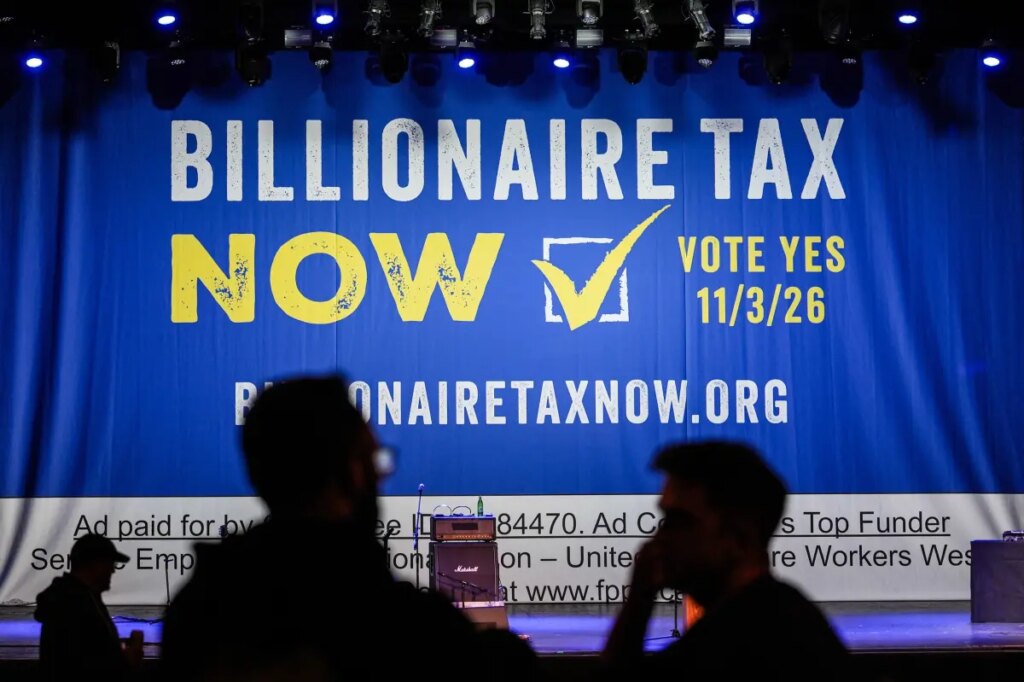
California’s proposed “billionaire tax” will collect less than half of what is promised — with a net fiscal effect that will leave the state in worse shape.
The state is attempting a crazy fiscal experiment: seeing how much revenue it can raise by aiming a large tax at a small group of people who are superbly well-equipped to move themselves — and their money — somewhere else.
The result isn’t likely to be positive — in the literal sense of the word — for the mad fiscal scientists pushing the idea.
The Billionaire Tax Act, an initiative that could appear on California’s November ballot, would impose a onetime 5% tax on the net worth, above $1 billion, of anyone who was a state resident as of Jan. 1, 2026.
The initiative’s proponents claim it would raise roughly $100 billion, but their figure doesn’t survive contact with actual billionaires.
In fact, according to research from our team at Stanford University’s Hoover Institution, the tax would collect less than half of what’s promised — and ultimately lose more money than it brings in.
A simple Google search unearths the first problem with that $100 billion estimate: It draws from a base of payers that includes people who don’t live in California.
Proponents relied on the Forbes Billionaire List to make their calculation, but they didn’t verify residencies.

Larry Ellison moved to Hawaii when Oracle’s headquarters relocated in 2020. Two others left well before the initiative was filed. Erroneously including just these three billionaires inflated the estimate by about $15 billion.
That’s only the beginning.
Six more billionaires left the state between the initiative’s filing in October and the Jan. 1 residency cutoff.
These exits included Google co-founders Larry Page and Sergey Brin; PayPal and Palantir co-founder Peter Thiel; and film director Steven Spielberg. Though just six individuals, this group represents nearly 30 percent of the state’s billionaire base — some $536 billion in aggregate net worth.
Once these adjustments are made and residential real estate, which would not be subject to the tax, is excluded, the revenue figure falls to $67.5 billion.
But the better guess is even lower than that.

Given the huge incentive to leave, additional departures have already happened quietly, without public notice. (Uber co-founder Travis Kalanick revealed this weekend that he is already gone.)
We can estimate how many have left quietly by drawing on the experience of European wealth taxes, which had the same effect in the past.
That drops the revenue projection to about $40 billion — less than half what voters are being told.
That’s still a lot of money, of course — until you factor in what California will lose in return.

When billionaires depart, all the income tax revenue they provide, year after year, departs with them.
Currently, the state’s more than 200 billionaires contribute an estimated $3.3 billion to $5.8 billion a year in personal income taxes, based on our analysis of data from the California Franchise Tax Board on the highest-income filers.
Over time, that more than offsets any one-time wealth tax collection under the act.
All told, across simulated combinations of plausible revenue outcomes, 71 percent of scenarios yield a negative net present value, with a mean of negative $24.7 billion.
In other words, in the most likely outcome, California would forfeit more in future income-tax revenue than it would collect from the wealth tax.
Adopting this tax would be akin to a bad financial transaction — a one-time payment today in exchange for a permanently diminished revenue stream tomorrow.
And there’s one more problem to consider.
The act has been presented as a one-time measure. It is not. Rather, it is a constitutional amendment that permanently removes California’s cap on taxes on intangible personal property.
Once that limit is gone, future ballot initiatives can impose additional taxes, at any rate and on any wealth threshold, without requiring another amendment.
Why would the founders of dynamic new companies who think their net worth could eventually exceed $1 billion stay in California knowing that could happen?
Voters deserve honest numbers before they head to the polls.
What remains is not a tax on billionaires but a tax on California’s future — and the returns are already negative.
Joshua Rauh is the George P. Shultz senior fellow in economics at the Hoover Institution and a finance professor at the Stanford Graduate School of Business. Benjamin Jaros is a research fellow at the Hoover Institution. Gregory Kearney is a research associate at the Hoover Institution.
The post The ‘billionaire tax’ is a fiscal flop appeared first on New York Post.