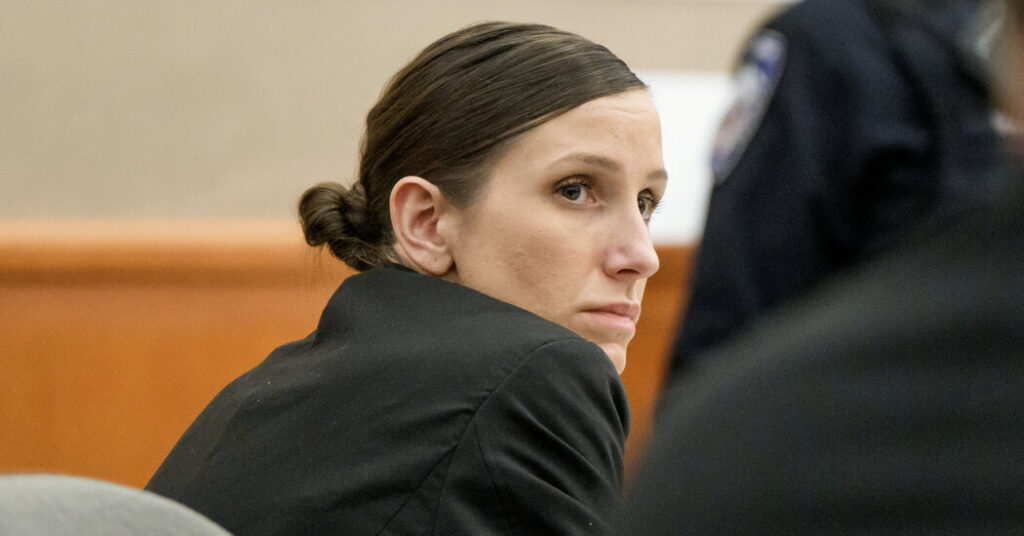
A Utah mother of three who wrote a children’s book about grief after her husband’s death was found guilty of his murder on Monday evening.
Kouri Richins, 35, was also found guilty of attempted murder, two counts of falsifying insurance claims and forgery in what prosecutors argued was a scheme for Ms. Richins to poison her husband, Eric Richins, 39, and inherit more than $4 million. She had also opened multiple life insurance polices on her husband without his knowledge, totaling about $2 million, prosecutors argued.
Ms. Richins now faces 25 years to life in prison. Her sentencing is scheduled for May 13. The jury took about three hours to deliberate after three weeks of testimony from 40 witnesses. Ms. Richins waived her right to testify and her lawyers did not call any witnesses.
About a year after Mr. Richins’s death, Ms. Richins published “Are You With Me?,” a children’s book she said she wrote to help her three boys process the loss, and promoted it on a local news station.
Prosecutors said Ms. Richins, deeply in debt, killed her husband for financial gain and planned to start a new life with a man with whom she had been having an affair. On the day Mr. Richins died, Ms. Richins owed more than $3.1 million related to her house-flipping business, court documents show.
However, Mr. Richins, who owned a stone masonry business, had quietly put much of his estate into a trust under his sister’s name.
In closing arguments on Monday, the Summit County prosecutor Brad Bloodworth argued that Ms. Richins was an “intensely ambitious person” with a plan to leave her husband and start a new life with another man.
“There was a way forward,” Mr. Bloodworth said. “Eric had to die.”
The case against Ms. Richins dates to March 3, 2022, when prosecutors said Ms. Richins spiked a cocktail with five times the lethal dose of fentanyl, which had been purchased from a housekeeper, and served it to her husband while the couple was at their home outside Park City, Utah. They were supposed to be celebrating the closing of a real estate deal by Ms. Richins.
Mr. Richins drank the cocktail around 9 p.m. About 30 minutes later, Ms. Richins said, she went to go comfort one of her sons who was having a nightmare, according to court documents. Ms. Richins told prosecutors that when she got back to the couple’s bedroom around 3 a.m., she found Mr. Richins unresponsive.
Prosecutors said that weeks earlier, on Valentine’s Day, she had tried to kill him by poisoning his favorite type of sandwich with fentanyl. Mr. Richins became extremely ill that day but recovered after using Benadryl and an EpiPen, charging documents said. Afterward, Ms. Richins asked the housekeeper, Carmen Lauber, for “something stronger,” Ms. Lauber told prosecutors, specifically asking for “the Michael Jackson stuff.”
(The pop artist died in 2009 after his personal doctor administered a lethal mixture of the powerful anesthetic propofol and the anti-anxiety drug lorazepam. His death was ruled a homicide.)
Ms. Richins’s lawyers argued that Mr. Richins was addicted to painkillers and had asked his wife to buy painkillers for him; they suggested he may have overdosed. They argued Mr. Richins could have purchased the drugs himself, and contended during the trial that there was no evidence that showed how Mr. Richins had ingested the fentanyl. Detective Jeff O’Driscoll, the lead investigator on the case, testified that law enforcement authorities did not find evidence of fentanyl on any glasses or straws in the home.
“Every fact that the state has put forth,” Wendy Lewis, a lawyer for Ms. Richins, said during closing arguments, “has another reasonable explanation,” adding later that “the investigation was nothing but sloppy, it was driven by bias.”
“Four years of investigation and they are still trying to find evidence to make their case because they know they don’t have enough,” she said, including that there was no evidence that fentanyl was in the drink Ms. Richins made for her husband.
Forensic analysis of burner phones used by Ms. Richins showed searches for “women utah prison,” “can cops.uncover deleted.messages iphone,” “if someone is poisned what does it go down on the death certificate as,” “how long does life insurance companies takento.pay” and “what is a lethal.does.of.fetanyl.”
Ms. Richins still faces an additional two dozen counts in separate cases involving financial fraud, including opening life insurance policies totaling nearly $2 million for her husband without his knowledge.
Adeel Hassan contributed reporting.
Remy Tumin is a reporter for The Times covering breaking news and other topics.
The post Utah Mother Found Guilty of Poisoning Husband appeared first on New York Times.