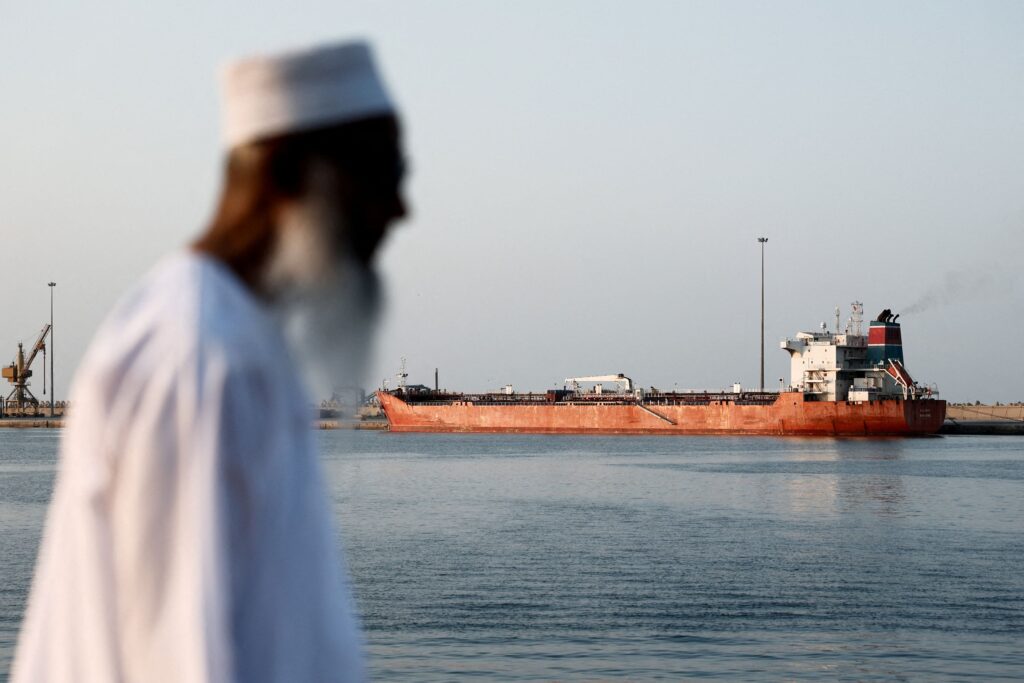
President Donald Trump knew when he started the war against Iran that the country could respond by disrupting energy markets worldwide and closing the Strait of Hormuz. Now it’s on the United States to solve a problem that threatens the global economy.
Trump is angry at countries, friend and foe, for resisting his requests to help the U.S. pry open the global shipping lane being held hostage by the regime in Tehran. He has warned that “we will remember” and it could even be “very bad for the future of NATO.”
Trump says Iran’s navy, air force and air defenses are “gone” — yet the U.S. Navy describes the strait as an Iranian “kill box” that’s too dangerous for escorts. If Iran is “defeated,” why can’t the preeminent global superpower open a waterway that’s about 30 miles wide?
The U.S. owns the skies over Iran, and reconnaissance drones can easily loiter over the coastline around the clock. But air supremacy is not the same as sea control. Iran’s mobile anti-ship missiles are hidden in mountainous coastal terrain, designed to “shoot and scoot.” The cheap Shahed drones it uses can be built in workshops and are easy to launch from almost anywhere.
The Pentagon’s own assessment is that escorts won’t be feasible any time soon. And Iran doesn’t even need to hit a ship to keep the strait closed. The mere suspicion of mines or surviving missile launchers is enough to make insurers pull coverage or make it cost prohibitive, which halts commercial traffic as surely as any weapon.
A better bet may be to declare victory and walk away. The Iranians would have no credible pretext for continuing their attacks on the Gulf once the bombing stops. And declaring victory would not be stretching the truth.
Trump has indeed extracted an enormous cost on Iran’s regime. Its missile volume is down more than 90 percent. Its supreme leader is dead.
By stopping the bombing without agreeing to any formal peace, Trump keeps his options open for future strikes. And in doing so, he also hands the regime a catastrophe. The clerics will emerge to face a shattered military, a wrecked economy and, most important, a population that will ask: What was all this for?
Air campaigns do not produce regime change on their own. NATO’s 78-day bombing of Yugoslavia in 1999 did not dislodge Slobodan Milosevic. But it weakened him enough that, little more than a year later, a popular revolution drove him from power. The same logic could hold for Iran. A regime that has just been as humiliated as this one is a regime living on borrowed time.
Trump does not need to finish the job himself. He just needs to stop doing things that make him look like he can’t.
The post How to solve the Hormuz crisis appeared first on Washington Post.