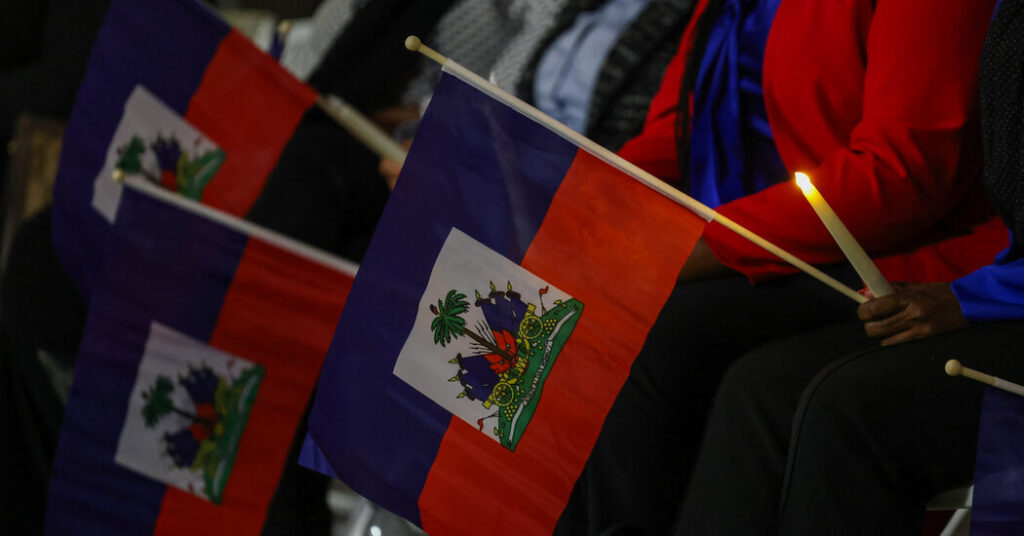
The Supreme Court on Monday declined to immediately allow the Trump administration to end deportation protections for hundreds of thousands of Haitian and Syrian migrants living in the United States, and instead agreed to hear oral arguments in the matter in late April.
As part of President Trump’s crackdown on immigration, the administration has moved to terminate a program, known as Temporary Protected Status, that has allowed migrants from certain troubled nations to live and work legally in the United States. At issue in the cases before the Supreme Court are protections for some 350,000 Haitians and more than 6,000 Syrians.
Solicitor General D. John Sauer asked the Supreme Court to intervene after lower court judges sided with the migrants and postponed plans to terminate their deportation protections. Instead of issuing a quick-turn order, the justices said on Monday that they would formally review the two cases on an expedited basis and provide clarity on when the administration can end protections for groups of migrants.
Monday’s brief order did not provide any reasons for the deferral, as is typical in emergency matters. It said the arguments would be scheduled for the week of April 27, meaning the justices are likely to rule on the issue in June or early July.
The issue has been added to a caseload in which the justices are already confronting key elements of the president’s agenda. Last month, the court invalidated Mr. Trump’s sweeping tariffs on imports from major U.S. trading partners. They will also decide in the coming months whether the president can fire independent agency leaders and if he can end the longstanding guarantee to birthright citizenship.
At issue in the deportation cases is a statute that gives the secretary of homeland security authority to provide humanitarian relief, Temporary Protected Status, to citizens of countries affected by armed conflict, natural disaster or other catastrophes, if they are already in the United States.
The effort to lift the protections is part of a broader deportation push by the Homeland Security Department, which has announced that it would terminate the program for hundreds of thousands of people from Haiti, Venezuela and several other countries.
The justices previously allowed the Trump administration to move forward with its plans to lift protections for more than 300,000 Venezuelan immigrants who had been living in the United States under the program. They ruled twice in that case in emergency orders, providing technically temporary authorization for the administration to revoke the protected status while litigation over the issue was underway. Those orders did not include the justices’ legal reasoning.
Haiti first received the designation in 2010 after a devastating earthquake. The program has been extended for Haitians several times, including by the Biden administration after the assassination of the country’s last elected president in 2021. Since then, Haiti has been grappling with gang violence, political instability and food shortages.
The Trump administration had originally set a Feb. 3 expiration date for the protected status for Haiti. Haitians sued in federal court to halt the termination, arguing that the government had not taken into account the conditions on the ground, as required by law, and that its decision was preordained and based on racial animus.
This month, a divided three-judge panel of the U.S. Court of Appeals for the District of Columbia Circuit blocked the Trump administration from ending the program. The appeals court said that the Haitian immigrants would face “substantial and well-documented harms” if they lost protected status, even temporarily.
Mr. Sauer, the solicitor general, had urged the justices in an emergency request to clear the way to end the protections, asserting that lower courts were “again attempting to block major executive branch policy initiatives in ways that inflict specific harms to the national interest and foreign relations.”
Monday’s order allows hundreds of thousands of Haitians to remain in the United States and continue to lawfully work while the Supreme Court weighs the issue.
“This is a positive for the hundreds of thousands of people who have been granted T.P.S. and who district courts and courts of appeals are protecting,” said Ira Kurzban, co-counsel for the Haitian migrants.
In the case of the Syrian migrants, the government initially put protections in place in 2012, citing the “extraordinary and temporary conditions” in the country resulting from “a brutal crackdown” by the nation’s president at the time, Bashar al-Assad. Those temporary protections were repeatedly extended, including during the first Trump administration.
Kristi Noem, the homeland security secretary, announced in September that the conditions in Syria no longer met the criteria for “an ongoing armed conflict” that would endanger the safety of returning nationals.
Lawyers for a group of Syrian nationals sued in October. They argued that the Department of Homeland Security’s decision to cut off protections was based on a “predetermined plan” rather than an assessment of conditions in Syria, which has faced a humanitarian crisis and is now in the middle of the war with Iran. As in the case of the Haitian migrants, lower court judges agreed.
The Supreme Court’s willingness to use emergency orders to allow the administration to deport hundreds of thousands of migrants has been controversial.
In a court filing, a group of more than 175 former federal and state judges appointed by presidents and governors of both political parties supported the migrants.
They argued that Supreme Court orders from the emergency docket that do not include any explanation “are not binding, or even especially informative,” when lower court judges are evaluating different cases involving different circumstances. Those kinds of criticisms may have contributed to the justices’ decision to change course and agree to receive more legal briefing and hear oral arguments in the case of Haitian and Syrian migrants.
Miriam Jordan contributed reporting.
Ann E. Marimow covers the Supreme Court for The Times from Washington.
The post Supreme Court Defers Decision on Trump’s Bid to End Protections for Migrants appeared first on New York Times.