By his own account, President Trump was asked to personally pick the name of the military operation against Iran and was bored by all the choices presented to him. “They gave me, like, 20 names, and I’m like, falling asleep,” he said last week. “I didn’t like any of them.”
Then at last he was offered another option: Operation Epic Fury. That woke him up. “I like that name,” he told supporters at a rally in Kentucky. “I like that name.” And so it was selected.
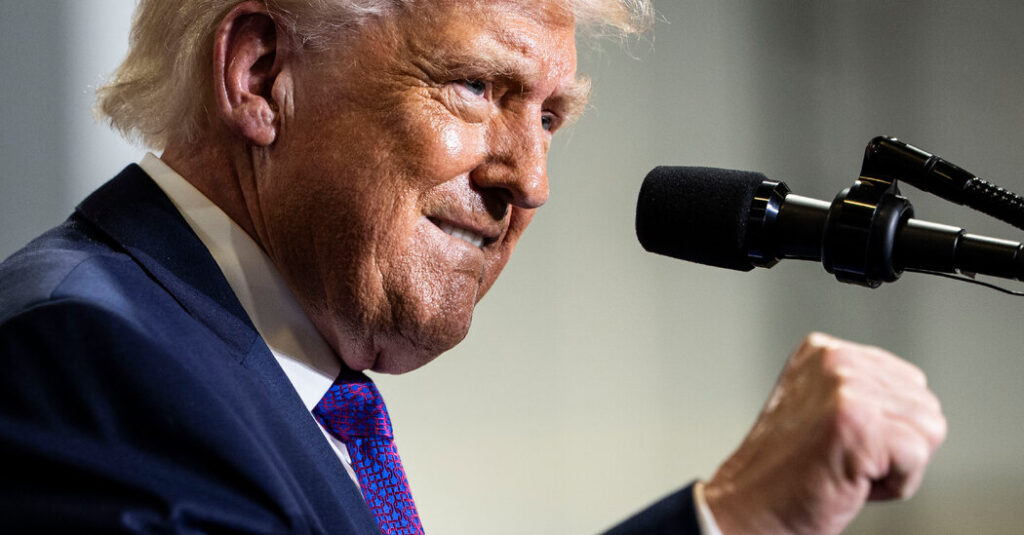
After all, Epic Fury captures the Trump presidency in its essence. Everything Mr. Trump does, at least as he sees it, is epic — the biggest, the most, the first, “like we’ve never seen before,” as he likes to say. And much of what he does seems to be driven by fury, a deep and abiding enmity toward the forces arrayed against him or those he blames for what he considers the downfall of the country under other presidents.
Operation Epic Fury, therefore, is a quintessentially Trumpian choice for the name of a war. Not for him an Operation Just Cause (Panama), Operation Restore Hope (Somalia), Operation Uphold Democracy (Haiti) or Operation Enduring Freedom (Afghanistan). While other military operation names in modern times have evoked broader American values or uplifting sentiments like freedom and hope, Mr. Trump prefers rage.
This is in a way the Anger Presidency. Anger defines Mr. Trump’s decade on the political stage. Anger at foreigners who come to this country and change its nature. Anger at allies who take advantage of America. Anger at Democrats who cross him. Anger at Republicans who cross him. Anger at appointees he deems insufficiently loyal. Anger at prosecutors, F.B.I. agents, judges, journalists, law firms, elite universities, cultural figures, corporate leaders, pollsters, central bankers and the Norwegian Nobel Committee.
His rally speeches, news conferences and social media feed are suffused with anger. In the past week, he attacked the “truly sick and demented people” in the news media, the “Radical Left Democrats,” the “Cognitive Mess” governor of California, a “COMPLETE AND TOTAL DISASTER” Republican congressman from Kentucky and a “misfit” Harvard professor, not even counting the “deranged scumbags” in Iran.
Stewing over recent losses in court, he spent Sunday night posting a series of rambling rants assailing the “completely inept and embarrassing” Supreme Court, the “Deranged” former special counsel, the “absolutely terrible” chair of the Federal Reserve, the “grossly incompetent” former President Joseph R. Biden Jr., journalists who “should be brought up on Charges for TREASON” and “a Wacky, Nasty, Crooked, and totally Out of Control Judge” who ruled against him.
He has aroused plenty of anger in others as well, an intense and visceral ire at a leader whom many on the other side of the political spectrum despise and fear. The word volunteered the most by Democrats to describe their emotions about Mr. Trump’s presidency in a January survey by The New York Times and Siena College was “anger.” Independents offered that same word alongside “disappointment.” Mr. Trump and his allies regularly accuse opponents of being afflicted by what they call Trump Derangement Syndrome.
All this, of course, has further charged an age of road-rage politics. Mr. Trump did not inaugurate the polarization that has deepened in America in recent years, but he tapped into it and added rocket fuel. More than at any time in years, Americans view one another through the lens of politics and tribal differences, led by a president who encourages that rather than trying to heal the divisions.
Americans are so angry that many no longer want to associate with people who disagree with them. Back in 1960, pollsters asked Americans if it would bother them to have their son or daughter marry someone from the other party. Only about 5 percent said yes. By 2024, that had risen to 38 percent for Republicans and 45 percent for Democrats. Studies show that Americans increasingly are flocking to their own geographic, media and online spaces where they can associate with like-minded compatriots and seethe against those who see the world differently.
Mr. Trump is not the first president with a temper. Even the genial Dwight D. Eisenhower was known to be sharp behind closed doors. Lyndon B. Johnson’s tantrums were Texas sized. Richard M. Nixon seemed to be on a medium boil for most of his nearly six years in office. Bill Clinton, known for being sunny in his public appearances, was famous among aides for what they called his “purple rages” at his staff when the cameras were off. In the privacy of the West Wing, Joseph R. Biden Jr.’s avuncular grandfather demeanor could turn cranky and snappish.
But they rarely showed that side of themselves in public if they could help it. The disparity between public poise and private pique was lampooned by Barack Obama at the White House Correspondents’ Association Dinner in 2015 when he showed up with Luther the anger translator, played by Keegan-Michael Key. From stage, Mr. Obama, a self-described “mellow sort of guy,” would utter some typically bland comment, and Luther would “translate” that into the angry diatribe the president wished he could say out loud.
Mr. Trump, by comparison, does not shy away from diatribes. He embraces anger as part of his persona. His favorite pose for photographers is not a smile but a scowl. “How is the look?” he sometimes asks advisers after a photo shoot. The whole shtick of his 14-year run on reality television was celebrating his end-of-the-episode “You’re fired” takedowns of the losing contestants. Indeed, after laying into Volodymyr Zelensky, the embattled president of an embattled Ukraine, in the Oval Office last year, Mr. Trump noted with satisfaction that “this is going to be great television.”
Public displays of anger have become standard for his team too. Wartime briefings by Pete Hegseth, the Fox News host turned defense secretary, have become exercises in combative attacks on “fake news.” Jeanine Pirro, another former Fox host now serving as a U.S. attorney, lashed out on Friday at a reporter whose question she did not like. “Cut it out!” she snapped.
Attorney General Pam Bondi shows up for congressional hearings as if ready for a gladiatorial showdown, complete with opposition research on lawmakers and schoolyard put-downs to deploy. “Hypocrite,” she berated one. “Washed-up, loser lawyer,” she jabbed at another.
And White House officials, using official government accounts, seem to be in a pit-bull contest to be the nastiest on any given day, upbraiding anyone perceived to be an adversary: “Total hack and loser.” “Wrong again, numbnuts.” “A sad and pathetic excuse for a human being.” “An entitled prick.” “A known liar and fraud.” And that was just from one of them over just one week.
For a military operation name, Epic Fury sounds like a video game, which may be apt because that’s the way the Trump White House is marketing this war. Online videos circulated by the administration have portrayed the assault on Iran as if it were the latest installment of “Call of Duty.”
In choosing the name, Mr. Trump was focused less on anger than on American strength, according to a White House official who spoke on condition of anonymity to describe the president’s thinking. He believes he was elected on a platform of restoring the country’s standing on the world stage and the name reflects that, the official said.
For generations, military operation names were picked somewhat at random. But during the Korean War, Lt. Gen. Matthew Ridgway tried to bolster his demoralized troops by giving aggressive names to operations, including Thunderbolt, Killer, Courageous and Audacious, as Gregory C. Sieminski recounted in a 1995 history published in the Army War College journal. Operation names have often reflected power, like Rolling Thunder, the bombing campaign during the Vietnam War.
After Vietnam, the Pentagon set up a computerized system called the Code Word, Nickname and Exercise Term System, or NICKA, to record operation names and help commanders avoid repeats. But for major offensives, political sensibilities became increasingly important starting in 1989 when George H.W. Bush invaded Panama.
General James J. Lindsay, the Special Forces commander, objected to the original name of that invasion, Operation Blue Spoon. “Do you want your grandchildren to say you were in Blue Spoon?” he asked. Another general suggested Just Action, which became Just Cause. Most operation names since then have similarly tried to project virtue. Even Mr. Trump’s raid on Venezuela in January was called Operation Absolute Resolve.
At least one previous operation used the word “fury.” Ronald Reagan’s invasion of Grenada in 1983 was called Operation Urgent Fury, only to draw criticism for sounding too angry and militant, rather than inspiring. The danger of using Epic Fury, as any political consultant could have warned the White House, is that if the war is not perceived as successful, it could easily be mocked as Operation Epic Fail.
But Mr. Trump likes the visceral, manosphere sound of Epic Fury, much like Operation Midnight Hammer, his air assault on Iran last year. His administration has adopted similarly testosterone-heavy names for domestic operations, including immigration roundups in Florida (Operation Dirtbag) and Maine (Operation Catch of the Day).
He trotted out the Iran war nomenclature at the Kentucky rally as if he were rolling out his latest branding campaign. “Operation Epic Fury!” he proclaimed. “Is that a great name?”
“Well,” he added, “it’s only good if you win.” So rather than wait, he simply declared victory. “And we’ve won. Let me tell you, we’ve won.”
Peter Baker is the chief White House correspondent for The Times. He is covering his sixth presidency and sometimes writes analytical pieces that place presidents and their administrations in a larger context and historical framework.
The post In Choosing ‘Epic Fury,’ Trump Names a War and Defines His Presidency appeared first on New York Times.