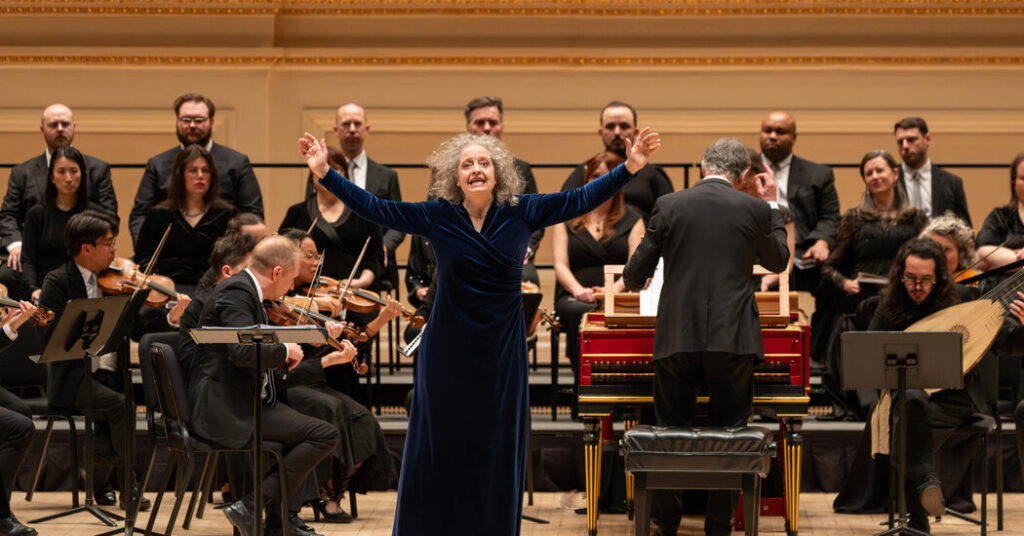
Handel’s “Hercules” is a study of trauma. This dramatic oratorio, which received a gripping performance by the English Concert at Carnegie Hall on Sunday, under the direction of Harry Bicket, draws on Sophocles and Ovid to tell the story of two victims of the title hero: the captive princess Iole, whose father he has killed, and Hercules’ wife, Dejanira, who was racked with anxiety while he was away at war and becomes consumed with the thought that something might be going on between him and his beautiful prisoner.
Years earlier, Dejanira narrowly escaped rape by the centaur Nessus, a memory she holds on to in the form of a garment, soaked in his blood, that will unleash its destructive power by the end of the drama. The story thus pits two wounded women against each other: the hypervigilant, obsessive Dejanira and the sweetly empathetic Iole, who metabolizes loss into forgiveness and serenity.
For Handel, “Hercules” represented its own kind of trauma. The work flopped so badly at its London premiere in 1744 that he withdrew it after two performances and ran a mortified announcement in the press announcing a premature end to his concert season. Sunday’s performance, featuring the luminous Clarion Choir and a strong cast of soloists, made a persuasive case for the piece as one of Handel’s most musically and psychologically brilliant creations. It’s also easy to see what alienated Handel’s contemporaries. Even today, “Hercules” feels strikingly modern, with flights of chromatic daring and a compassionate gaze on mental torment that pierces through the moralizing veneer of 18th-century English spectacle.
The mezzo-soprano Ann Hallenberg gave a moving portrayal of Dejanira. She is approaching 60, and her voice does not always project her chiseled coloratura and golden top notes. But she threw herself into the role with dramatic commitment, embodying a character Handel draws with extraordinary specificity.
Even Dejanira’s first aria, expressing longing for her absent husband, unfolds over such a chaotic series of leaps and turns that it is clear we are dealing with a woman who lives at emotional extremes. Dejanira’s later mad scene, in which she imagines herself pursued by Furies, was uncomfortably, compellingly raw.
Opposite her, the bass-baritone William Guanbo Su brought a suitably brawny, majestic sound to the title role. His Hercules is both heroic and self-involved. When Dejanira needles him about his interest in Iole, he responds by pointing to his fame: His public acclaim alone should assuage her suspicion.
As Iole, Hilary Cronin revealed a soprano of winning complexity and emotional weight. For most of the oratorio she functions as a voice of moral courage, offering wisdom even to those who destroyed her family. Yet in her first appearance she gives voice to her pain. Conducting from the harpsichord, Bicket allowed one rest to linger long enough to suggest a woman insisting on processing her grief in her own time.
The countertenor Alexander Chance sang the messenger Lichas with idealistic fire and purposeful clarity. The tenor David Portillo brought tremulous ardor and youthful sincerity to Hyllus, Hercules’ son. It falls to Hyllus, in the end, to build the funeral pyre that releases his father from the agony caused by the blood-soaked memento of Dejanira’s sexual trauma, which she offered believing it to be a charm. And it is Hyllus who ultimately weds Iole, allowing the oratorio — breaking with Sophocles — to conclude in reconciliation.
The choruses, sung with gleaming precision by the Clarion forces, underscored how radical Handel’s writing can be. In “Jealousy! Infernal pest” explodes from a wasp’s nest of dissonances that seem to catapult the music out of the world of Baroque harmony into something more elemental. In the chorus mourning Hercules’ death, too, the music gropes through harmonic turns that startle and destabilize.
With its strong, cohesive plot, “Hercules” is increasingly being adopted by opera directors in fully staged productions. Sunday’s performance was a reminder how well the oratorio works in the concert setting for which it was conceived. The drama — all its ambiguity, violence and pain — is right there in the music.
The English Concert
Performed on Sunday at Carnegie Hall, Manhattan.
The post Review: A Handel Flop Reveals Itself as a Work of Brilliance appeared first on New York Times.