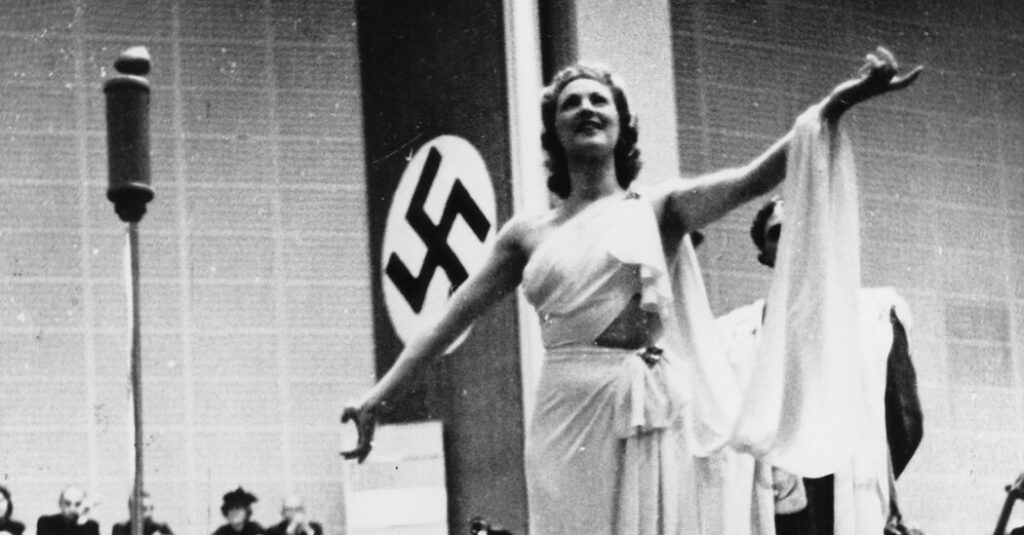
STAY ALIVE: Berlin, 1939-1945, by Ian Buruma
Autocrats love to be loved. In the first days of the Nazi invasion of Poland in 1939, German propagandists boasted of the “stormy passion” of Berliners for their Führer. Cleareyed observers, however, noted an unexpected ennui that had settled over the capital. The Berlin-based American journalist William Shirer reported that he witnessed “no excitement, no hurrahs, no cheering.” Oddly, there was “not even hate” for the British and French enemies.
Dictators, in reality, thrive not on love but on indifference. As Ian Buruma shows in “Stay Alive,” his crisply told and uncomfortably relevant history of wartime Berlin, they feed off the tepid responses to violence and the thousands of daily compromises that citizens choose to survive. Most people in wartime Berlin, Buruma writes, were “neither cynics, nor bullies, nor ideological fanatics; they simply conformed.” Their story, he suggests, is a warning about the “temptation to look away” amid the drift toward autocracy.
Throughout the war years, Berliners turned looking away into an art form. They distracted themselves with movies and concerts and fashion shows. Some sought consolation in the supply of fine wines that had been liberated by the Germans from France; others found a way to wrangle rationed coffee and cakes. “For the right price, you can get anything you want,” the author Erich Kästner told his diary in the winter of 1941. “Everything is for sale.” As late as 1944, spectators were still filling the stands to watch soccer matches — albeit on crater-pocked pitches.
The essential commodity was Beziehungen: clout. Those well connected in the National Socialist hierarchy possessed the most. The promise of influence reshaped fundamental aspects of personal identity. Buruma cites the case of Erich Alenfeld, a Jewish convert to Christianity, who wrote a letter to Hermann Göring in 1939 volunteering his service in the German Army; his son later joined the Hitler Youth. Such transformations were not always cynical accommodations. They were also driven by the nationalistic spirit of the day. People like the Alenfelds, Buruma writes, “were as much influenced by German romanticism as anyone of their generation.”
When escapism and patriotism failed, there was always exile — a choice popular among German literati of a range of political persuasions. Bertolt Brecht, the leftist playwright, and Thomas Mann, the once-conservative novelist, had both left the country in 1933 as the fascists came to power. Mann could be scathing about contemporaries who chose to remain behind. Anything published in Germany between the years of 1933 and 1945, Mann insisted, bore the scent “of blood and shame.”
The conductor Wilhelm Furtwängler told himself that he was an artist first and foremost — unpolitisch, in the idiom of the hour. He stayed in Germany and, despite his opposition to the Reich, conducted the Berlin Philharmonic in 1942 on Hitler’s 53rd birthday. The stench of blood and shame followed him for the rest of his life. After the war, when he was offered a prominent job as conductor of the Chicago Symphony Orchestra, his Italian contemporary Arturo Toscanini and others campaigned against him. The symphony rescinded its offer.
Many Germans, of course, had no choice but to stay. Oppressive exit taxes for Jewish residents made emigration expensive. Instead, they were forced to flee to the seedy Berlin underworld. The capital in the 1940s was only a decade or two removed from the Babylon Berlin of the Weimar era. Families took rooms in brothels and hid out in louche pool halls. Their circumstances made them vulnerable to sexual extortion. These domestic refugees referred to themselves as “U-boats,” plunging below the surface of society.
Buruma’s own father, Leo, spent part of the war in Berlin, dodging Allied air raids and attempting to find his own balance between resistance and survival. Leo had been forced to move from the Netherlands to Germany, working in a factory that made brakes for locomotives but also light machine guns. He recalled seeing the Allied bombers glimmering in the sky like a school of silverfish. The falling bombs from one raid burst a gas line, injuring his girlfriend. For the rest of his life, Buruma recounts, his father could not bear the sound of fireworks.
Buruma’s account is long on anecdote and primary sources but somewhat short on big ideas. A former editor at The New York Review of Books, he is a writer who is comfortable with intellectual history; he is the author, for instance, of a fine recent study of the philosopher Baruch Spinoza. Perhaps that is why, amid the color of wartime Berlin in “Stay Alive,” I found myself wishing that he would delve deeper. Germany in the first half of the 20th century was a crucible for the great debates over the relationship between art and politics. This volume could have benefited from a dash of structured exposition and context.
By the end of the war, in any case, high-minded ideology had devolved into nihilism. Berliners were beset by dangers from all corners. While the Nazi leadership frolicked in alcohol-soaked end-of-days orgies, human U-boats had to hide out from the Reich’s “chain dogs,” thugs who arrested and executed anyone older than 15 who refused to fight. City dwellers suffered under the presence of the arriving Soviet troops; more than 100,000 Berlin women and girls were raped. Buruma interviewed one survivor in an assisted-living facility who described being raped twice by Russian soldiers when she was just 14.
A major virtue of Buruma’s book is his interviews with survivors, a population that is disappearing fast. A Berliner who was 10 years old in 1945 would be 91 today. In that respect, Buruma’s title, “Stay Alive,” takes on an added layer of significance. His history preserves a world that is fading from living recollections. Although memory can fuel ultranationalism, it can also serve as a tool of reconciliation. Buruma describes his book as a kind of “love letter” to the city — his own passionate challenge to the corrosive power of indifference.
STAY ALIVE: Berlin, 1939-1945 | By Ian Buruma | Penguin Press | 382 pp. | $35
The post With the Third Reich at War, Most Berliners Just Carried On appeared first on New York Times.