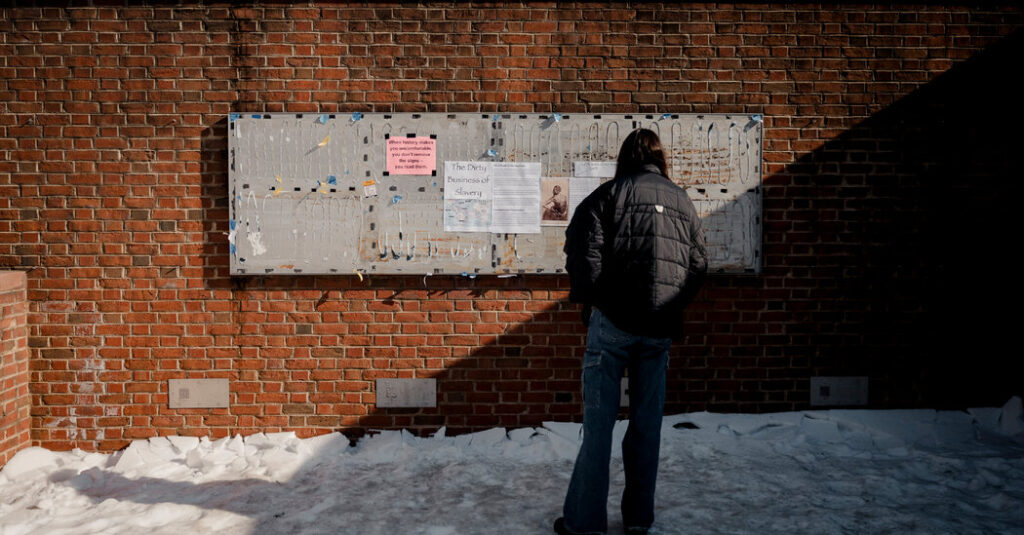
As the Interior Department carries out President Trump’s order to remove or hide information at parks and other sites that might “disparage Americans,” internal records show striking inconsistencies around the displays the agency is eliminating and those it chooses to keep.
An exhibit at Grand Teton National Park in Wyoming about the massacre of Blackfeet Native Americans was ordered removed. But at a wildlife refuge in Virginia, the agency preserved an exhibit about the harassment and displacement of Tauxenent people.
It labeled a display on climate change at a North Dakota wildlife refuge “factual.” But it removed similar information at Muir Woods, Acadia National Park and elsewhere.
Historians have called the deletions an effort to sanitize America’s past and erase scientific truths that Mr. Trump dislikes. Critics have also accused the administration of making decisions in secret, leading to erratic choices about what history gets preserved or dismantled.
“It’s very willy-nilly, and there’s a lack of transparency about what’s being removed and why,” said Gerry Seavo James, a campaign director at the Sierra Club, an environmental group.
The Interior Department did not respond directly to questions about what criteria the agency is using to review displays. It also declined to say who is reviewing the content or making final decisions about whether signs should be changed or removed.
Interior Department documents obtained by the Sierra Club under public records laws show that, of 32 items flagged for review by Fish and Wildlife Service employees, a third were considered “factual” with no need for changes. In some other cases, similar content was deemed to be inappropriate.
In a letter to Interior Secretary Doug Burgum this week, Democratic lawmakers said they had not yet received answers to basic questions about the reviews, like how many exhibits so far have been removed or altered. They also asked for a comprehensive list of all exhibits where changes are being considered as well as an explanation of the rationale for removing or changing content.
“So far there has been little clarity on the process, and of course, zero public comment. ” Senator Martin Heinrich, a New Mexico Democrat, said on the Senate floor on Wednesday.
A federal judge has already temporarily blocked one of the Trump administration changes, the removal of displays about slavery at a site in Philadelphia where George Washington lived as president. The Trump administration has said it will appeal the ruling.
Beth English, the executive director of the Organization of American Historians, which represents about 6,000 scholars of U.S. history, said the process for adding or removing information from federal sites is supposed to involve a thorough and public review.
Her organization worked with the Park Service in the early 2000s when it was considering including the information about slavery at one of George Washington’s homes. Professional historians with expertise in early American history, slavery and women’s history convened and, in 2005, published a review with recommendations that were later adopted.
“Removing or changing content without repeating that same process is very arbitrary,” Ms. English said, adding, “When you throw out process, it’s not shocking that things start to go off the rails.”
The current efforts to erase or change content stems from an executive order that Mr. Trump issued nearly one year ago. It required the Interior Department to ensure that none of the sites under its jurisdiction contain “descriptions, depictions, or other content that inappropriately disparage Americans past or living,” and that descriptions of ecosystems focus only on “natural features, the beauty, abundance, and grandeur of the American landscape.”
Mr. Burgum then ordered civil servants to flag content at parks and other sites for possible removal. According to interviews with a half-dozen agency staff members who spoke on the condition of anonymity because they were not authorized to speak about the process, employees received no guidance on defining problematic content.
Essentially left to guess, some staff members opted to flag for review exhibits on topics that Mr. Trump has disparaged, like climate change and immigrants, or on subjects like slavery that he has said Americans hear about too much. Information from an internal government database, posted recently on two public websites, identifies hundreds of such items, as well as displays about L.G.B.T.Q. rights, Native Americans, racism, sexism and pollution.
The agency has been using that data to help determine what signs, exhibits and other items should be banished. But the process appears to show wide discretion in what the agency considers to be improper content.
For example, the Interior Department has decided to withdraw a film circulating in the National Wildlife Refuge System that describes violence against Indigenous communities, according to agency documents obtained by the Sierra Club.
But the at Occoquan Bay National Wildlife Refuge and the Elizabeth Hartwell Mason Neck National Wildlife Refuge, both in Virginia, the agency marked panels that discuss the harassment and forced removal of the Tauxenent people from their ancestral lands as “factual.”
Also factual: A sign at wetland in southwestern Minnesota named Slaughter Slough that notes a massacre of white settlers during the Dakota War of 1862; and information at the Bear River Migratory Bird Refuge in Utah describing how, before 1970, wetland destruction was encouraged by the U.S. government.
Perhaps most surprisingly, a kiosk panel at the Audubon National Wildlife Refuge that discussed the “challenges of climate change” was also assessed as factual.
Climate change is indeed an established scientific fact. But Mr. Trump has called climate scientists “stupid people,” and his administration has removed signs, exhibits and displays about climate change at several other parks and historic sites.
Most of the information that has been gleaned about what has been changed or removed comes from leaks of government information and from activists and volunteers who monitor parks, since the Interior Department has issued little public information about the process.
Lisa Friedman is a Times reporter who writes about how governments are addressing climate change and the effects of those policies on communities.
The post What Displays Get Scrapped at America’s Parks? It Looks Like Anyone’s Guess. appeared first on New York Times.