Joe Costa is director of the Atlantic Council’s Forward Defense program. Ely Ratner is a principal at the Marathon Initiative.
The United States has achieved significant tactical gains in its military campaign against Iran. Nuclear facilities have been degraded and military capabilities destroyed. The strategic bill, however, is coming due. Every resource consumed in Iran is now unavailable for the Pacific, where the United States faces its most consequential military challenge. Credibly balancing against China in the foreseeable future will require husbanding resources more carefully.
Even before this conflict, the U.S. military was seriously strained. The Government Accountability Office reported earlier this month that readiness has degraded over the past two decades. Most recently, support for Ukraine, operations against the Houthis and the defense of Israel had depleted critical munitions and taxed the force. High-tempo deployments, such as during the Venezuela buildup and the ongoing Iran campaign, have made a bad situation considerably worse.
While the headlines rightly focus on dwindling supplies of critical air defense interceptors — THAAD, Patriot, ship-launched Standard Missiles and air-to-air variants such as AMRAAM — designed to destroy incoming aircraft, drones and ballistic missiles, these munitions are only one part of an integrated air defense system. Iran is also striking the radars that detect incoming missiles. Air defense is central to any China campaign, and these scarce assets could take years to replenish, even with aggressive efforts at recapitalization. Also in short supply are long-range missiles like Tomahawks, which can be launched from ships, submarines or ground launchers to strike targets 1,000 miles away. In a war against a peer competitor, the United States will not have the luxury of dominating the skies and shifting to cheaper and larger arsenals of air-delivered munitions, as it has in Iran.
But that is not the whole story. Most important, the Iran war has cost American lives, and will result in deferred maintenance, cannibalization of units for equiment, broken deploy-to-dwell thresholds meant to ensure soldiers have enough time to recover at home and compressed training schedules across the force.
Consider a single data point: After redeployments to the Caribbean and now the Middle East, the Navy is projecting what could be a record 11-month deployment for the aircraft carrier USS Gerald R. Ford. The human costs, including fatigue and family strain, are real. So are the cascading maintenance and training impacts. The Navy follows the “rule of thirds” for its fleet: one-third for deployment, one-third in maintenance and one-third in training. Now that the USS George H.W. Bush is reportedly en route to the region, three aircraft carriers — the U.S. military’s premier power-projection assets — are either in or heading to the Middle East. By contrast, none are currently operating in the Indo-Pacific.
The story is no better for the assets that fight alongside carriers. The Congressional Budget Office recently projected that Arleigh Burke-class destroyers — among the Navy’s most capable platforms for shooting down ballistic missiles and launching Tomahawks — will spend 27 percent of their planned service lives in maintenance, more than double the Navy’s estimate. These ships are proving indispensable in Iran. They are also essential for deterring China.
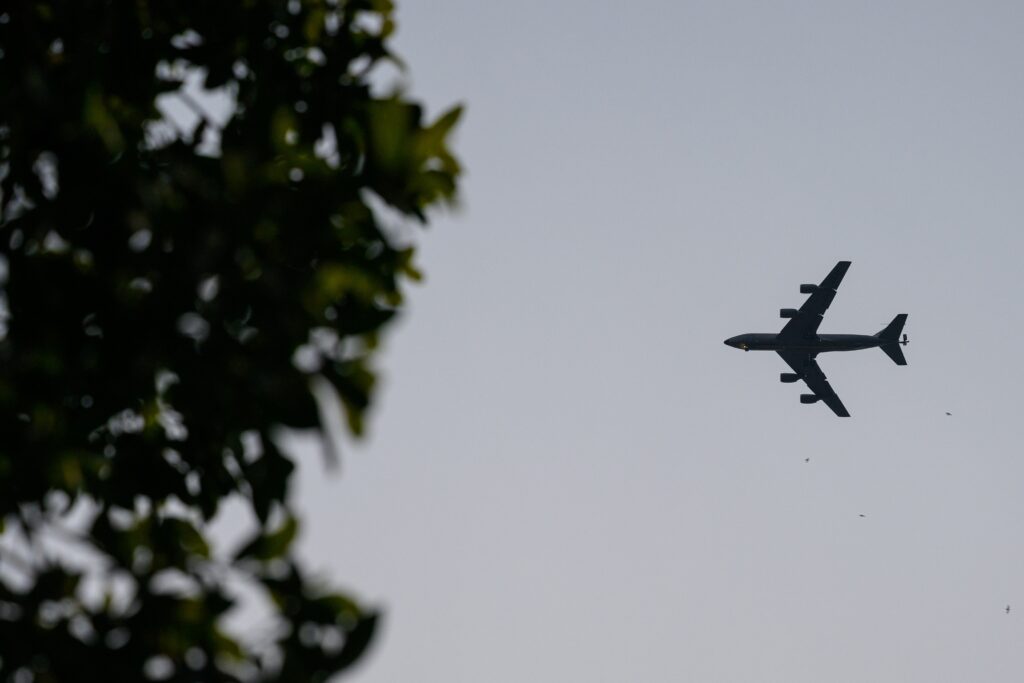
Strategic airlift and aerial refueling face similar pressures. The C-17 and KC-135 fleets — aged aircraft already under stress — are being consumed and degraded by ongoing operations. Already, at least seven U.S. refueling planes have reportedly been damaged or destroyed since the start of the war. The former leader of U.S. Transportation Command called air refueling “our most stressed capability” and foundational to U.S. power projection. In any China scenario, projecting force across the vast distances of the Indo-Pacific is not incidental to the mission; it is the mission.
Intelligence, surveillance and reconnaissance assets are another concern. ISR is critical to early warning of Chinese military movements, where tactical advantage is measured in hours. Open-source reporting indicates that more than one-third of the Air Force’s E-3 AWACS fleet is now committed to the Iran war. Inventories of MQ-9 Reaper drones have been worn down by high demand and combat losses. The RC-135 Rivet Joint — among the most valuable spy platforms in the inventory — is also committed to the Middle East, while Air Force budget documents flag spare parts concerns driven by “Diminishing Manufacturing Sources.”
A high-end conflict with China would require peak readiness across all these domains — across a theater spanning thousands of miles. China’s military planners have studied U.S. operational patterns for decades. They know that a degraded, over-deployed, under-maintained force presents an opportunity. Every Arleigh Burke sitting in maintenance longer than planned, every scarce air defense radar Iran hits, every RC-135 committed to the Middle East and every soldier on multiple extended deployments is a data point Beijing is tracking.
The Iran campaign must not become an open-ended military commitment that further hollows out the force. And the broader pattern of U.S. military operations — from Venezuela to Nigeria — also demands greater discipline. Not every problem requires a military solution, and military action is rarely low cost.
The United States cannot deter China with a force stretched thin across multiple theaters. Combat-credible deterrence begins with readiness, and readiness requires strategic discipline.
The post The Iran war is eroding America’s China deterrent appeared first on Washington Post.