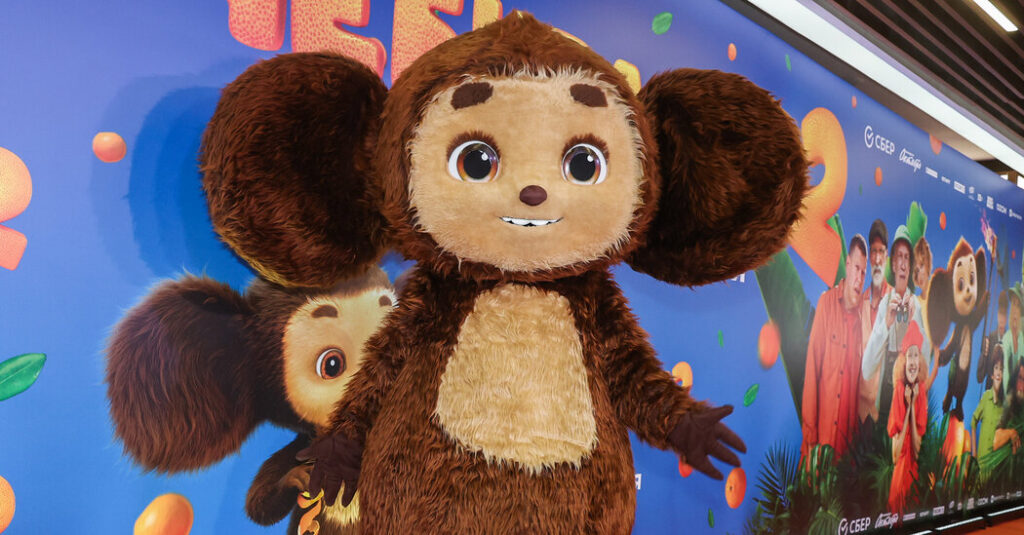
He might be a monkey, or maybe a bear. It never really mattered to the generations of Soviet children who embraced Cheburashka, a taxonomically ambiguous cartoon character with enormous ears and a gentle disposition.
In a culture that relentlessly hammered home grandiose themes like patriotism, socialism or war, the four short Cheburashka stop-motion animated films, the first of which appeared in 1969, were an oasis of innocent delight. The titular hero and his best friend, a pipe-smoking crocodile named Gena, engaged in benevolent adventures. After the Soviet Union collapsed in 1991, Cheburashka was one of the bygone era’s few symbols that people found worth preserving.
The character’s popularity has reached new heights thanks to two live-action features — including “Cheburashka 2,” released in January — that have become far and away Russia’s highest-grossing domestic films. But that success has troubled some influential conservatives, who have accused the cuddly rascal of undermining Russian values, rotting young minds and weakening national pride as the country enters its fifth year of fighting in Ukraine.
Those charges have turned Cheburashka into an unlikely proxy for debates about identity and culture, about Russia’s future and its Soviet past.
“There are two narratives at the same time present in today’s Russia,” said Anna Narinskaya, a Russian journalist and critic who left Russia after the invasion of Ukraine. Russians are largely encouraged to live as if the country were not at war or estranged from much of the West. That irks conservatives who want Russians to embrace what they regard as a crucial moment in the rebirth of an empire. Dwelling in the Cheburashka cinematic universe doesn’t exactly advance that goal.
The first “Cheburashka” film, heavy on computer graphics and edgier than the original cartoons, premiered on Jan. 1, 2023. It would bring in about $94 million in box office receipts. (Russian film earnings can be difficult to verify.) That performance was seeming proof that if wartime sanctions deprived Russians of legal access to Hollywood productions, the domestic film industry could produce blockbusters of its own.
“We rejoice with the creators of this film,” the Kremlin spokesman, Dmitri S. Peskov, said at the time.
“Cheburashka 2” appeared three years later to the day. Russians from St. Petersburg to Vladivostok braved punishing deep freezes and mountains of snow to watch Cheburashka help Gena — who has evolved in the new movies from affable reptile to grumpy human — save his house from a developer. The film has made $80 million so far. It became available for streaming this month, meaning that many more Russians are likely to see the movie now, especially outside large cities.
There were anti-Cheburashka voices when the first of the new films was released, though they were generally ignored. The reception this time has been more complex, with official Moscow less celebratory than it was three years ago. (The novelty of the first film may have partially insulated Cheburashka from the criticism that has shadowed the sequel, despite the many similarities between the two.)
The dispute began several weeks before the movie opened, when Andrei M. Makarov, a member of Russia’s lower parliamentary chamber, the Duma, said he believed Cheburashka to be Jewish. He reached that conclusion — which he aired during a budget hearing that dealt partly with toys — because in the 1969 cartoon, Cheburashka is discovered in a crate of oranges, which the Soviet Union for a time imported from Israel.
Mr. Makarov may have been joking. But a familiar brand of Russian anti-Semitism also seemed to be at work.
In response, the Israeli consul general in St. Petersburg joked back, telling the state news agency RIA Novosti that “the only way to verify that he belongs to the Jewish nation, if we don’t have any information about his parents, is to check for a circumcision and make sure that he doesn’t eat pork.”
That exchange would turn out to be a prelude to much harsher attacks.
The standard-bearer of the anti-Cheburashka crusade has been Aleksandr G. Dugin, an influential political theorist with ties to the Kremlin who envisions Russia embracing Orthodox Christianity and regaining influence over parts of Eastern Europe and Asia. Mr. Dugin’s religious nationalism has found traction in the West, and he has been interviewed by Tucker Carlson and the conspiracy theorist Alex Jones.
His pronouncements have become strikingly apocalyptic since his daughter, Daria, died in 2022 in a car bombing that U.S. intelligence agencies believe was directed by Ukraine.
Shortly after “Cheburashka 2” premiered, Mr. Dugin took to Telegram, where he offered a blunt assessment. If Russia were to continue its “unhealthy” obsession with Cheburashka, he warned, “God will surely curse us.” Mr. Dugin was more explicit in a subsequent radio interview with the newspaper Komsomolskaya Pravda, blaming Cheburashka for destroying the Soviet Union. (Mainstream historians generally point to other reasons.)
Provocation, and the attention that comes with it, may have been the point, said Evgenii V. Bershtein, a native of St. Petersburg who now teaches in the Russian department at Reed College in Portland, Ore. “I am not sure that the sharp line can be drawn between ‘trolling’ and ‘serious’ when it comes to Dugin and his kind,” Dr. Bershtein wrote in an email.
Mr. Dugin significantly elaborated on his views in an article titled “Cheburashka, or the Metaphysics of Disintegration.” With his usual mix of political invective, occult philosophy and dire declaration, Mr. Dugin described Cheburashka as a “lunar demon,” an example of “late-Soviet brainrot” whose “Second Coming” had brought about “the deepest metaphysical and aesthetic” unease. Mr. Dugin did not respond to requests for comment.
Others picked up the call. The well-known critic Sergey Sosedov declared in the newspaper Pravda that he had “never seen a stupider film.” The movie “teaches disrespect for elders, the cult of childish permissiveness and ostentatious luxury,” he added.
Relative to the conformity of 1970s Soviet culture, the original Cheburashka was subtly transgressive with his understated independence. “He’s an outcast” and “absolutely centered in private life,” said Ms. Narinskaya, the Russian journalist and critic. “He lives as if the state doesn’t exist.”
Ms. Narinskaya pointed out that the cartoon’s creator, Leonid A. Shvartsman, was Jewish. So was Roman Kachanov, who directed the beloved original “Cheburashka” cartoons, and Vladimir Shainsky, who scored them. Their shared experience of growing up in a society that valued Jewish contributions but denigrated Jewish people informed Cheburashka’s status as an outsider.
“It’s not like they sat together and conspired and said, ‘Let’s make hints about Jewishness,’” Ms. Narinskaya said. “But it’s how art works. They express their experience through this animated film.”
Since the Kremlin keeps tight control over Russian culture, the political backlash could translate into real-world consequences. The Duma’s culture committee recently debated a bill that would fully fund animated children’s films as long as they closely adhere to traditional Russian values.
Dmitriy Pevtsov, a conservative legislator and actor, used a hearing of the committee to call “Cheburashka 2” a “harmful cinema product that corrupts our children.” He urged fellow legislators to “forget what the people think” and, in an interview with the news agency Tass, explicitly called for stricter censorship.
At another hearing, a legislator complained that “Cheburashka 2” was “frightening.” The deputy culture minister, Zhanna V. Alekseyeva, stepped in to defend the movie, pointing to its commercial success and denying that the film was dampening wartime resolve. “After all, our population is already quite patriotic and well mannered,” Ms. Alekseyeva said.
The bill was advanced. (Neither the culture ministry nor other Kremlin officials responded to requests for comment.)
Cheburashka has been central to the war effort since Russia first invaded Ukraine in 2014. In 2018, pro-Russian forces in the contested Donetsk region introduced the Cheburashka multiple rocket launcher, a relative of the Katyusha arrays that helped defeat Hitler.
When the full-scale invasion of Ukraine began in 2022, Cheburashka frequently appeared on the battlefield as a sticker or a plush toy. Some toymakers began to manufacture Cheburashka dolls emblazoned with a Z, a symbol of the Russian war effort. Russian schoolchildren crafted Cheburashka “talismans” for soldiers.
Many Russians plainly do not share the views of Cheburashka’s critics, even if they regard the new franchise as far inferior to the original cartoons. To some, Cheburashka recalls a more stable era, even if it was repressive and dull. At least it was predictable and, for a while, peaceful.
In any case, Russians will have plenty more opportunities to litigate all things Cheburashka. A third installment is scheduled to open on Jan. 1, 2027.
The post Is This Cuddly, Big-Eared Rascal Leading Russia to Ruin? appeared first on New York Times.