RICHMOND — Karen Taylor Dantzler heard the arguments against Virginia’s referendum giving Democrats the power to gain as many as four seats in Congress: claims that it was unconstitutional, would put rural communities under control of the D.C. suburbs, or even would disenfranchise Black voters like her.
But she voted for it anyway, citing just one reason — President Donald Trump.
“Trump is trying to make it unfair. That wouldn’t be a democracy, it would be a dictatorship,” Dantzler, 64 and retired, said outside the Richmond registrar’s office last week after she cast her ballot.
Trump started a national battle over maps and power last summer when he pushed Texas and other Republican-run states to redraw their congressional districts, a rare step outside the usual 10-year-cycle, in hopes that his party could retain its narrow control over the House. Democrats have lodged a surprising counterpunch, led by California.
Virginia, one of the most moderate blue-run states, has become a key to Democrats’ hopes of keeping up with Republicans but by no means is it an automatic win. As early voting for the April 21 referendum allowing them to redraw their maps began on March 6, they had a clear edge in momentum. But in an offseason election where low turnout is likely, the results are difficult to predict.
Democrats are building their entire push on the belief that voters are more concerned about thwarting the president and his policies than preserving a bipartisan congressional delegation. That message worked last year in California, a much bluer state where voters approved redistricting that could deliver five more Democratic seats in Congress, and it’s powering a well-funded and coordinated campaign across Virginia.
In both states, elected Democrats had worked earlier to approve popular, bipartisan redistricting commissions that they are now trying to undo — at least temporarily — in the face of Trump. Virginia’s referendum asks voters whether to amend the state constitution so that lawmakers can draw new maps mid-decade; the process would revert to the bipartisan commission in 2030.
Republicans have so far responded to the Virginia referendum with scattered opposition campaigns pushing a variety of messages, as well as legal challenges. But they point to signs that their efforts are beginning to gel, with early voting numbers showing red, rural areas outperforming blue urban centers and a slate of “vote no” events finally taking shape in several communities.
“Virginians recognize what is happening,” said former state attorney general Jason S. Miyares (R), who along with former congressman Eric Cantor (R) is leading the best-funded of several vote-no campaigns, Virginians for Fair Maps. In his home region of Hampton Roads, Miyares said, the economy depends on numerous military installations, and business leaders are “not happy that so much outside money is coming in to redraw the map.”
National Democratic groups have poured nearly $22 million into the vote-yes group Virginians for Fair Elections — including $10 million from the House Majority Forward PAC and $9 million from the organized labor-affiliated Fairness Project. The pro-referendum group had spent nearly $12 million on television ads by the time its opponents placed their first ad this week, according to AdImpact.
Some Republicans have grumbled that money has been slow to flow to their cause and that leaders such as former governor Glenn Youngkin have kept a low profile. Virginians for Fair Maps has raised just under $3 million so far, though its filing with the state elections office does not disclose who contributed the money. A spokesman for the group said he did not know the source of the funding.
State Sen. Glen Sturtevant (R-Colonial Heights) expressed “concern and consternation” about the “lack of funding” from national GOP groups in a video on social media this week. Republicans in Congress “seem to be very focused as to making sure that the Epstein files were not released” and on “sending bombs and munitions to other countries,” Sturtevant said, while Virginia Republicans are “not seeing a whole lot of help.”
Youngkin surfaced recently with a video urging Virginians to vote against the referendum, and the Fair Maps group rolled out two online ads — one that casts the referendum as “corrupt” and another that accuses Democrats of gerrymandering to silence voter voices.
Miyares said he believes the argument that resonates most is that the maps proposed by Democrats would carve the state into ungainly districts connecting regions that have little in common. Five of the 11 districts would be rooted in deep-blue Northern Virginia, with Fairfax and Prince William counties anchoring districts that stretch into conservative countryside far to the south and east.
Signs urging “vote no,” some of them homemade, have begun appearing in rural areas, including communities along the Chesapeake Bay that would share a representative with Alexandria, more than 130 miles away, if the new maps are approved.
One Republican-aligned group stirred controversy this week with mailers alleging that the new districts would disenfranchise Black voters, despite the fact that the state’s two Black members of Congress would be unlikely to lose their seats. Using imagery of civil rights marches and Klansmen in hoods, the mailers targeted African American households, said former delegate A.C. Cordoza of Hampton, who identified himself as leader of the Democracy and Justice PAC group that sent the mailers.
The imagery drew an immediate rebuke from Black lawmakers and the NAACP. “They are weaponizing one of the most hurtful and dark chapters in our history to scare people into voting no and helping Republicans rig the 2026 midterm elections,” state Sen. Mamie Locke (D-Hampton) told reporters.
“The people who have controversy with this mailer are the same people talking about fairness while constructing a map that disenfranchises Black voters in favor of Northern Virginia legislators,” Cordoza — who until losing his seat last year served two terms as the only Black Republican legislator in the General Assembly — said in a news conference last week in Richmond. He said he was unfamiliar with the source of the money for distributing thousands of mailers.
Other GOP groups distanced themselves from the project. “That’s not the party’s campaign,” said Jeff Ryer, chairman of the Republican Party of Virginia, which has its own “stop gerrymandering” page online. With Rep. Ben Cline (R) of the 6th District forming a separate Stop the Gerrymander group in the western part of the state, Ryer said he’s not concerned that the fight against the referendum is fragmented.
“The campaign is taking on many different players with different voices and different perspectives,” Ryer said.
Polling has been split on public support. A survey by Christopher Newport University in late January found that a slight majority of Virginia voters supports the redistricting amendment, while a survey by Roanoke College in February found a slight majority opposes it.
So far, early vote totals suggest strong engagement in red parts of the state. According to an analysis by the Virginia Public Access Project, the most votes cast as of Friday came in the five congressional districts now represented by Republicans.
Keren Charles Dongo, vote-yes campaign manager for Virginians for Fair Elections, said the early vote totals are not a good indicator because in-person voting locations are still opening in populous areas such as Fairfax.
The “yes” campaign cranked into high gear this week, with former president Barack Obama delivering a television ad in which he urges Virginians to “level the playing field” by redistricting so that Republicans can’t “steal enough seats in Congress to rig the next election.”
Volunteers have knocked on more than 50,000 doors to promote the referendum, Dongo said, and the group has scheduled town hall meetings around the state. “What we’re finding is Virginians aren’t happy with the policies that MAGA Republicans in the House and President Trump have implemented,” she said, blaming them for rising costs for health care, groceries and energy. “Allowing an unprecedented power grab to rig the 2026 midterm elections will continue the same policies.”
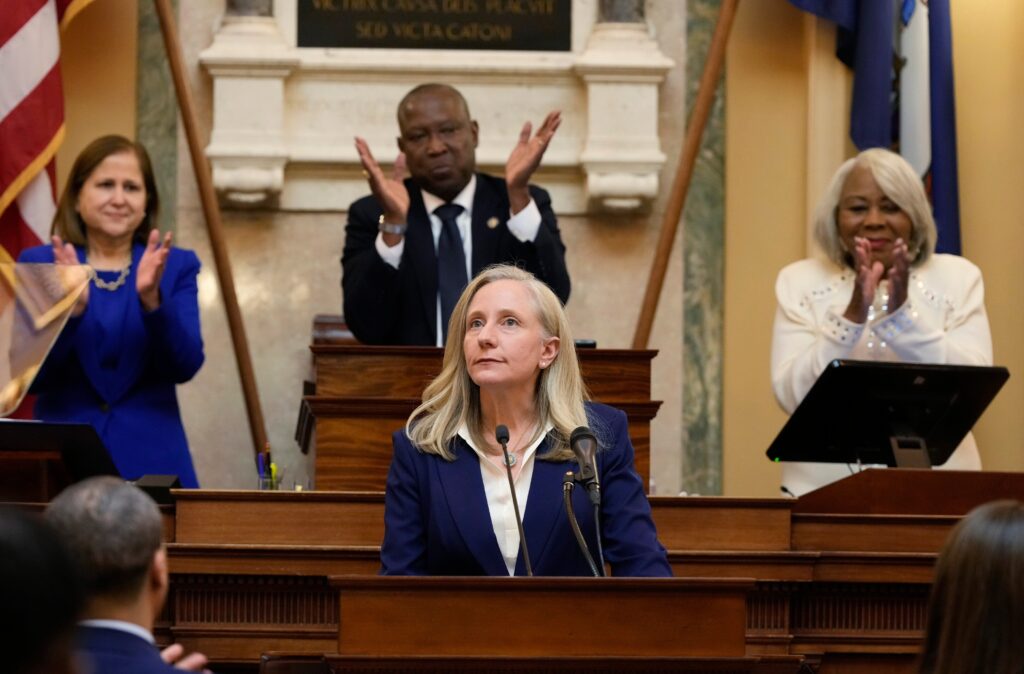
Democrats in the General Assembly have united behind the effort, but Gov. Abigail Spanberger (D) has not been the face of the campaign the way California Gov. Gavin Newsom (D), a likely presidential candidate, was in his state. Initially, Spanberger argued that Democrats could flip Republican House seats without redistricting.
Last week, though, she released a videoon social media making a case for voters to approve the referendum. Her support for the state’s bipartisan redistricting commission has not changed, Spanberger says in the online spot, but “what has changed is what we’re seeing in states across the country, and a president who says he’s, quote, entitled to more Republican seats before this year’s midterms.”
She stressed that the referendum would only allow mid-decade redistricting until 2030, when the commission would resume its duties as usual.
A legal threat hangs over the referendum even as voting moves forward. A judge in conservative Tazewell County ruled in favor of Republicans in two lawsuits that claimed various aspects of the process were improper; Democrats appealed, and the Supreme Court of Virginia said it would consider the cases after the election.
But several who voted in Richmond this week in favor of redistricting said no argument could outweigh their sense that circumstances in Washington demand an extraordinary response.
“There is no accountability whatsoever” from Congress as Trump starts wars, levies tariffs and prosecutes enemies, said Michael Cazares, 61, who works in telecommunications. “We need some way to enforce accountability.”
The post Why Democrats are counting on Virginia to thwart Trump’s plans appeared first on Washington Post.