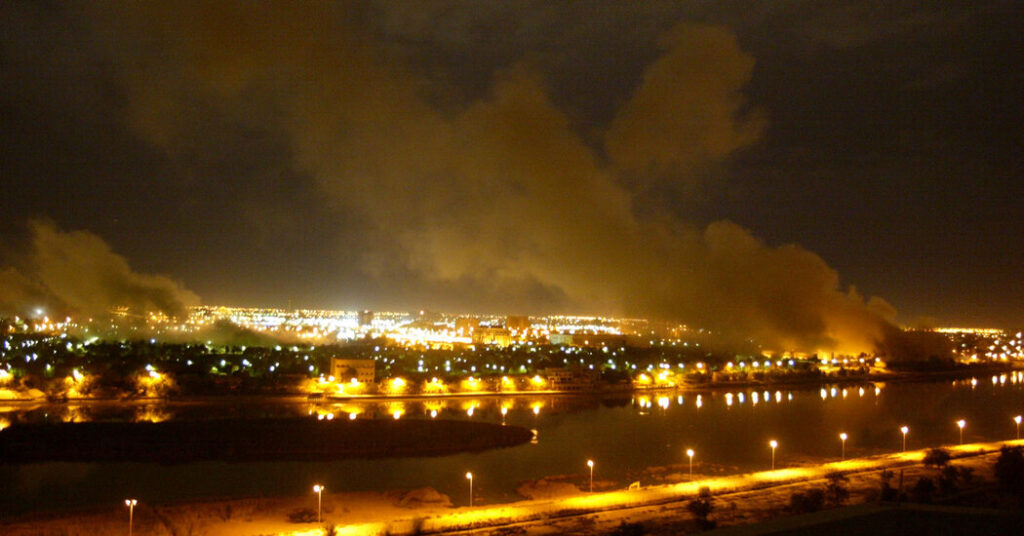
In 2003, only 18 months after NATO unanimously invoked collective defense after the Sept. 11 attacks on the United States, the alliance nearly split over Washington’s decision to go to war against Saddam Hussein in Iraq.
It was a war of choice, without United Nations Security Council approval, aimed to disarm Iraq of weapons of mass destruction, which did not exist, and overthrow Hussein.
Britain, Poland, Spain and other allies like Australia joined that war, while some major allies, like France, Germany and Belgium, refused. But the administration of President George W. Bush worked hard to consult the allies, prepare public opinion, involve Congress, debate the case in the United Nations and keep NATO together.
The contrast with President Trump’s war on Iran is stark. This is also a war of choice, but with varying aims, from regime change to nuclear dismantlement. There has been little effort to prepare public opinion, no discussion at the United Nations, no consultation with any ally except Israel and little effort to warn European or regional allies that the war was about to begin.
“In 2003, we worked the alliance, with President Bush and Secretary of State Colin Powell working the phones,” said Nicholas Burns, who was the American ambassador to NATO at the time and now teaches at Harvard. When Germany and France would not go along, “we didn’t like it, but we stood by our NATO allies,” he said. “That’s the difference with President Trump.”
One of Mr. Trump’s fundamental mistakes now, Mr. Burns said, is his failure to consult or even inform European and Asian allies dependent on oil and gas, or think through the day after. “If you prepare the ground diplomatically before you go in,” he said, “even if they don’t want to fight alongside you, they understand your strategy and you get so much more buy-in.”
Instead, a clearly frustrated Mr. Trump called on Sunday for countries that get energy through the Strait of Hormuz to help the United States open up the waterway. That would mean joining the U.S.-Israeli war on Iran, which allies are clearly reluctant to do.
“It’s only appropriate that people who are the beneficiaries of the Strait will help to make sure that nothing bad happens there,” Mr. Trump told the Financial Times. “If there’s no response or if it’s a negative response I think it will be very bad for the future of NATO,” he added.
NATO itself is a trans-Atlantic alliance that has traditionally not involved itself in the Middle East. It is committed to collective defense, but the United States initiated the war, which most European countries regard as illegal under international law. And they have made it clear that while they will not enter the war against Iran, they are prepared to help ensure the safety of ships through the Strait of Hormuz once hostilities end.
Europeans have come to see this war as just another indication that the Trump administration is indifferent to their concerns. The way it has been conducted has deepened the sense of alienation from Washington and the dysfunction of the alliance as Mr. Trump changes the rules among allies, perhaps permanently.
“This time there was not even the beginning of a pretense of a discussion,” said François Heisbourg, a French defense analyst. “As a place for consultation and decision-making, the alliance is basically over, because the Americans are not interested.”
The snub has left the Europeans both confused and divided, anxious onlookers, underscoring the fragility of their relationship to Mr. Trump’s America. Left hanging are questions about their role once the war ends, and even while it is being waged. That matters not only to them but also to the United States should it need help.
While the divisions in the alliance in 2003 were severe, with American officials playing off “Old Europe versus New Europe,” as Donald H. Rumsfeld, then the defense secretary, put it, Europe mattered, said Nathalie Tocci, director of the Institute of International Affairs in Rome.
“Underlying those divisions was a sense of European identity and agency, which has been lost,” she said. European public opinion was fiercely against the war in Iraq, with huge demonstrations and support for international law and effective multilateralism.
After that war, Britain, France and Germany came together with the European Union and its foreign policy chief at the time, Javier Solana, to begin negotiations on restraining Iran’s nuclear program, which produced the 2015 Iran nuclear deal that Mr. Trump excoriated and abandoned in his first term.
Despite its divisions, Europe stood up and acted.
The contrast to today is painful, Ms. Tocci said. “There are fewer divisions now about this war,” she said, “but paradoxically, it doesn’t lead to European agency, but to the opposite, to inaction and confusion and subservience to the U.S.”
The European response has been mixed, muted and muddled. Britain, France, Germany and Italy have refused to join the war, considering it a violation of international law.
At the same time, they have been reluctant to criticize Mr. Trump openly. (The clear condemnation from Prime Minister Pedro Sánchez of Spain has been an exception.)
There are two main reasons for that reluctance. First, Europeans do not want to be seen as defending the Islamic Republic in Iran, which has killed thousands of its own people, enriched uranium far beyond civilian uses and sponsored terrorism.
More important, they want to retain as much American support as possible for Ukraine against Russia. Unlike Iran, that war is a pressing European security danger, and they judge that the capricious Mr. Trump needs to be handled carefully.
Leaders like Prime Minister Keir Starmer of Britain initially refused to let America use British bases for the war. After Iran’s Lebanese ally, Hezbollah, hit a British base on Cyprus with a drone, Mr. Starmer allowed the bases to be used, but only for “defensive purposes.” He has also moved some military assets to help protect British soldiers and Persian Gulf allies.
President Emmanuel Macron of France behaved similarly once France’s own bases and regional allies were struck by Iran, as did Prime Minister Giorgia Meloni of Italy.
Germany, for its part, has toed a cautious, pragmatic line. Chancellor Friedrich Merz allowed American forces to use their many bases in Germany from the outset and was careful not to criticize Mr. Trump at their meeting in the Oval Office early this month. But given the importance of Ukraine, he and Mr. Macron objected on Friday to Washington’s temporarily lifting sanctions on the Russian oil sales that fund the war.
Unlike Iraq in 2003, when Germany knew that there were no weapons of mass destruction there, Iran is different, a senior European official said. Europeans have not been asked to join the war and have no military or even diplomatic leverage on Mr. Trump, the official said. The energy and stock markets have more influence on him, the official suggested.
The lack of consultation should not be a surprise, said John Sawers, a former British ambassador and former head of MI6, the Secret Intelligence Service.
“Trump has always treated the Europeans with a degree of contempt and doesn’t seem to think he needs allies, that allies hold America back,” he said. “He hasn’t changed his attitude toward Europe, and Europe hasn’t changed its attitude toward him.”
Europe’s great fear is a collapse of state power in Iran, with fragmentation, civil conflict and a huge outflow of refugees, he said.
“What is astonishing is that the U.S. doesn’t see the dangers of the aftermath,” Mr. Sawers said. “The countries of the region and Europe and the rest of us will be clearing up the mess of this for the next 10 to 15 years.”
At the same time, Europe appears confused. Some E.U. leaders in Brussels talk about standing up for the principles of international law. Others talk about working with the reality of a world in which the United States, Russia and China are acting with scorn for international organizations and norms.
These conflicting statements reflect European ambivalence, Mr. Heisbourg said.
“The Europeans are in a deep funk, with the sense that the wind of history is leaving us behind, with the rise of the authoritarians and the predatory states,” he said. “But Europe must defend its interests here, especially for the day after, and what it means for American power if the Islamic Republic survives and for the global energy and trading system.”
That explains why Mr. Macron has ordered an unprecedented number of French naval ships and its nuclear aircraft carrier to the region, to ensure that France has chips on the table, once hostilities end, to help protect navigation and discuss the future.
Once Mr. Trump decides to declare victory and end the war, Europeans believe, he will leave the broken pieces to others and go home, saying that he had given the Iranian people the chance to change their regime but that they had failed to do so.
Steven Erlanger is the chief diplomatic correspondent in Europe and is based in Berlin. He has reported from over 120 countries, including Thailand, France, Israel, Germany and the former Soviet Union.
The post In Iraq, the U.S. Tried to Bring Allies on Board. Not in Iran. appeared first on New York Times.