After Jeffrey Epstein agreed to pay more than $14,000 in private school tuition for the children of a German artificial intelligence researcher, he followed up with a pointed request: “You have yet to tell me your insights into how people see me.”
It was the summer of 2017. Mr. Epstein had recently been sued by yet another woman who had accused him of having trafficked her for sex, and he was eager for the opinion of the researcher, whose work he was funding.
The exchange, which was included in the millions of files related to Mr. Epstein by the Justice Department, shows how he wielded tuition payments to private primary and secondary schools, and the perception that he could sway their admissions processes, to build relationships and gain influence even after he was convicted of sex crimes in Florida.
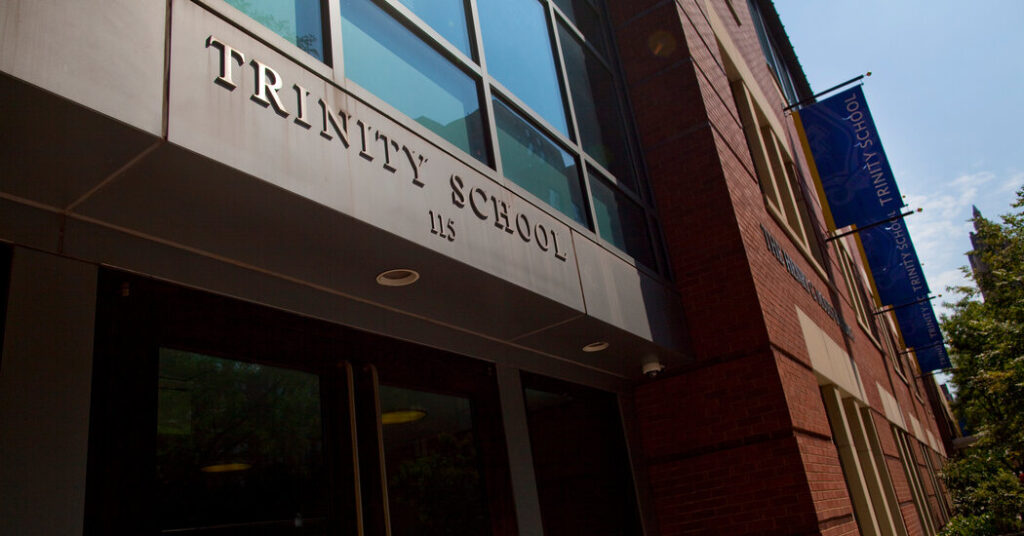
A review of the Epstein files turned up dozens of mentions of the Trinity School in Manhattan, Riverdale Country School in the Bronx, the Masters School in Westchester and other elite academies across casual conversations, dashed off emails and other records. In some cases, hopeful parents contacted Mr. Epstein for help with tuition or gaining admission for their children. In others, he appeared to reach out to the parents on his own initiative.
Among the parents were the researcher, Joscha Bach, the parents included the media and real estate mogul Mortimer Zuckerman; Eva Andersson-Dubin, a former Trinity board member who dated Mr. Epstein before marrying the hedge fund manager Glenn Dubin; and Mr. Epstein’s private banker.
All the exchanges occurred after Mr. Epstein was convicted of sex crimes in Florida in 2008, and before federal prosecutors in Manhattan accused him of sexually abusing dozens of girls and indicted him on sex trafficking charges in the summer of 2019. There is no suggestion in the files that the parents aided Mr. Epstein in any wrongdoing.
But the messages underscore how deeply entrenched Mr. Epstein had remained in the circles of the powerful even after he registered as a sex offender.
Mr. Epstein had long associated with prestigious private schools. He served briefly as a math and science teacher at the Dalton School on Manhattan’s Upper East Side before he was dismissed for poor performance and went to work in finance, and in the years that followed he moved in the same circles as some of the school’s leaders and prominent alumni.
In doing so, and occasionally offering to call in favors, Mr. Epstein was following a well-worn path for Americans of wealth and privilege, said Adam Howard, an education professor at Colby College who has studied prestigious private schools.
“This issue is not simply about Epstein or one man,” Mr. Howard said. “It is that these elite institutions often operate in a culture of quiet sponsorship and leverage and social networks. Most of us in the U.S. have no way of accessing these kind of networks that have one function and one function only: to make and remake elites.”
For Mr. Bach, the tuition payments came as part of an agreement that Mr. Epstein would fund his research at M.I.T. and Harvard — and his family’s living costs in the United States — from about 2013 to 2019.
Mr. Bach, who studies theories of consciousness and artificial intelligence, said he was connected with Mr. Epstein by other prominent scientists. In all, Mr. Bach accepted more than $180,000 from Mr. Epstein and stayed in one of his Manhattan apartments for a time in 2015.
The payments included more than $31,000 in tuition for Mr. Bach’s children to attend the private German International School Boston in 2016 and 2017, emails show. School officials did not immediately respond to a request for comment.
In an email to The New York Times, Mr. Bach said he received advice from scientists he respected saying that he should accept funding from Mr. Epstein.
“However, if I had known or suspected the horrible things that Epstein had been accused of after he was arrested again, or that he might engage in any renewed criminal conduct, I would not have accepted his funding or associated with him in any way,” Mr. Bach said.
“When Epstein offered to fund my research,” Mr. Bach said, “I told him that this might be difficult, because I have two children and would have to move my family to the U.S., which I could not afford.”
“He told me that he would take care of our living expenses for the time of the project,” he added, and said of the tuition payments: “This was part of the research funding he gave me.”
The files do not include a reply from Mr. Bach in which he shared his views about Mr. Epstein’s reputation. In a post on the website Substack late last year, he described Mr. Epstein as a “high-functioning sociopath” who was “high strung, intensely curious and utterly devoid of fear, guilt or shame.”
In the case of Mr. Zuckerman, he and Mr. Epstein had a long association, socializing and even at one point investing alongside one another. But by early 2014, their relationship had become tense: Mr. Epstein was aggressively pushing for Mr. Zuckerman, a billionaire, to hire him for estate planning, and Mr. Zuckerman had decided against doing so, the files show.
“Jeffrey, I just don’t feel comfortable with your structure I have tried and it doesn’t fit,” Mr. Zuckerman wrote to Mr. Epstein that February. “Sorry but that is why I could not proceed.”
Eight days later, Mr. Epstein sent an email to Mr. Zuckerman suggesting that he had learned through Ms. Andersson-Dubin that Mr. Zuckerman was trying to get his daughter into the Trinity School in Manhattan.
“We should speak,” Mr. Epstein wrote.
It was not clear whether Mr. Epstein took steps to aid Mr. Zuckerman’s daughter, but later that week, he emailed Mr. Zuckerman again, saying that he “was glad that everything worked out” for her.
Mr. Zuckerman, 88, did not respond to requests for comment.
Ms. Andersson-Dubin, for her part, called on Mr. Epstein for a favor related to Trinity when she was serving as a board member there in 2012, the files show.
That September, she emailed asking whether Mr. Epstein could arrange for the Nobel laureate and molecular biologist Richard Axel to speak at an assembly in 2012. She also noted that “if Woody Allen would consider this they would die!”
It was not clear whether either man ever attended an event at the school, and neither Ms. Andersson-Dubin nor representatives of Trinity responded to requests for comment.
Mr. Epstein also made tuition payments totaling more than $89,000 for the daughter of his longtime accountant, Richard Kahn, to attend the Nightingale-Bamford School on Manhattan’s Upper East Side.
Mr. Kahn’s lawyer declined to comment, as did a representative of the school.
In February 2018, Mr. Epstein’s personal banker, Paul Barrett, provided Mr. Epstein with a list of the headmasters and board members for Riverdale Country School, the Ethical Culture Fieldston School and the Masters School in Westchester and asked for help in getting his son off the schools’ wait lists, emails show.
Mr. Epstein replied, “late, but I’ll try.”
It was unclear what, if any, steps Mr. Epstein took on behalf of Mr. Barrett, who wrote again a month later, saying: “Did you have any more thoughts on this? Public school looking likely at this point.”
Mr. Barrett declined to comment.
Aside from those transactions, Mr. Epstein also donated more than $400,000 over a 13-year period beginning in the 1990s to Interlochen Center for the Arts, a prestigious boarding school in Michigan with grade-school- and high-school-level programs. And he and his longtime companion, Ghislane Maxwell, used a lodge that he funded there to recruit some of their earliest victims, NPR reported in February.
A spokeswoman for Interlochen said that in 2009, when administrators learned of Mr. Epstein’s criminal convictions, the school conducted an internal review and found no record of complaint or concern about Mr. Epstein, who died in a Manhattan jail cell while awaiting trial on the federal sex trafficking charges in 2019. His death was ruled a suicide.
After his arrest in 2019, a second review was conducted at Interlochen that failed to turn up any complaints about Mr. Epstein, said the spokeswoman, Maureen Oleson.
“We continue to be appalled at what we have learned about the scope of conduct by Epstein and his co-conspirators and we expect that a more comprehensive understanding of the full scope will continue to evolve,” Ms. Oleson said.
Jan Ransom is an investigative reporter for The Times focusing on the criminal justice system, law enforcement and incarceration in New York.
The post One of Epstein’s Levers of Power: Access to Elite Private Schools appeared first on New York Times.