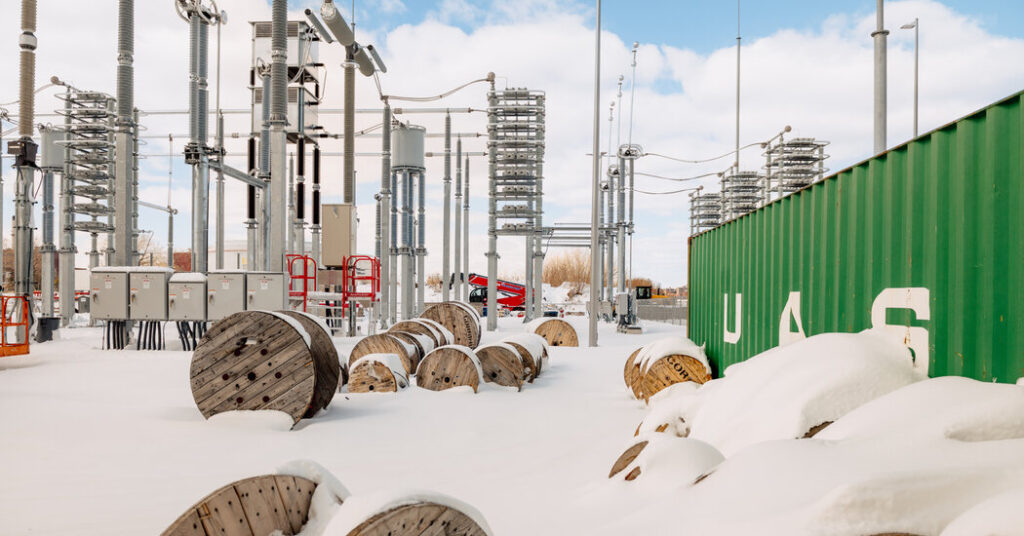
Behind a security gate on an industrial lot in Queens, a futuristic-looking hangar sits on the site of an old fossil fuel storage facility. Inside, an obstacle course of spiraling coils and knobs will convert hydropower from Canada into clean electricity for the New York City grid.
The site is the terminus of a 339-mile transmission line known as the Champlain Hudson Power Express. When the $6 billion endeavor comes online this spring, it will feature the longest buried transmission line in North America, capable of providing up to 20 percent of the city’s power, according to Transmission Developers, the company that built it.
The massive power project, expected to provide energy to a million New York City customers a year, travels underground and underwater, from the northern plains at the Canadian border to the filled-in marshlands of coastal Queens, much of it loosely following the Hudson River. Its construction included the underwater installation of more than two million feet of cable imported from Sweden. It also required special boats, loaded with equipment that could shoot water jets deep into the sediment, to create trenches for the cable. Then, when it came to placing cable beneath the landscape, more than 700 land-use easements were needed, plus an additional 1.55 million feet of cable.
“This is far and away the largest project I have ever worked on,” said Bob Harrison, who has worked in infrastructure for 40 years and is the head of engineering for the Champlain Hudson Power Express. “We like to say it’s the largest project you’ll never see.”
The arrival of hydropower in New York City comes as fossil fuels are suddenly back in the spotlight, thrust there by President Trump, who has sought to reopen forgotten mines and push his “Drill, baby, drill” agenda. At the same time, energy costs are rising — in part because of the war in the Middle East. As a result, Gov. Kathy Hochul of New York is moving to amend the state’s landmark 2019 climate law, which calls for reducing planet-warming greenhouse gas emissions.
The hydro project was designed to do just that, but whether emissions overall will decline depends on myriad factors beyond the walls of the Queens plant, including any changes to the climate law; upcoming city and state regulatory decisions; and shifting weather patterns, some of them wrought by climate change.
Still, the completion of the project is a renewable energy victory for Ms. Hochul, who threw her support behind the ambitious initiative five years ago. That paved the way for Transmission Developers, a company owned by Blackstone, the private-equity firm, to pay for, begin and complete construction of the transmission line.
“Despite the federal headwinds we are facing, New York under my administration is still committed to a clean energy future,” Ms. Hochul said in a statement.
The state is no stranger to hydropower, an ancient form of energy that works by converting moving water to electricity. In 1931, Franklin D. Roosevelt, who was New York’s governor at the time, capitalized on the state’s natural resources to create the largest state-owned electric utility in the United States. Its hydroelectric plant near Niagara Falls ranks as one of the top four largest, by capacity, in the nation. These days, hydro represents more than 20 percent of New York’s total power.
But the state’s hydro facilities are already at capacity. Plus, connecting transmission lines to the city has historically proved difficult because power system bottlenecks abound, as wires and cables compete with sewers and subways underground. In a situation often referred to as a “tale of two grids,” upstate New York receives the bulk of hydropower, resulting in much cleaner electricity upstate, whereas New York City depends mostly on fossil fuels.
The Champlain Hudson Power Express has found a way to plug into the city, but it wasn’t easy. The work included 10 new manholes and more than three miles of new underground circuitry, according to Con Edison, the city’s primary electricity provider. “It was literally a hand weave under the streets of Queens,” said Jennifer Laird-White, the head of external affairs for Transmission Developers.
The hydropower travels from Canada via two buried cables that are as round as cantaloupes. Those lines snake for hundreds of miles under a lake, several rivers (including the Hudson for about 90 miles) and through buried trenches alongside train tracks and roads. The cables resurface in Astoria, Queens, where a converter station shapes, filters and refines the raw power into a product that New Yorkers can consume.
In two cavernous rooms that could be mistaken for “Star Wars” sets, the electricity flows through 30 hanging structures encased in what look like metallic, dinosaurlike exoskeletons. Each one weighs about as much as a small humpback whale and contains microprocessors, thousands of valves and fiber wires.
“I am still wowed when I walk into that facility,” said Mr. Harrison, the engineer. “I mean, it is just mind-boggling.”
Con Edison customers will not pay more for the construction to connect the transmission line to New York City. When a new power venture plugs into Con Edison’s grid, the developer typically pays for the hookup, a spokesman for the utility said. Statewide, however, ratepayers are projected to see their monthly energy bills increase about $1.65 for 2027, the first full year that the Champlain Hudson Power Express will be online.
Hydro-Québec, the Canadian company providing the energy, will pay Blackstone for use of the transmission line, while also selling its energy to the New York Independent System Operator, a not-for-profit corporation that manages the state’s flow of electricity.
Once the new system is operational, it will play an important role in the city’s climate law, which requires large buildings to decrease harmful emissions. Property owners will be able to offset some of their pollution by buying state-subsidized credits to support the Champlain Hudson Power Express. The deal is concerning to some climate activists who view the credits, called renewable energy certificates, as an easy way for building owners to keep polluting.
“Instead of upgrading their properties to high energy efficiency, owners could opt to purchase renewable energy credits generated by the project, especially if the price of those certificates is low,” said Pete Sikora, a campaign director at New York Communities for Change, a nonprofit organization. (The state has yet to determine the price of the credits.) Mr. Sikora’s group supports the Champlain Hudson Power Express, he said, but would like to see the city push for a stricter cap on credit purchases.
Drew Gamils, an attorney at Riverkeeper, an environmental nonprofit, said that a hydropower project should not have qualified for the credits.
“Hydro is not truly a renewable source,” Ms. Gamils said, because building dams releases greenhouse gases and destroys habitats, a view shared by other groups and energy experts, including Robert McCullough, principal of McCullough Research, an energy consulting firm in Portland, Ore.
“Is hydro better than coal, yes,” he said. “But it is worse than wind and solar.”
In North America, much of the environmental damage associated with hydropower occurred in the middle of the last century, when most major dams were built, including in Quebec, where the land of Indigenous people was taken for the construction of the province’s vast hydropower network, originally without their consent or compensation.
Lucien Wabanonik, the chief of the Anishnabe First Nation of Lac-Simon, a community of about 2,500 residents in Canada, said he and others would like a seat at the table for future infrastructure decisions. “The dams are within our territory,” he said. “So the energy comes from our territory.”
Since the 1970s, Hydro-Québec has made progress on this front, having entered into more than 50 agreements with Indigenous communities, though negotiations are ongoing. For the Champlain Hudson Power Express, the Canadian utility has entered into a revenue-sharing partnership with the Mohawk Council of Kahnawà:ke, a First Nation community in the path of the project.
Though the agreement was signed almost two years ago, several key items to finalize the partnership are still needed, according to Cody Diabo, the Mohawk Council’s grand chief. “The real test of these partnerships lies in how they are implemented in practice,” Mr. Diabo said.
Another concern about the hydropower project: extreme weather. In January, a similar transmission line made its debut in Massachusetts. But days later, a deep freeze hit Quebec and the Northeast, interrupting the flow of hydro to Massachusetts for several days, because Quebec needed the energy to survive the cold snap.
It turns out that even as Hydro-Québec was exporting hydropower to Massachusetts this winter, the Canadian power supplier was having to import electricity generated from natural gas and oil from other Canadian provinces and the United States, “making environmental benefits questionable,” Mr. McCullough said.
The temporary hydro slowdown that beset Massachusetts could just as easily happen in New York City, because Quebec’s energy needs run high from November to March, Mr. McCullough said.
Serge Abergel, the chief operating officer at Hydro‑Québec, said that the utility was legally obligated to deliver enough energy for roughly one million homes throughout the year. The contract allows for flexibility, with looser terms in the winter, when Quebec faces higher demand, which bodes well for New York’s summer heat waves.
But Quebec also has been in a three-year drought, which has reduced its reservoir levels, a phenomenon occurring in other parts of the world. A spokeswoman for Hydro-Québec said that its nearly 30 reservoirs could weather the drought, because they store rain from wetter seasons to compensate for drier ones.
But Mr. McCullough said that less water meant less energy production, and it’s possible that the region could experience a fourth year of a drought.
“This is a very serious problem for Quebec, since almost all of its electricity is generated from hydroelectric dams,” Mr. McCullough said.
Hilary Howard is a Times reporter covering how the New York City region is adapting to climate change and other environmental challenges.
The post Hydropower Line From Quebec to Queens Could Power a Million N.Y.C. Homes appeared first on New York Times.