Grand Central Atelier, despite its name, is not a fashion design studio near the famed transit hub in Manhattan, but a small art academy in the Ridgewood neighborhood of Queens, near nightclubs and a cemetery.
There on the outskirts of the art world, in sky-lit studios stacked with replicas of famous sculptures and posters of Renaissance paintings, around 50 students study a classical style of art as they strive to become the next Michelangelos and Rembrandts.
Now, Grand Central has also been enlisted in the Trump administration’s efforts to reclaim the arts and humanities from the progressive trends of mainstream academia.
In January, the school — which has three full-time employees and no formal accreditation — was among the first-time recipients of outsize grants from the National Endowment for the Humanities. Grand Central received $2 million to support what the agency described as “a two-year public humanities project focused on the vital role of the humanities in American public life.”
The grant was about as large as the school’s annual budget. And like many of the agency’s other recent multimillion-dollar awards, it went to a handpicked recipient, outside the agency’s usual open competitive process.
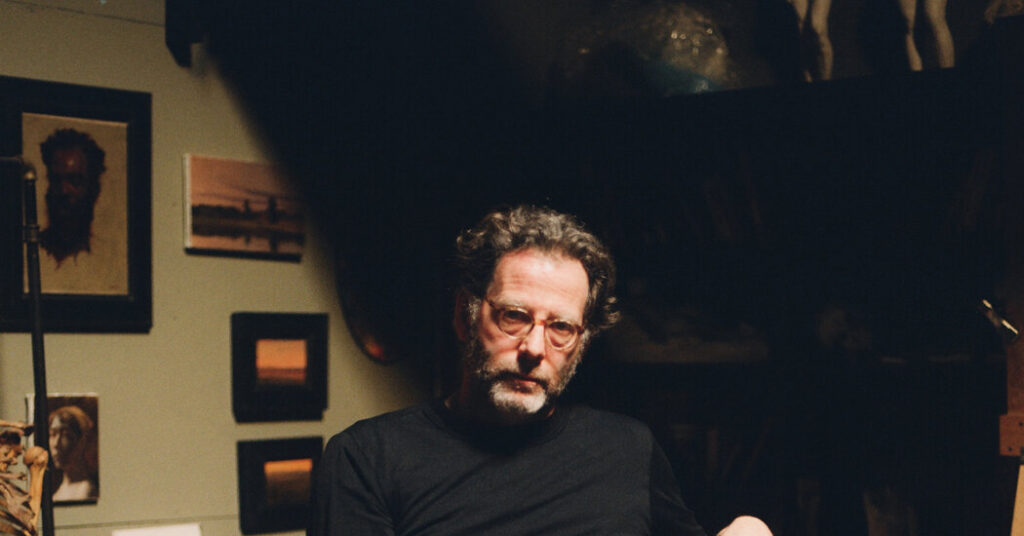
For its founder and artistic director, Jacob Collins, the grant is an opportunity to raise his school’s profile. It also represents a chance to further what he calls his lifetime mission to inspire a return to a classical style of art that last reigned supreme in an era before the Civil War, when neoclassical styles and painting scenes from real life were dominant.
For the Trump administration, this return to classicism echoes its priorities in building a triumphal arch in Washington and issuing an executive order last year to “Make Federal Architecture Beautiful Again” — symbols of a bygone era when classical aesthetics were the federal government’s default style.
Many art schools teach students basic techniques in painting and drawing before leading them into critical theory and studio practices. But at Grand Central, artists continue honing those core skills.
“We are an unusual outfit,” Mr. Collins said, walking down the narrow hallway between the atelier studios, as aspiring artists sketched live models. “There aren’t a million places that do what we do.”
These are also unusual times for the endowment, the nation’s largest public funder for the humanities, with an annual budget of $207 million.
Last spring, after the agency’s previous leader, a Biden administration appointee, was ousted, the agency abruptly canceled nearly all previously approved grants — some 1,400 in all — as part of a pivot to what the agency’s interim leader has described as an “America First” vision. The White House then fired nearly all members of the outside scholarly board that by law must advise on most grants.
Still, the money has continued to flow, with multimillion-dollar awards — including several of the largest in the agency’s history — going to handpicked recipients for projects that promote Western civilization and traditionalist humanities.
Some of the largest grants have gone to conservative-backed civic thought centers at state universities, which have been created in recent years as a counterweight to the liberal tilt of academia. Others will support a network of small traditionalist humanities institutes that have been established near elite schools like Harvard and Columbia.
The shift in the agency’s granting has been cheered by some on the right, who see a new openness to conservative ideas, and criticized by many academics, who discern a traditionally apolitical agency being turned into an ideological arm of the Trump administration.
Mr. Collins has waded into politically charged debates about what constitutes authentic American culture, and the artist’s role in promoting it. At the 2025 National Conservatism Conference in Washington, the artist — a grandnephew of the art historian Meyer Schapiro — argued that America’s turn toward modernism over the past century had been “an error.” The European models of abstraction, he said, had complicated the optimism of “natural American empiricism” that had existed in paintings made between the late 1700s and the beginning of the Civil War.
Still, he sees the school’s mission as being above the ideological fray. “To say things aren’t politics — that’s just not true,” he said. “But the artist is very wise to be as unpolitical as possible.”
Rejecting Modernism and Gaining Fans
Since graduating from Columbia University and studying painting at schools like the New York Academy of Art, Mr. Collins, 61, has established himself as one of the city’s leading classical painters, espousing the emotional honesty of early American painting and Renaissance idealism.
“From an early age, I had this tremendous, passionate love for what people call old masters,” Collins said, naming painters like Vélasquez and Titian. “I found myself trying to do something that wasn’t on the menu.”
So he started his own classical art academy, the Water Street Atelier, in the 1990s as he built a family with his wife, Ann Brashares, author of the “Sisterhood of the Traveling Pants” book series. The school later morphed into Grand Central Academy, which had a partnership with the Institute of Classical Architecture in Manhattan, before it began operating independently as a nonprofit in 2014 under its current name.
Most scholars attribute the global ascent of American art through the 20th century to its embrace of modernism, which laid the groundwork for homegrown movements like Abstract Expressionism and Pop Art.
Mr. Collins said that his biggest gripe was with the institutionalization of modernism within art history, which he described as “some kind of inauthentic overlay, like AstroTurf,” laid down by wealthy art collectors and major institutions like the Museum of Modern Art.
Views like these have brought him a devoted fan base among conservatives. In 2018, the Texas billionaire Harlan Crow commissioned him for a portrait of Justice Clarence Thomas that now hangs at Yale Law School.
Since at least 2023, Mr. Collins has served on the advisory board of the Roger Scruton Legacy Foundation, a group promoting “the philosophical and cultural achievements of the West.” Other advisers at the foundation include a number of scholars and artists aligned with the Trump administration, including the architect Robert Adam, who is working on the new White House ballroom.
And at last fall’s National Conservatism Conference, which attracted a who’s who of pro-Trump political and intellectual figures, Mr. Collins appeared on a panel called “The Artist as Nation Builder.” He spoke alongside Justin Shubow, who helped write the White House’s executive order on architecture, and Jonathan Keeperman, the founder of the far-right publisher Passage Press, who has argued for “reclaiming” American culture from an overly feminized and anti-American elite.
Admirers of the painter said his work was helping to revive an appreciation of neoclassical styles. “Jacob is one of the best living painters working within the classical tradition,” Mr. Shubow said in an interview. “He is deeply respected among connoisseurs and collectors of traditional art.”
High Expectations, Little Experience
But exactly how Grand Central came onto the agency’s radar, and why it was selected for such a large noncompetitive award, is unclear.
The humanities endowment, which is defending itself against two lawsuits challenging the mass cancellation of grants last spring, did not respond to a detailed list of questions about the grant. And Mr. Collins offered conflicting versions of what led to it.
He initially said he was approached by Michael McDonald, the agency’s acting chairman. But he later said that he had reached out to Mr. McDonald in August after a mutual friend he declined to identify suggested he do so. (Last month, President Trump nominated Mr. McDonald, the agency’s general counsel, as permanent chair.)
Grants from the humanities endowment are typically awarded through a rigorous competitive process, with a public call for applications and proposed projects undergoing multiple rounds of review.
Only 16 percent of applications are successful, according to the endowment’s website. In recent years, awards have ranged from $1,000 to about $750,000, with seven-figure awards a rarity.
Past applicants describe an arduous process, with applications running to hundreds of pages and including detailed work plans, thorough lists of partners and budget justifications that account for costs down to postage and envelopes.
“These are not projects where you wing it,” said Joseph Horowitz, a conductor and historian who has been involved with nine successful grants, including one that was terminated last spring. “These are projects where you know exactly what you are doing, how you’re doing it and how you chose the participants you chose.”
According to a news release from the humanities agency, the $2 million grant to Grand Central will support “a public lecture series, studio lectures for art students, a symposium, a digital publication, and the creation of two new postdoctoral fellowships — all designed to deepen understanding of the intersections between art, history, and civic culture.”
The whole project is named in honor of Bruce Cole, a Renaissance art historian who ran the endowment in the George W. Bush administration and was known for critical views about progressive trends in academic art history.
In the past, Grand Central, which does not have an event space, has organized occasional small-scale lectures and concerts that have attracted a few dozen people. And Mr. Collins, who had not previously applied for a federal grant, found some of the terminology unfamiliar.
“They have this word — deliverables — which is not a word that I have used before,” he said.
Mr. Collins declined to provide a copy of Grand Central’s official application. But in an email, the school provided what it described as a brief budget outline.
It lists $207,600 for a series of 12 public lectures, $120,000 for fellowships and $102,000 for a one-day symposium, plus $174,000 for “contracted administrative support.”
In addition to the standard 15 percent markup for overhead, there is an additional $930,000 — nearly half the grant — for unspecified “staffing.”
The school later clarified that the $930,000 would cover four new two-year positions with salary packages close to $100,000, plus $60,000 for an “artistic director,” the position currently held by Collins.
“We thought we could do something great and we figured it was going to be expensive,” Mr. Collins said. “We figured, let’s ask for enough.”
The Politics of Traditional Art
Collins knows that his atelier is an outlier in the art world. But he sees the project as a chance to cultivate “an incipient community of patrons, collectors and scholars to surround what could be a tiny — or maybe not so tiny — new renaissance.”
Some students have returned to teach at the school, where annual tuition is $13,800, to join a small ecosystem of jobs and patronage outside of the mainstream art world. Several artists have also gained a foothold on social media platforms like Instagram and TikTok, where they publish videos about the process of making art.
Chelsea Bard, an alumna and former teacher, said that she had a positive experience at the school. “As a student, it felt like Jacob was someone who had spent a lifetime trying to understand how to make the classical skill set accessible to people who weren’t exposed to those concepts,” she said.
While politics weren’t discussed in the classroom, many students debated among themselves what it meant to pursue such an old genre of painting. “I know that for me and other instructors in the program, studying classical art was firmly not a decision to go back to the past,” Ms. Bard said. “For us, it was about having a conversation with those traditions in new contexts and conditions.”
But when he speaks about classical painting, Mr. Collins often expresses his own desire for returning to the past. “It is a curse for me that I could never get to be that person that the 1890s allowed,” he said in a 2016 Brooklyn Rail interview.
Sitting in his atelier, Mr. Collins said that artists should resist becoming polemicists. One way to do that is by avoiding current trends. “I think there are intellectual vulnerabilities to the contemporary art tradition,” he said.
Wading through the attention that comes with being an art group associated with the Trump administration, Mr. Collins understands that he might be opening up his school to outside criticism. But he thinks the risk is worth it.
“I worry there is not a culture to embrace that particular passion,” he said, walking between the atelier’s classrooms. “I’m not trying to change the art world, I’m just trying to carve out a little space for these artists.”
Zachary Small is a Times reporter writing about the art world’s relationship to money, politics and technology.
The post Why Did Trump Officials Award $2 Million to a Small Art School in Queens? appeared first on New York Times.