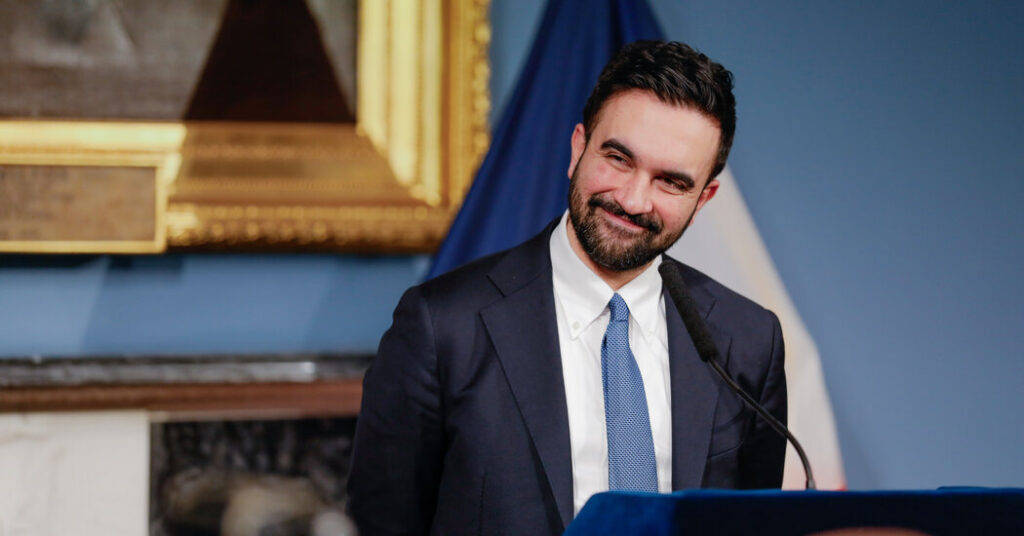
Zohran Mamdani was on the brink of completing his buoyant ascent to City Hall last November when he stepped off the campaign trail to take care of a less savory matter.
He had gotten wind that a fellow young leftist, Councilman Chi Ossé of Brooklyn, was gearing up to challenge Representative Hakeem Jeffries, the House Democratic leader. The councilman, inspired by Mr. Mamdani’s insurgent campaign, might have expected to have his support.
But when Mr. Mamdani phoned Mr. Ossé on the eve of Election Day, the mayor-to-be was furious. He told the councilman that he could not win, and that if he started a high-profile fight, it would undermine the left. Then the hardball started.
First, Mr. Mamdani told Mr. Ossé he would like to make him a key figure in his governing coalition — imagining the councilman at his side, for example, when he announced a new bus lane in his district — but only if he dropped the bid, according to three people familiar with the call. Then he levied what Mr. Ossé has described to associates as a more overt threat, saying that if his ally persisted, he would ice him out completely.
After the call ended, an email was waiting in Mr. Ossé’s inbox: His invitation to Mr. Mamdani’s victory party the next day had been rescinded.
In the year since he burst onto the city stage, Mr. Mamdani, 34, has eagerly played the part of happy warrior. Young, idealistic and self-deprecating, he appeared to soar right over New York’s famously cutthroat political culture on the path from obscurity to power.
But several incidents described by people close to him — including the previously unreported call with Mr. Ossé — offer a glimpse into another, equally consequential side of the new mayor often hidden by his omnipresent smile. What emerges is a pragmatic and cunning politician at the height of his powers and unafraid to use them — even if it means delivering a sharp elbow to old friends and compromising his ideological purity as a democratic socialist.
“Every successful political person has to either come to the table with the ability to be a little bit ruthless from time to time, or they have to pick it up quickly,” said Jay Jacobs, the state Democratic Party chairman, who did not support Mr. Mamdani’s campaign.
“Otherwise,” he added, “you don’t survive.”
The heavy-handed approach has bruised some allies, who say the Democratic mayor is wasting capital on internal fights that they worry are sometimes driven less by strategy than by a desire to exert personal control over the movement.
More than a dozen spoke extensively about what they see as a disconnect between his public and private personas, but insisted on remaining anonymous because they feared the consequences of angering him. Mr. Ossé declined to comment.
Others argue that Mr. Mamdani is making smart bets to push his policy priorities through Albany and build up democratic socialist power. The mayor, they say, is not interested in lost causes, even noble ones.
When asked about Mr. Mamdani’s recent political maneuvering, Morris Katz, his top political adviser, said, “The mayor is incredibly popular, and he’s going to harness that popularity. People should understand that and be on the right side.”
Mr. Mamdani’s strategic flexes have sometimes broken into public view. He recently presented President Trump with a mocked-up newspaper front page with Mr. Trump’s face on it, playing to the ego of a man he once called a “despot,” to entice him into funding housing construction. He endorsed Gov. Kathy Hochul, a moderate loathed by the left, over a progressive primary challenger because she is helping him expand free child care.
Behind the scenes, though, Mr. Mamdani has wielded his power in even more personal and often surprising ways, including by strong-arming liberal nonprofit groups, snubbing close friends and warring with a leading ally who was trying to secure her legacy.
Many of the clearest examples of Mr. Mamdani’s tactics involve appeasing Ms. Hochul, who has the power as governor to make or break his agenda.
When he was an assemblyman, Mr. Mamdani was a critic of the governor, once saying that her policy reversals were “why people don’t trust politicians.” As mayor, though, he has not only opted out of public fights with Ms. Hochul, but has used his political capital on her behalf.
In February, Mr. Mamdani learned that the Working Families Party, an influential left-wing party, was moving toward potentially backing Ms. Hochul’s lieutenant governor, Antonio Delgado, in a Democratic primary against her. An endorsement from the group promised to breathe new life into Mr. Delgado’s campaign and cause headaches for the governor.
Mr. Mamdani privately got to work trying to kill it. Along with two political advisers, Mr. Katz and Andrew Epstein, he spent hours on the phone leaning on members of the party’s advisory committee, which was set to vote on an endorsement.
Mr. Mamdani did not make any direct threats, people familiar with the calls said. But the mayor and his advisers told them that they thought an endorsement of Mr. Delgado would be a wasted gesture that could damage the left’s working relationship with Ms. Hochul.
Mr. Mamdani knew many of the party’s members would never endorse Ms. Hochul, given her opposition to raising taxes and other leftist priorities, but he pushed them to simply stay neutral in the race.
When the party voted in February, he got what he wanted — and called Ms. Hochul to make sure she knew his role. A few days later, Mr. Delgado dropped out of the race, leaving Ms. Hochul unopposed for the nomination.
It was not the first time the mayor’s team had quietly done a favor for Ms. Hochul.
In January, he and the governor struck an agreement to begin expanding free child care. They held a celebratory rollout at a Brooklyn Y.M.C.A., where they posed with dozens of elected officials and advocates — with one notable exception, State Senator Jabari Brisport.
Mr. Brisport, a fellow democratic socialist and onetime roommate of Mr. Mamdani, had fought for a child care expansion for years. But that week, he had also endorsed Mr. Delgado, and Ms. Hochul’s team was not pleased when the senator took a place onstage.
The governor’s office demanded that Mr. Brisport be moved out of the view of television cameras. Mr. Mamdani’s top aide interceded and fulfilled the request, according to Mr. Brisport and two people briefed on the exchange. (City and State previously reported the snub, but not that the mayor’s office had played a role.)
In an interview, Mr. Brisport said he had spoken afterward to Mr. Mamdani, who was apologetic. “I blame the governor 100 percent for what happened,” the senator said.
Mr. Mamdani has had embarrassing misses, too, highlighting the limits of his use of power. The highest-stakes example came after his election, when he tried to use his clout with unions and other Democrats to stop Julie Menin, an Upper East Side moderate, from becoming City Council speaker. He was outflanked, and as speaker Ms. Menin has quickly demonstrated a willingness to criticize the mayor.
The mayor has also expended an unusual amount of effort trying to shape a handful of state and congressional races, often in ways that have divided his own coalition.
The most notable case began in November, when Representative Nydia M. Velázquez, a revered matriarch of the left, unexpectedly announced her retirement. She had been the first member of Congress to back Mr. Mamdani’s mayoral campaign, and now hoped he would not interfere with her desire for one of her protégés to succeed her.
Ms. Velázquez, 72, and the mayor privately discussed several potential candidates, including one she thought they could both get behind, City Councilwoman Tiffany Cabán — who is Puerto Rican, like Ms. Velázquez, and a democratic socialist, like Mr. Mamdani.
He had other ideas. Ms. Cabán had been a critic of his decision to run for mayor, and the mayor’s advisers made little secret of his dislike for her. He began clearing the field for another candidate, Claire Valdez, a first-term assemblywoman from outside Ms. Velázquez’s circle who was closely aligned with Mr. Mamdani within the Democratic Socialists of America.
In January, after Mr. Mamdani had asked Ms. Velázquez to try to stay neutral in the race, the congresswoman was blindsided when he publicly endorsed Ms. Valdez, using his popularity to help box out Ms. Cabán, according to three people familiar with their exchanges.
Ms. Velázquez felt disrespected. She soon backed another protégé, Antonio Reynoso. Now, what could have been a seamless transition has turned into one of the nastiest primaries in the state, testing Mr. Mamdani’s political influence against that of the congresswoman and other progressives who have sided with Mr. Reynoso.
She declined to comment for this article, but previously told The New York Times that Mr. Mamdani’s actions risked driving a wedge through the left.
And then there was the case of Mr. Ossé.
After November’s phone call, Mr. Mamdani followed through on a promise to try to stop the councilman’s campaign, personally showing up at a D.S.A. meeting to lobby members against backing him, despite their dislike of Mr. Jeffries.
After the group narrowly sided with the mayor in a vote, Mr. Ossé dropped out of the race in December. Three months later, the two men evidently have not reconciled.
Dana Rubinstein and Jeffery C. Mays contributed reporting.
Nicholas Fandos is a Times reporter covering New York politics and government.
The post Behind Mamdani’s Smile, a Politician Who Can Be a Ruthless Operator appeared first on New York Times.