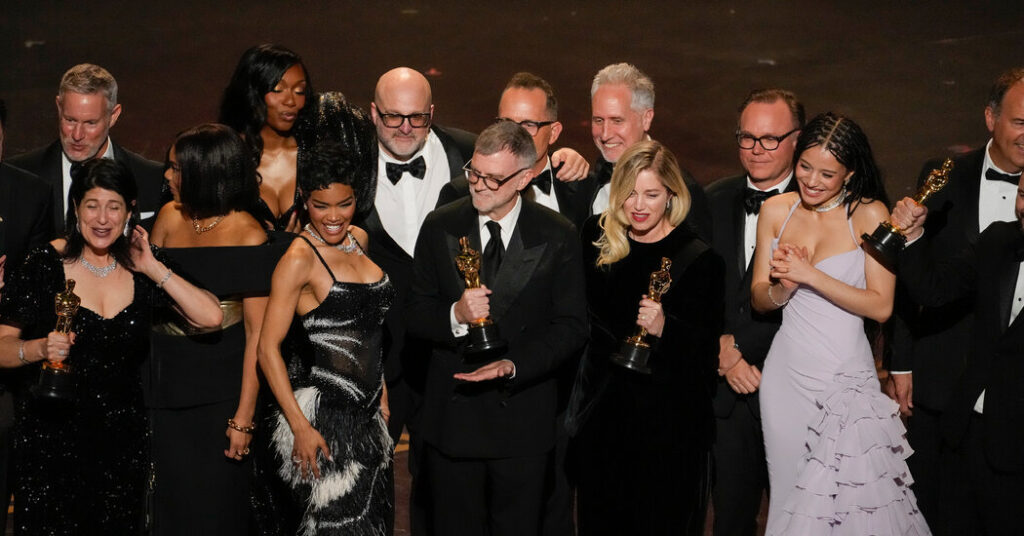
“One Battle After Another” won six Oscars at the 98th Academy Awards on Sunday, including those for best picture and best director, at long last cementing Paul Thomas Anderson’s status as one of the foremost filmmakers of his generation.
A primal scream about authoritarianism and citizen resistance, “One Battle After Another” was also honored for Anderson’s adapted screenplay, giving the 55-year-old auteur three statuettes to take home after 28 years of nominations but no wins. (His first career nod was for “Boogie Nights” in 1998.) “One Battle After Another” added statuettes for best supporting actor (a no-show Sean Penn), casting and editing.
“What a night!” Anderson said from the stage. “Let’s have a martini.” The camera cut to the audience, where a hooting Steven Spielberg was using his hands like a megaphone.
But the evening was not a sweep. “Sinners,” a period horror fantasia about African American identity and trauma, received four Oscars, including one for Ryan Coogler’s original screenplay. The film added trophies for its score, lead actor (Michael B. Jordan, another first-time winner) and cinematography.
Jordan played the diabolical twins Smoke and Stack. He thanked Warner Bros. and Coogler for “betting on original ideas and original artistry.”
With her victory in the cinematography category for “Sinners,” Autumn Durald Arkapaw became the first woman to receive the honor in academy history. During her acceptance speech, she asked the women in the room to stand. “I feel like I don’t get here without you,” she said.
Here are other takeaways from the show:
-
Big night for Warner Bros.: “One Battle After Another,” which collected $210 million worldwide, and “Sinners,” which sold $369 million, both came from the same studio: Warner Bros. Most of Hollywood’s old-line movie companies have become fixated on sequels and remakes, but Warner has also gambled on highly original, big-budget movies, with “One Battle” and “Sinners” as prime examples. Netflix and Paramount Skydance spent recent months trying to acquire Warner and related corporate assets. Paramount Skydance, which notably had no Oscar nominations on Sunday night, emerged as the winner. If the acquisition clears a regulatory review later this year, the Oscars will be the end of an era for Warner — its end as a stand-alone movie company.
-
Tough night for indies: Netflix left the ceremony with seven Oscars, the most in its history, according to Ted Sarandos, the streaming services’s co-chief executive. Those wins — along with the love showered on Warner’s auteur blockbusters — came at the expense of indie darlings like A24’s “Marty Supreme,” which starred Timothée Chalamet and left empty-handed despite having nine nominations. (The voter backlash to Chalamet’s swaggering antics on the Oscar campaign trail has been real.) Also blanked were “The Secret Agent,” a Brazilian film, and the absurdist “Bugonia,” each of which had four nominations.
-
Best actress: The Irish actress Jessie Buckley completed an awards season sweep (the Golden Globes, the BAFTAs, various guild ceremonies) by winning the best actress Oscar. She was honored for her performance of a mother shattered by grief in “Hamnet.” It was the specialty film’s only victory out of eight nominations.
-
Three wins for ‘Frankenstein’: “Frankenstein,” a lavish period drama on Netflix, won the best costume category. It also won the Oscar for makeup and hairstyling. Anne Hathaway and a surprisingly funny Anna Wintour, the Condé Nast czarina, appeared as the presenters in a scripted marketing moment for the coming 20th Century Studios movie “The Devil Wears Prada 2.” (ABC, which broadcasts the Oscars, is owned by Disney, which also owns 20th Century. Welcome to today’s corporately consolidated Hollywood.) The film also won for production design.
-
Casting gets a statue: For the first time, the Academy Awards gave a casting director a little gold man, honoring Cassandra Kulukundis for helping to put together the sprawling ensemble of “One Battle After Another.” It was an upset: Going into the ceremony, Francine Maisler had been a favorite for her work on “Sinners.”
-
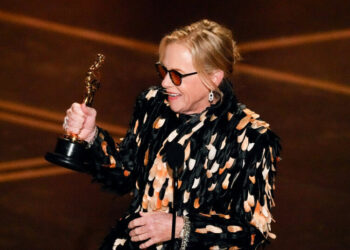
Supporting actress: Amy Madigan received the supporting actress Oscar for her unhinged Aunt Gladys in “Weapons.” It was a late-career triumph for Madigan, 75, who has been a character actress since 1982. “He just wrote a dream part and let me just grab it by the throat,” Madigan said from the stage, thanking Zach Cregger, who wrote and directed the film.
-
‘KPop Demon Hunters’: The film was named best animated movie, and it also won for best song. Maggie Kang, one of the film’s directors, used her acceptance speech to encourage diversity in filmmaking. “This is for Korea, and for Koreans everywhere,” she said.
-
And the award goes to … two!: In a rarity at the Oscars, one category — live-action short — resulted in a tie between “Two People Exchanging Saliva” and “The Singers.” The outcome resulted in an awkward moment, when producers for the show tried to move things along by turning off stage lights during an acceptance speech; the microphone also began to retract into the stage.
-
In memoriam: Billy Crystal opened the in memoriam segment by honoring the director Rob Reiner. Barbra Streisand later briefly sang in tribute to Robert Redford, with words projected on the wall above the orchestra: “The glory of art is that it cannot only survive change, it can lead it.”
-
Documentary winners: Jimmy Kimmel — taking a comedic swipe at Melania Trump’s recent vanity documentary — presented the Oscars for nonfiction filmmaking. “All the Empty Rooms,” about the bedrooms left behind by children killed in school shootings, won for short documentary, while the feature prize went to “Mr. Nobody Against Putin,” about Russia’s efforts to control public perception during its war with Ukraine.
-
The host: Conan O’Brien, hosting for the second consecutive year, opened the show with a parody of “Weapons,” appearing in drag as that film’s terrifying Aunt Gladys in a pre-taped segment. The stars ate it up, giving him a standing ovation. As the telecast went on — for more than three and a half hours — a relaxed O’Brien mixed barbed Hollywood jokes with goofy sight gags, keeping the ceremony loose and occasionally ridiculous. References to politics were relatively few.
Brooks Barnes is the chief Hollywood correspondent for The Times. He has reported on the entertainment industry for 25 years.
The post Oscars 2026 Takeaways: ‘One Battle After Another’ Takes Top Honors appeared first on New York Times.