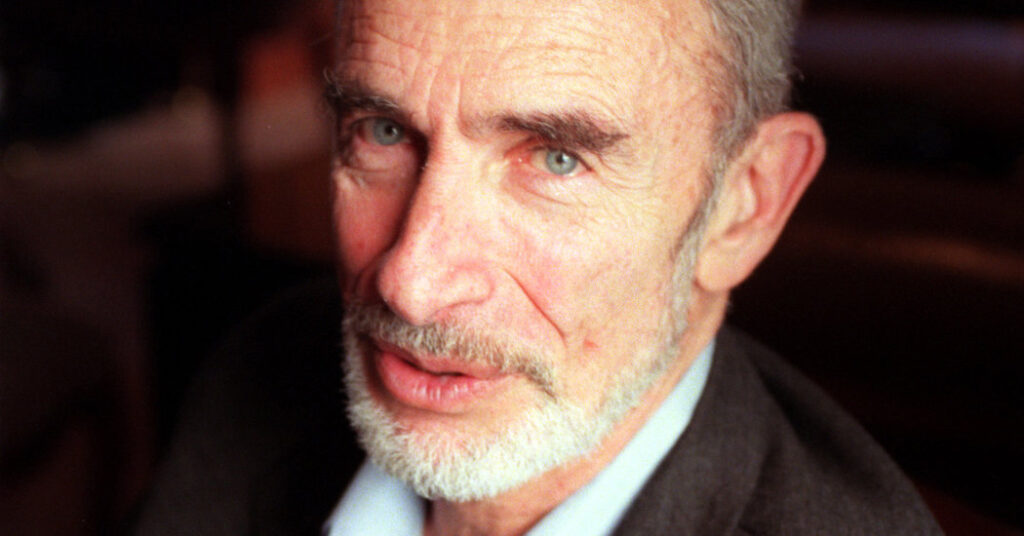
Paul R. Ehrlich, an eminent ecologist and population scientist whose best-selling book, “The Population Bomb,” was celebrated as a prescient warning of a coming age of food shortages and famine but later criticized by conservatives and academic rivals for what they called its sky-is-falling rhetoric, died on Friday in Palo Alto, Calif. He was 93.
His death, at a nursing facility in the retirement community where he lived, was caused by complications of cancer, his daughter, Lisa Marie Daniel, said.
As a young professor of biology at Stanford University in the mid-1960s, Dr. Ehrlich was known for his absorbing lectures on evolution, in which he described what plants and animals faced on a planet stressed by industrial pollution and rapid population growth. He distilled those lectures into an article published in December 1967 in New Scientist magazine.
Six months later, encouraged by David Brower, the executive director of the environmental group the Sierra Club, to write a book on the subject, Dr. Ehrlich published “The Population Bomb.” In 233 pages, he asserted that the planet’s condition began to deteriorate rapidly in the 1950s, when the rate of population growth exceeded the increase in food production — or, as he put it, when “the stork passed the plow.” He called on couples to limit their families to one or two children.
Witty, knowledgeable and not at all reticent, Dr. Ehrlich gained a huge audience on television, especially on “The Tonight Show Starring Johnny Carson,” which he appeared on roughly 20 times. His forecast of food riots in the United States and of imminent global famines caused by escalating population growth found a worldwide readership.
One of the best-selling nonfiction books about the environment to date, “The Population Bomb” sold three million copies and transformed Dr. Ehrlich, who was 37 at the time, into one of the global environmental movement’s most recognized leaders. His influence motivated international governments to convene conferences on controlling population, and his message was heard in private homes across the industrialized world as couples conceived fewer children.
Dr. Ehrlich expanded on his thesis in “The End of Affluence” (1974), which he wrote with his wife, Anne H. Ehrlich, who wrote or edited 15 books with him. The book forecast a “nutritional disaster” in the 1970s, predicting that “before 1985, mankind will enter a genuine age of scarcity.”
Such bold predictions, some of which turned out to be premature or in error, prompted rivals in business and academia to question the validity of his claims. In 1980, Julian Simon, an economist at the University of Maryland, challenged Dr. Ehrlich and two of his colleagues with what Stewart Brand, a founder of the Whole Earth Catalog, called “one of the great revelatory bets.”
Convinced that the growing population would make natural resources ever more scarce and thus drive up costs, Dr. Ehrlich accepted Mr. Simon’s challenge, betting that the prices of five key metals would rise in the 1980s. Mr. Simon believed that innovation would drive prices down.
In 1990, Dr. Ehrlich and his colleagues conceded defeat and sent Mr. Simon a check for $576.07 — an amount that represented the decline in the metals’ prices after accounting for inflation.
The disclosure of the bet came amid a national backlash to American environmentalism in the early 1990s, led by free-market conservatives and industrial executives who questioned the movement’s scientific data.
Dr. Ehrlich and his wife responded in 1996 with “Betrayal of Science and Reason: How Anti-Environmental Rhetoric Threatens Our Future,” a book that defended the predictions made in his earlier work and explored the partisan and ideological roots of the attacks on them.
“Some things I predicted have not come to pass,” Dr. Ehrlich told Grist, a prominent environmental news website, in 2004. “For instance, starvation has been less extensive than I (or rather the agriculturalists I consulted) expected. But it’s still horrific, with some 600 million people very hungry and billions under- or malnourished.”
Paul Ralph Ehrlich was born on May 29, 1932, in Philadelphia, and grew up in Maplewood, N.J. He was the eldest of two children of Ruth (Rosenberg) Ehrlich, a junior high school teacher, and William Ehrlich, a salesman for Marlboro shirts in New York. In later years, Dr. Ehrlich told interviewers that he became interested in butterflies, his scientific specialty, because he watched them disappear from fields near his boyhood home that had been cleared for new housing.
He received a degree in zoology from the University of Pennsylvania in 1953 and did his graduate work at the University of Kansas, where he earned a master’s degree in 1955 and a Ph.D. in entomology in 1957, and where he met his future wife, a writer and illustrator. He joined the faculty at Stanford University in 1959 and was promoted to full professor in 1966.
In addition to his daughter, Lisa Marie, Dr. Ehrlich is survived by Ms. Ehrlich, his wife of 72 years; his sister, Sally Kellock; two granddaughters; one step-granddaughter; two great-grandchildren; and four step-great-grandchildren.
A member of the National Academy of Sciences, Dr. Ehrlich was a founder of Zero Population Growth (now known as Population Connection) in 1968, and Stanford’s Center for Conservation Biology in 1984. He was the author, co-author or editor of 50 books and hundreds of scientific articles. He won a MacArthur prize in 1990, and many other prestigious national and international environmental science and achievement awards, several of which were shared with his wife.
In the last years of his life, journalists would occasionally remind Dr. Ehrlich about some of his dire predictions that had not come to pass: that 65 million Americans would starve to death, for example, or that there were fair odds that “England will not exist in the year 2000.”
But he stood by his fundamental convictions. In 2018, he told The Guardian that an unsustainable focus on “perpetual growth” meant that the collapse of civilization was “a near certainty in the next few decades.”
And in 2015, he told The New York Times that his analysis in the 1960s had actually been somewhat conservative, adding: “My language would be even more apocalyptic today.”
Alex Traub contributed reporting.
The post Paul R. Ehrlich, Who Alarmed the World With ‘The Population Bomb,’ Dies at 93 appeared first on New York Times.