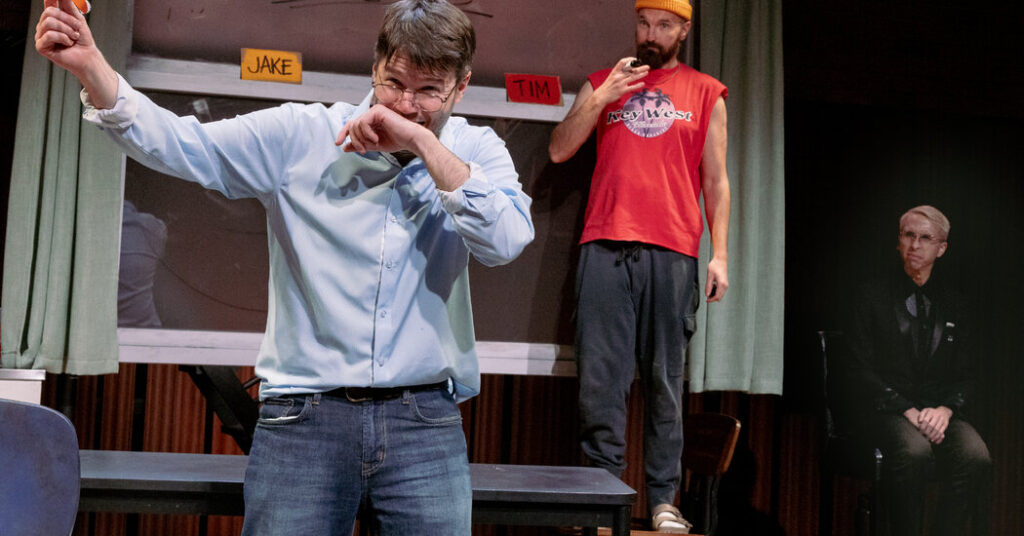
Standing unobtrusively in a corner of Jake and Tim’s kitchen is an old jukebox, salvaged after decades of tune-spinning in diners and bars. It wouldn’t seem of much use to a pair of Deaf 20-something roommates, except that it is touched with a kind of theatrical magic. It still plays songs, but its more practical use is as a real-time translator of American Sign Language, verbalizing the speech aloud.
In James Caverly and Andrew Morrill’s “Trash,” this ingenious jukebox, played by a human, is an accommodation for hearing audience members like me, who don’t speak the show’s principal language, A.S.L. But the device is only a partial accommodation, translating just some of the performance. We are meant to be left, for extended periods in this highly conversational comedy, to figure things out for ourselves: not only the gist of what is being said, but what it feels like to be shut out of comprehension.
Is it audist — biased against Deaf people — to lead with that in a review of a play by Deaf writers, focused on Deaf characters? It might be, if “Trash,” at the Perelman Performing Arts Center in Manhattan, weren’t so acutely aware of the hearing world’s gaze on the Deaf world. That inhibiting consciousness is one of the most potent, thought-provoking motifs in this play, which stars its authors as Jake (Caverly) and Tim (Morrill).
Caverly is known for playing the likable, layered Theo Dimas — son to Nathan Lane’s Teddy — on the Hulu series “Only Murders in the Building.” Morrill won an Obie Award as director of artistic sign language for Ryan J. Haddad’s game-changingly inclusive “Dark Disabled Stories.”
With “Trash,” Caverly and Morrill prioritize Deaf inclusion, and along the way make valuable points about Deaf life in a society constructed for hearing people. Yet this overloaded play skimps on fullness of story and depth of character. Curiously for actor-playwrights, they have written themselves fairly bland roles. (Having read the script after seeing a performance, I know what I missed in the A.S.L. dialogue.)
Directed by Nathaniel P. Claridad for Out of the Box Theatrics, “Trash” gets its title from a protracted disagreement between Jake and Tim over taking out the garbage. Since Tim is under house arrest (more on that shortly), you might think the question was moot. Nope. They empty their apparently reeking kitchen bin onto the floor — someone’s used condom and all — to bicker over who is more responsible for the mess.
As they sort through it all and argue about the rent, thrown-out items (like Jake’s aborted birthday card to an ex and Tim’s acceptance letters from various prestigious universities) lead to discussion of marginalization, opportunity, education. (The director of artistic sign language is Kailyn Aaron-Lozano.)
Jake’s phone, meanwhile, is a portal to his romantic obsession: Carly (Rebecca Spigelman), a hearing woman who blogs about Deaf culture. Wanting the freedom to be incredibly loud in bed, she has sex only with Deaf men. Creepy fetish, but as Tim notes in a message that he scrawls on a hand-held whiteboard and shows to the audience, “Jake dates only hearies.”
Given Tim’s house arrest — which stems from an ugly encounter with a police officer who refused to communicate in a way that Tim could understand — it’s logistically convenient that his secret lover is the landlord, Nicolas (Vishal Vaidya). The actors’ lack of chemistry makes that relationship less than believable, though.
“Trash” uses projections to translate spoken English and note sound effects, which we can also sense through the soles of our shoes. (The set is by Suzu Sakai, projections by Taylor Edelle Stuart, sound by Howard Ho.) Jake and Tim make good use of their whiteboards, too, periodically writing questions on them to poll the audience, who have color-coded cards to hold up in response. One such vote determines the play’s ending.
And yet Jukebox (Chris Ogren), their faithful machine, is the one character who gets the audience right in the heart — because of Ogren’s stealthily sympathetic performance, and because the role as written, which includes an existential monologue, is the play’s most freshly and freely imagined.
“Trash” ultimately feels very inside the box, constrained perhaps by expectations of what Deaf theater aiming for a mainstream stage ought to be. Mental obstacles like that get in the way of telling an entertaining story. Next time, they need to be tossed out.
Trash
Through March 28 at the Perelman Performing Arts Center, Manhattan; pacnyc.org. Running time: 1 hour 40 minutes.
The post ‘Trash’ Review: Bickering About Chores, in Sign Language appeared first on New York Times.