For years, the agricultural sector has faced a tight labor market as farmworkers age and fewer new immigrants and younger Americans are willing to toil in the fields. Top Trump administration officials vowed that mass deportations would help, leading to “higher wages with better benefits” and a “100 percent American work force.”
But the administration has quietly acknowledged in recent months that its immigration raids and crackdown on the border have aggravated the issue. So it has instead turned to an alternative source, making it cheaper for farmers to hire immigrant farmworkers on temporary visas.
Many farmers have celebrated those changes, made to an increasingly popular visa program known as H-2A, noting the difficulty in hiring American workers and tough economic conditions for the industry. But immigration hawks and labor unions alike are opposed, arguing the move will only increase the share of foreign workers and hurt native workers and suppress their wages.
The simmering debate underscores how some of the administration’s top goals of reducing immigration, keeping food prices low and helping American workers may inevitably conflict. The competing interests at play also show the spillover effects of Mr. Trump’s hard-line approach to legal and illegal immigration.
Brooke L. Rollins, the agriculture secretary, said in a statement that the administration was enacting “real reforms to ease regulatory burdens and lower labor costs.”
“The farm economy is in a difficult situation, and President Trump is utilizing all the tools available to ensure farmers have what they need to be successful,” she said.
Only 0.4 percent of farmers in California reported losing workers directly to farm raids, according to a new survey by the California Farm Bureau and Michigan State University. But more than 14 percent said the raids and general anxiety surrounding enhanced immigration enforcement caused worker shortages. Among labor-intensive crops like fruit and vegetables, that number was nearly 20 percent.
The Labor Department, in a regulatory filing revamping the H-2A program in October, acknowledged the challenges of finding workers. “The near total cessation of the inflow of illegal aliens combined with the lack of an available legal work force,” it said, “results in significant disruptions to production costs and threatening the stability of domestic food production and prices for U.S. consumers.”
Those difficulties, the agency warned, would only increase in light of Mr. Trump’s signature domestic policy bill, raising the possibility of deterring about 225,000 workers. “This threat will grow as the tools Congress provided in H.R. 1, One Big Beautiful Bill Act, to enhance enforcement of the nation’s immigration laws are deployed,” the agency continued.
Under the new changes, the agency adjusted how wages paid to H-2A farmworkers are calculated, effectively lowering hourly rates by between $1 and $7 depending on the state, according to some estimates. Farm owners can also now include housing as part of the compensation package they provide to guest farmworkers.
The reduction in wages has prompted a lawsuit from the United Farm Workers of America, which represents thousands of field workers. It argues that the rule will adversely harm American farmworkers by lowering their wages as well or pushing them out of the labor pool entirely.
“These actions are going to displace domestic farmworkers who have been working in the fields and putting food on dinner tables for decades, and bring a work force that is even more vulnerable to abuse,” Teresa Romero, the president of the union, said in an interview, noting that H-2A workers are often exploited and trafficked.
Mark Krikorian, the executive director of the Center for Immigration Studies, which supports lower levels of immigration and increased enforcement, agreed. The changes are likely to encourage more foreign migration and discourage automation in agriculture, he wrote in an opinion essay in November, “two consequences that are contrary to the administration’s stated objectives.”
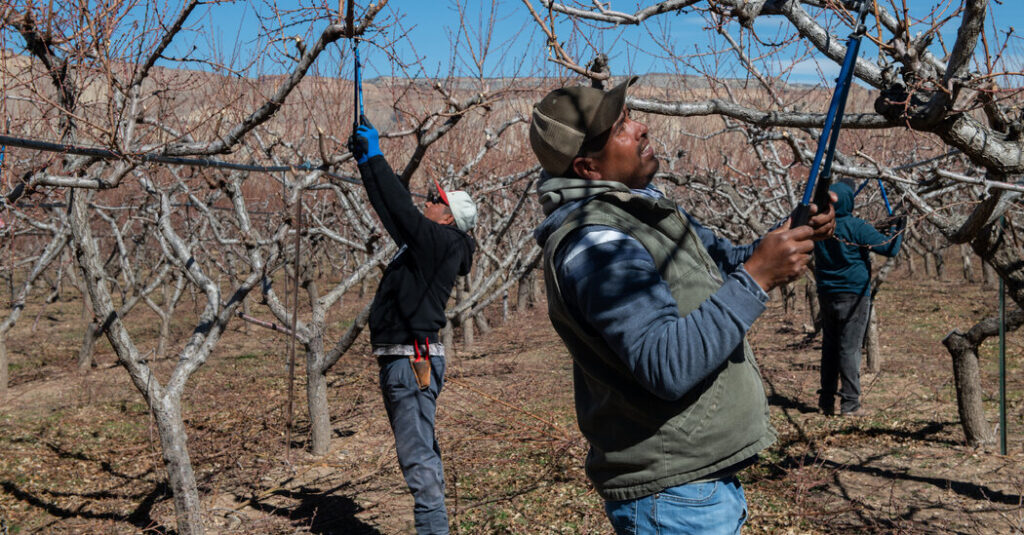
But for Bruce Talbott, who operates a peach orchard and vineyard in Colorado, the move will reduce his wage bill and allow him to hire more workers, making the economics of farming a little more viable. Mr. Talbott has tapped into the H-2A program for more than a decade, as the pool of locally available labor slowed to a trickle.
Because Colorado’s fruit and vegetable industry is seasonal, he said he could not offer year-round employment like farms in California, which makes the already grueling work of pruning trees and picking fruit less attractive to local workers. One year, when unable to hire enough local workers and while waiting for H-2A visas to be approved, the orchard lost 40,000 pounds of fruit.
Mr. Talbott’s farm employs four dozen to five dozen guest farmworkers annually, the vast majority of whom are returning workers and from Mexico, and just half a dozen local workers.
“Are there hard-working Americans? Of course there are,” he said, “and they’re in construction and they’re in oil and gas and they’re in career jobs. They’re not in seasonal farming.”
Mr. Talbott’s point about the lack of domestic workers is reflected in the data. Under the H-2A program, employers must also demonstrate an inability to hire U.S.-based workers. In 2025, only 182 of more than 415,000 advertised positions received a domestic applicant.
In the past two decades, the number of certified H-2A visa positions has risen sharply, to nearly 400,000 in the 2025 fiscal year from about 50,000 in 2005. These temporary workers now make up 15 percent of all crop workers. (About 40 percent of crop workers are unauthorized migrants and about a third are American citizens, according to the latest government estimates.)
Maria, a farmworker of nearly three decades in Idaho who declined to share her last name because she is not authorized to work in the United States, said in an interview that she had witnessed the program’s growth firsthand. Over the past four years, she has spent fewer and fewer weeks planting and harvesting onions, beans, alfalfa and wheat as more and more H-2A workers arrive.
To make up for the lost hours, Maria has resorted to selling tamales while other local workers have taken on second jobs. And her American-born 17-year-old son was unable to find a job in the fields and was told that teenagers were no longer wanted, given the availability of H-2A workers.
This year, as a result of wage cuts to H-2A workers, Maria may also see her hourly earnings drop to $11 from $17 — a reduction that has her considering leaving Idaho to look for work elsewhere.
“I don’t think it’s fair that our pay will be lowered so much,” Maria said, noting that although she was nearing retirement age, she could not afford to stop working.
The predicament Maria and her son face underline a point made by economists: Lowering wages for H-2A workers will not lead to more American workers in agriculture or increased pay for native workers.
The Economic Policy Institute, a left-leaning think tank, estimated that the methodological changes would result in a $2 billion cut to the annual wages of guest farmworkers — and a $3 billion cut for U.S.-based farmworkers.
Philip Martin, a farm labor economist and professor emeritus at the University of California, Davis, said he was skeptical of the administration’s claims of an impending mass shortage in agricultural labor. Whatever the justification, he noted the moves would not increase the number of American workers in agriculture.
“It’s a basic economic point,” he said, adding, “If you have a shortage of something like energy — gas and oil — you raise the price to give people an incentive to go out and find more, right?”
Reducing wages, he said, will instead mean that American farmers will rely increasingly on mechanization, guest farmworkers and food imports.
Congress, too, is considering more sweeping changes to the program. A bipartisan bill introduced last year would streamline the application process, reduce costs and expand it to yearlong employers that currently do not qualify, like dairy farmers. (The bill would also establish a pathway to legal status for unauthorized farmworkers already in the United States.)
Mr. Talbott, the orchard operator in Colorado, praised the administration’s changes to the H-2A program and said he hoped Congress could make it more transparent and easier to use. Still, he worried that the moves were “too little, too late,” noting that several produce growers in his area were already closing shop this year.
“Labor is a big component of why people are saying this enterprise is not viable, I’m not doing this anymore,” he said.
That is why for Mr. Talbott, the H-2A program is essential. “We can’t farm without going back” to guest workers, he said.
Charo Henríquez contributed translations.
Linda Qiu is a Times reporter who specializes in fact-checking statements made by politicians and public figures. She has been reporting and fact-checking public figures for nearly a decade.
The post To Address Farm Labor Shortage, Trump Administration Turns to Migrant Workers appeared first on New York Times.