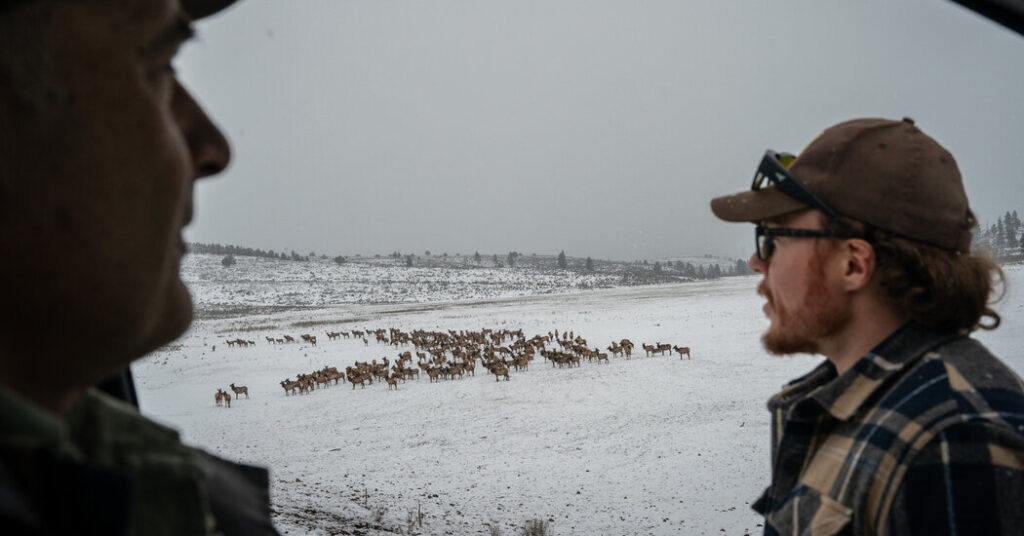
Traveling through the Blue Mountains, where Washington, Idaho and Oregon meet, elk are everywhere — on road signs, restaurant menus, home décor and, increasingly, the 4,300 acres where Shaun Robertson raises cattle.
On a recent winter afternoon, he drove his pickup slowly down Grant County Road 88, the gravel dividing line between his property, where thinned stands of trees sloped down into a wide valley, and the Malheur National Forest, thick with trees and overgrown. Animal tracks stood out on the snow-dusted road between them, elk, coyotes, a mountain lion, and more elk.
“These elk are just moving all the time to find someplace safe,” said Mr. Robertson, who turned to ranching after a career as a biologist, including working for the Rocky Mountain Elk Foundation. “We’re seeing them more often because there’s nowhere they feel safe.”
For decades, federal and state wildlife managers assumed that elk would spend most of their time in national forests, where hunting quotas and habitat management could keep populations in check.
But across the Blue Mountains, a complicated mix of forces are pushing elk onto private land like Mr. Robertson’s, fueling political conflict, economic strain and concern among biologists about declining calf survival. Near constant shifts in forest management, rising predator pressure and increasingly severe wildfires are part of the problem. So is President Trump’s push to expand access to public lands for logging, recreation and hunting.
“It’s bad for the elk, it’s bad for the humans,” said Jason Earl, a conflict supervisor overseeing seven counties in southeastern Washington for the state’s Department of Fish and Wildlife. His team uses noise makers, bright lights and their mere presence to scare off elk when they encroach on private land.
Historically, farmers and state regulators focused more on protecting and encouraging the spread of elk than scaring them. The animals are a primary part of the diet of many native tribes and were an early food for white settlers in the mid- to late-1800s. Elk were so easy to hunt that by the turn of the 20th century, they were at risk of disappearing.
In the 1910s, Oregon and Washington officials brought in elk from Yellowstone and other parts of Montana and Wyoming by train and horse-drawn wagons.
They thrived, leading to the modern problem.
Elk favor well-managed forests with enough clearing to produce grasses and shrubs to eat and sufficient cover to hide from predators like mountain lions, bears and humans.
But in the last generation or so, federal policy has swung like a weather vane in a hurricane. In the 1970s and 1980s, widespread logging across federal forests in the Blue Mountains and surrounding ranges reduced the tree cover that elk used for safety. In the 1990s and early 2000s, environmental concerns led to crackdowns on logging, creating forests that may have felt safer but became dense with trees and brush elk don’t want to eat.
Today, more than a decade of increasingly destructive wildfires has prompted another shift. Federal policy is moving back toward thinning forests to reduce wildfire fuel. At the same time, the Trump administration is pushing for more roads, more trails and more forests open to hunters, hikers and off-road vehicles.
Biologists say their success restoring predatory populations such as mountain lions, bears and wolves have added to the pressure elk feel on public land.
A typical Rocky Mountain bull elk weighs 700 pounds and stands more than five feet tall; cows are smaller but can still run 500 pounds. A few hundred elk on farmland can cause thousands of dollars in damage by eating crops, uprooting plants and trampling fields into mud. To keep up with demand, the state of Washington recently more than doubled its annual budget to reimburse farmers whose crops are damaged by elk or deer, but that brought spending only to $420,000, not nearly enough, landowners say.
Fences don’t work either. On Mr. Robertson’s ranch, adult elk routinely jump standard barbed-wire fencing. Their hides are too thick for the barbs to deter them. He’s designed a new type of fence, using high-tensile steel, and is gradually replacing his 35 miles of fencing to make it harder for elk and predators to enter and more challenging for cattle to escape.
The only way to nudge stressed elk back to public land is to stress them more, even as some biologists worry about the impact of stress on elk calves. To control the population, both Oregon and Washington rely on hunting and granting farmers the right to harass elk that wander onto their land.
The elk population in Oregon is robust, according to wildlife biologists. But on the Washington side of the Blue Mountains, scientists are also studying a decline in calf survival that they believe may be caused, in part, by all the competing pressures elk herds face. Researchers are using helicopters, dart guns and tags to track elk movement and their health.
Some private landowners want elk on their property. Real estate listings across eastern Washington and Oregon increasingly advertise former ranches as potential hunting preserves. Elk, however, do not understand property lines, and private hunting ranches adjacent to working farms can create new conflicts between neighbors.
“You’ve got more and more of these people who come out on the weekends, jump on their four-wheeler, drive around and then go back to the city,” Mr. Robertson said. “Some of them don’t care what all those elk they like to see on their land means for me next door.”
The Forest Service has been trying to come up with a long-term management plan for the Blue Mountains for more than 20 years, and is again considering a change. The current draft management plan emphasizes thinning forests and using prescribed fire, which would create the mix of open forage and cover that biologists say elk prefer.
But it’s still not clear what the higher powers in the Trump administration — which has emphasized expanding logging and recreation — will put in the final version. Federal officials have paused proposals that would reduce access in parts of the Northwest while such policy questions are resolved.
Meantime, leaders in elk-free Portland, Ore., 275 miles away from Mr. Robertson’s ranch, are spending $2 million to restore a downtown elk statue damaged during 2020 protests, evidence of the deep cultural meaning that elk carry across the Pacific Northwest.
Andrew Wildbill, wildlife program manager for the Confederated Tribes of the Umatilla Indian Reservation, noted that many tribal creation stories feature elk and other ungulates in important roles, guiding guileless early humans.
“Basically, we didn’t know how to live or take care of ourselves, so the animals took pity on us,” he said. “They said, ‘We’ll be there for you, but you have to be there for us.’”
Anna Griffin is the Pacific Northwest bureau chief for The Times, leading coverage of Washington, Idaho, Alaska, Montana and Oregon.
The post In a Wild Corner of the West, Elk Are Everywhere and Causing Conflict appeared first on New York Times.