On a recent trip to San Francisco, I hopped in a Waymo at the airport for a nearly 30-mile journey to Mountain View, Calif. As the car merged onto the 101, I assumed the smooth jazz playing in the car was meant to soothe my nerves and help me forget that there was no human in the driver’s seat.
Waymo, a self-driving car company owned by Google’s parent, Alphabet, is in 10 American cities, including Miami and Dallas, and is eyeing New York City, London and Tokyo next.
The company has its own app and partners with ride-hailing services like Uber, and by the end of this year it expects to serve up one million rides weekly. Last month, Waymo raised $16 billion, giving it a valuation around $126 billion, to help with its expansion plans.
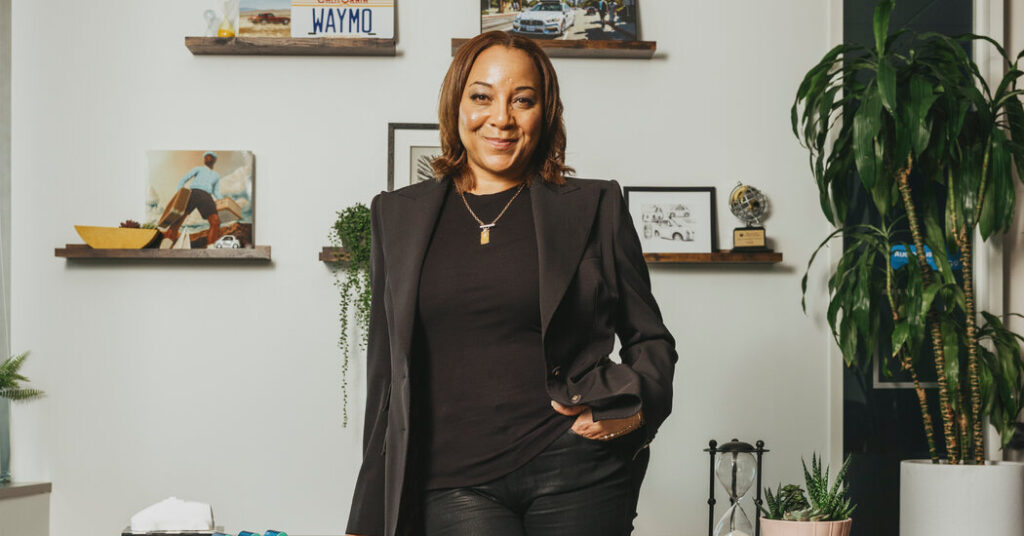
Still, many people are wary of self-driving cars. The company’s co-chief executive, Tekedra Mawakana, knows she needs to earn the public’s trust.
It won’t be easy. Waymo is facing federal investigations for traffic violations. The company issued a recall of some of its vehicles in December, after its robotaxis illegally passed stopped school buses. Its cars have also been involved in more serious incidents, including an ambulance blocked from getting to the scene of a shooting in Austin, a cat killed in San Francisco and a child struck in Santa Monica.
In response to the episode involving the child, Ms. Mawakana said that the car had been going 17 miles per hour and had slowed to six miles once it sensed the child nearby. “That’s superhuman performance,” she said. “A human would not have been able to do that. Is having contact with a child what we want? No. Is the fact that she got up and walked away really important to say? Yes.”
As the company’s other chief executive, Dmitri Dolgov, focuses on the technology behind the vehicles, Ms. Mawakana, a trained lawyer who previously oversaw public policy for eBay and Yahoo, spends her days making the case to lawmakers and the public that accidents involving Waymo vehicles are rare compared with ones involving human drivers.
“We have a higher bar,” Ms. Mawakana, 54, said. “We have a higher burden of proof for all of society.”
This interview, which was conducted at Waymo’s headquarters in Mountain View, has been edited and condensed for clarity.
Let’s talk about safety. Do you think the number of accidents involving Waymo’s vehicles will eventually be zero?
We are always improving. How much safer than a human will we get to? We don’t know. What I can tell you, though, is it won’t be zero. It’s a really, really challenging reality to grapple with.
Waymo has had to respond to the accidents that its cars have been in. How do you approach these conversations?
It’s really important for us to recognize that, because the technology is so new, the burden is on us. There’s so much pressure to say what happened before we know what happened. We have to be disciplined. We will say what happens after we take the moment we need.
Elon Musk’s Tesla Robotaxis and Amazon’s Zoox driverless cars use different technology. Are you worried about different robotaxis on the road?
This is, to me, where the government has a role to play. I think the regulators should issue a national standard, so everyone is demonstrating their safety.
We share the roads, but we’ve really built the Waymo driver to operate on the roads as they exist today. We don’t want anything to happen that undermines the trust that we’re working so hard to build. Because it’s not just building trust in our brand; it’s building trust in this new product category.
In dense cities like New York City and London, there are traffic rules that human drivers sometimes have to skirt to not block traffic. How do regulators want Waymo to deal with this gray area?
I think what you’re saying is there’s the letter of the law and then there’s the custom of a place. Some of those customs are what the Waymo driver learns over time.
When we were first in Chandler, Ariz. — this was 2020, 2019 — if there was a double-parked U.P.S. truck, we stay behind it far longer than any human would. Now we cross over the double yellow line to go around it. Technically, that’s not what you’re supposed to do, but the technology understands that that’s exactly what you have to do in order to not block traffic.
Waymo wants its fleets in New York City next. How will you navigate a complicated city like New York?
New York is complicated for the same things that we have seen in San Francisco, which is there’s a lot of congestion. There’s pedestrians, there’s cyclists, there’s jaywalkers, there is double-parked cars, there’s bike lanes. And sometimes there’s mounds of snow.
The other reason New York is complicated is because the regulatory path isn’t clear yet. The governor recently pivoted from moving forward with robotaxis this year. We’re going to continue to partner with her because we think this is a really important technology for New Yorkers to have access to. It will be odd if we are in a lot of major cities around the world and New York is excluded from them.
Senator John Fetterman of Pennsylvania and others have said robotaxis can lead to job loss. What’s your response to this?
Now that we’ve been in a few markets for a few years, it’s great to be able to see that we haven’t eliminated jobs in those markets.
Humans are still rotating those tires and working on those vehicles. We have fleet operators, we have fleet technicians. All of our fleets are fully electric. Those charging companies are building the infrastructure, putting them in city centers, pulling those wires from the utility company.
I was recently in Los Angeles and my Uber driver saw a Waymo driving past and said he was concerned that autonomous vehicles would hurt his income.
That driver wants long trips. We want very efficient, high-volume trips. We are actually both benefiting by slightly different types of demand.
Ride hailing isn’t the only application that we’re focused on as a business. We will license our technology to automotive companies. So the same person who has a business driving people could own a Waymo in the future and decide how best to deploy it.
Do you see a time when Waymo moves away from ride hailing for that broader application?
I think there’s room for all, but consumers are going to decide. I see a world where personal car ownership and city centers are so expensive that people are going to prefer ride-hailing and never having to find a parking space.
You were born in Mississippi and raised in Atlanta. What is a formative memory you have from that time?
Both of my parents are from Mississippi, born and raised. My dad was in the Air Force, and I spent time in Mississippi every summer, which is actually, I think, one of the most important parts of who I am.
My dad is one of these people who can build a house by himself. He always said, “If you have your hands, you can make anything.” I started to feel that at such a young age. The cousins made fun of me and my brother because we would be like, “time to go feed the pigs” or “time to get the eggs from the chickens.” That was fun for us. It was really this understanding that you can create something out of something quite small, and it can sustain the family or sustain the town.
I believe you did some crisis management work as a lawyer. How does that experience fit within what you have to do now as co-C.E.O. of Waymo?
When I came for the interview with Waymo, it was the week Waymo spun out of the Google self-driving car project. So the name Waymo was brand-new. It needed to be introduced.
It was really exciting but also extremely audacious. It was a brand-new brand.
If it doesn’t terrify you, that’s probably not the right next role for you. It definitely terrified me, and I just remember being like, Put me in, coach. Either it’s going to work wonderfully or it’s not. But it was my first chance to be a part of a moonshot. Make something without any preconceived presumptions.
You’re one of the few Black women running a large company in corporate America right now. How do you think about your presence?
I’m always and forever standing on the shoulders of everyone who went before, whether they have this role or not. The reality is, every single accomplishment helped land the next accomplishment.
Time for the lightning round. How often do you ride in a Waymo?
It depends on where I am in the world. If I’m in San Francisco, L.A., Phoenix, then I only take them, period.
When you get in a Waymo, what’s the first thing you look at to make sure the car is operating as it should?
Cleanliness. I really want to make sure that people are getting a premium experience.
What do you most often do when you’re in a Waymo?
I’m usually between meetings, so I’m looking at notes for the next meeting or getting out a thank you from the last meeting.
What’s your biggest pet peeve as C.E.O.?
People being so comfortable with the state of the roads as they exist today.
Jordyn Holman is a Times business reporter covering management and writing the Corner Office column.
The post Are Driverless Cars Safe? Waymo’s C.E.O. Has Been Trying to Make the Case. appeared first on New York Times.